Highlights

Selected Works

Selected results in trapped-ion control, microcavity interfaces and quantum networking.

Preprints

  • 2026
  • Chen-Xu Wang, Yi-Yang Wang, Tian-Xiang Zhu, Qing-Quan Yao, Peng-Jun Liang, Yuan-Cong Li, Zi-Peng Liu, Ran He, Yong-Jian Han, Jin-Ming Cui, Zong-Quan Zhou, Yun-Feng Huang, Chuan-Feng Li, Guang-Can Guo. Heterogeneous entanglement between a trapped ion and a solid-state quantum memory. arXiv preprint arXiv:2603.05836 (2026). PDF URL DOI Bibtex
BibTeX citation
@Article{WangGuo2026arXiv,
    author = "Wang, Chen-Xu and Wang, Yi-Yang and Zhu, Tian-Xiang and Yao, Qing-Quan and Liang, Peng-Jun and Li, Yuan-Cong and Liu, Zi-Peng and He, Ran and Han, Yong-Jian and Cui, Jin-Ming and Zhou, Zong-Quan and Huang, Yun-Feng and Li, Chuan-Feng and Guo, Guang-Can",
    title = "Heterogeneous entanglement between a trapped ion and a solid-state quantum memory",
    journal = "arXiv preprint arXiv:2603.05836",
    year = "2026",
    month = "March",
    date = "2026-03-06",
    eprint = "2603.05836",
    archivePrefix = "arXiv",
    primaryClass = "quant-ph",
    doi = "10.48550/arXiv.2603.05836",
    url = "https://arxiv.org/abs/2603.05836",
    groups = "preprints"
}

Journal articles

  • 2026
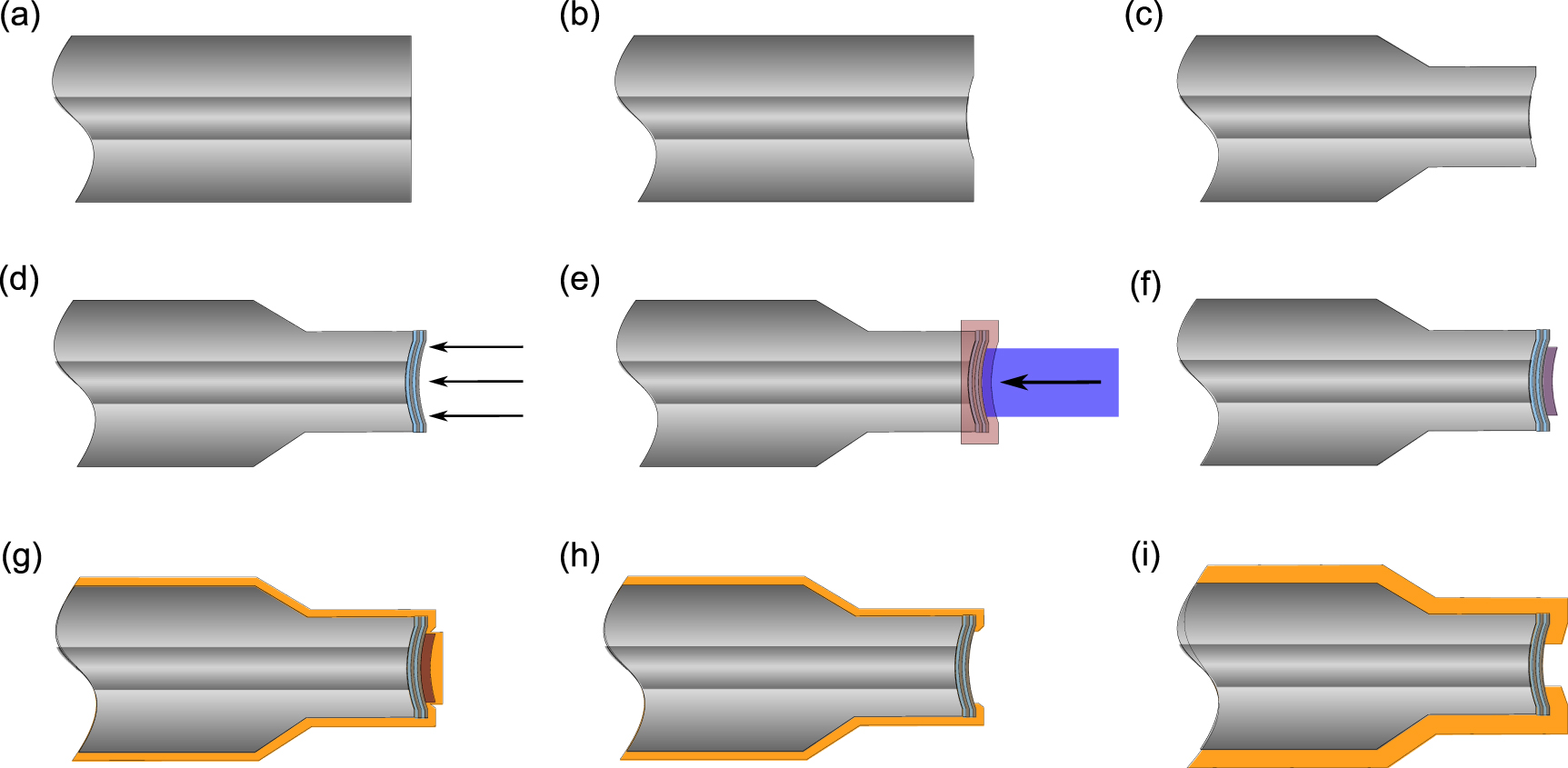
  • Wei-Bin Chen, Ding Fang, Cheng-Hao Zhang, Jin-Ming Cui, Yun-Feng Huang, Chuan-Feng Li, Guang-Can Guo. Design and fabrication of metal-shielded fiber-cavity mirrors for ion-trap systems. Quantum Sci. Technol. 11, 015045 (2026). PDF URL DOI Bibtex
  • Yan Chen, Quan Long, Yifan Zhou, Enteng An, Ran He, Jinming Cui, Yunfeng Huang, Chuanfeng Li. In-situ aberration correction for far-detuned laser systems via a trapped ion probe. Chin. Opt. Lett. 24, 010201 (2026). PDF URL DOI Bibtex
  • Ruo-Ran Meng, Pei-Xi Liu, Xiao Liu, Tian-Xiang Zhu, Peng-Jun Liang, Chao Zhang, Zhong-Yang Tang, Hong-Zhe Zhang, Jin-Ming Cui, Ming Jin, Zong-Quan Zhou, Chuan-Feng Li, Guang-Can Guo. Efficient integrated quantum memory for light. Nat. Photon. 20, 437–443 (2026). PDF URL DOI Bibtex
  • Qingquan Yao, Chenxu Wang, Yuancong Li, Jinming Cui, Yunfeng Huang, Chuanfeng Li, Guangcan Guo. Polarization-preserving quantum frequency conversion to VIS via cross-band achromatic UV-NIR waveguide coupling. Chin. Opt. Lett. 24, 021901 (2026). PDF URL DOI Bibtex
  • 2025
  • Asma Benbouza, Xiaoshui Lin, Jin Ming Cui, Ming Gong. Interacting Mathieu equation, synchronization dynamics and collision-induced velocity exchange in trapped ions. Commun. Theor. Phys. 77, 085104 (2025). PDF URL DOI Bibtex
  • Jin-Ming Cui, Yan Chen, Yi-Fan Zhou, Quan Long, En-Teng An, Ran He, Yun-Feng Huang, Chuan-Feng Li, Guang-Can Guo. Transverse Polarization Gradient Entangling Gates for Trapped-Ion Quantum Computation. Phys. Rev. Lett. 135, 260604 (2025). PDF URL DOI Bibtex
  • Jin-Ming Cui, Shi-Jia Sun, Xi-Wang Luo, Yun-Feng Huang, Chuan-Feng Li, Guang-Can Guo. Cold hybrid electrical-optical ion trap. Phys. Rev. Appl. 23, 054044 (2025). PDF URL DOI Bibtex
  • Ding Fang, Wei-Bin Chen, Cheng-Hao Zhang, Jin-Ming Cui, Yun-Feng Huang, Chuan-Feng Li, Guang-Can Guo. Cavity-assisted thermometry for a single trapped ion. Phys. Rev. Appl. 24, 024037 (2025). PDF URL DOI Bibtex
  • Ding Fang, Chenghao Zhang, Weibin Chen, Jinming Cui, Yunfeng Huang, Chuanfeng Li, Guangcan Guo. A fast-tunable and stable fiber microcavity for coupling Ba+ ions in quantum networks. Chin. Opt. Lett. 23, 120201 (2025). PDF URL DOI Bibtex
  • Wei-Ran Ye, Jin-Ming Cui, Yan Chen, Yi-Long Chen, Rui-Rui Li, Yun-Feng Huang, Chuan-Feng Li, Guang-Can Guo. An integrated laser system for manipulating trapped ions qubits. Optics & Laser Technology 186, 112694 (2025). PDF URL DOI Bibtex
  • 2024
  • Yi-Long Chen, Rui-Rui Li, Ran He, Shu-Qian Chen, Wen-Hao Qi, Jin-Ming Cui, Yun-Feng Huang, Chuan-Feng Li, Guang-Can Guo. Low-crosstalk optical addressing system for atomic qubits based on multiple objectives and acousto-optic deflectors. Phys. Rev. Appl. 22, 054003 (2024). PDF URL DOI Bibtex
  • Ding Fang, Jin-Ming Cui, Wei-Bin Chen, Yan Chen, Rui-Rui Li, Cheng-Hao Zhang, Yun-Feng Huang, Chuan-Feng Li, Guang-Can Guo. Arc Discharge Method to Fabricate Large Concave Structures for Open-Access Fiber Fabry-Pérot Cavities. Opt. Express 32, 2906–2915 (2024). PDF DOI Bibtex
  • Rui-Rui Li, Wei-Ran Ye, Yi-Long Chen, Shu-Qian Chen, Wen-Hao Qi, Jin-Ming Cui, Yun-Feng Huang, Chuan-Feng Li, Guang-Can Guo. Generation of Visible Raman Operation Laser by a Fiber Electro-Optical Modulator Feedback Loop. Chin. Opt. Lett. 22, 022702 (2024). PDF URL DOI Bibtex
  • Yi Zheng, Zhao-Di Liu, Rui-Heng Miao, Jin-Ming Cui, Mu Yang, Xiao-Ye Xu, Jin-Shi Xu, Chuan-Feng Li, Guang-Can Guo. Characterizing Biphoton Spatial Wave Function Dynamics with Quantum Wavefront Sensing. Phys. Rev. Lett. 133, 033602 (2024). PDF DOI Bibtex
  • 2023
  • Xing-Yu Bao, Jin-Ming Cui, Ding Fang, Wei-Bin Chen, Jian Wang, Yun-Feng Huang, Chuan-Feng Li, Guang-Can Guo. Design of a Fiber Cavity Ion Trap for a High-Efficiency and High-Rate Quantum Network Node. JUSTC 53, 0705–10 (2023). PDF DOI Bibtex
  • Xiao-Min Hu, Yi Xie, Atul Singh Arora, Ming-Zhong Ai, Kishor Bharti, Jie Zhang, Wei Wu, Ping-Xing Chen, Jin-Ming Cui, Bi-Heng Liu, Yun-Feng Huang, Chuan-Feng Li, Guang-Can Guo, Jérémie Roland, Adán Cabello, Leong-Chuan Kwek. Self-Testing of a Single Quantum System from Theory to Experiment. npj Quantum Inf. 9, 1–11 (2023). PDF DOI Bibtex
  • 2022
  • Ming-Zhong Ai, Yongcheng Ding, Yue Ban, José D. Martín-Guerrero, Jorge Casanova, Jin-Ming Cui, Yun-Feng Huang, Xi Chen, Chuan-Feng Li, Guang-Can Guo. Experimentally realizing efficient quantum control with reinforcement learning. Science China Physics, Mechanics & Astronomy 65, 250312 (2022). PDF URL DOI Bibtex
  • Ming-Zhong Ai, Sai Li, Ran He, Zheng-Yuan Xue, Jin-Ming Cui, Yun-Feng Huang, Chuan-Feng Li, Guang-Can Guo. Experimental realization of nonadiabatic holonomic single‐qubit quantum gates with two dark paths in a trapped ion. Fundamental Research 2, 661–666 (2022). PDF URL DOI Bibtex
  • Yan Chen, Yue Ban, Ran He, Jin-Ming Cui, Yun-Feng Huang, Chuan-Feng Li, Guang-Can Guo, Jorge Casanova. A neural network assisted 171Yb+ quantum magnetometer. npj Quantum Inf. 8, 152 (2022). PDF URL DOI Bibtex
  • Rui-Rui Li, Ran He, Jin-Ming Cui, Yan Chen, Wei-Ran Ye, Yi-Long Chen, Yun-Feng Huang, Chuan-Feng Li, Guang-Can Guo. A versatile multi-tone laser system for manipulating atomic qubits based on a fiber Mach–Zehnder modulator and second harmonic generation. Opt. Express 30, 30098–30107 (2022). PDF URL DOI Bibtex
  • 王晨旭, 贺冉, 李睿睿, 陈炎, 房鼎, 崔金明, 黄运锋, 李传锋, 郭光灿. 量子计算与量子模拟中离子阱结构研究进展. 物理学报 71, 133701 (2022). PDF URL DOI Bibtex
  • 2021
  • Ming-Zhong Ai, Jin-Ming Cui, Ran He, Zhong-Hua Qian, Xin-Xia Gao, Yun-Feng Huang, Chuan-Feng Li, Guang-Can Guo. Experimental verification of anti–Kibble-Zurek behavior in a quantum system under a noisy control field. Phys. Rev. A 103, 012608 (2021). PDF URL DOI Bibtex
  • Ran He, Ming-Zhong Ai, Jin-Ming Cui, Yun-Feng Huang, Yong-Jian Han, Chuan-Feng Li, Guang-Can Guo, G. Sierra, C. E. Creffield. Riemann zeros from Floquet engineering a trapped-ion qubit. npj Quantum Inf. 7, 109 (2021). PDF URL DOI Bibtex
  • Ran He, Jin-Ming Cui, Rui-Rui Li, Zhong-Hua Qian, Yan Chen, Ming-Zhong Ai, Yun-Feng Huang, Chuan-Feng Li, Guang-Can Guo. An ion trap apparatus with high optical access in multiple directions. Rev. Sci. Instrum. 92, 073201 (2021). PDF URL DOI Bibtex
  • Chang-Kang Hu, Roie Dann, Jin-Ming Cui, Yun-Feng Huang, Chuan-Feng Li, Guang-Can Guo, Alan C. Santos, Ronnie Kosloff. Experimental verification of the inertial theorem control protocols. New J. Phys. 23, 093048 (2021). PDF URL DOI Bibtex
  • Zhong-Hua Qian, Jin-Ming Cui, Xi-Wang Luo, Yong-Xiang Zheng, Yun-Feng Huang, Ming-Zhong Ai, Ran He, Chuan-Feng Li, Guang-Can Guo. Super-resolved Imaging of a Single Cold Atom on a Nanosecond Timescale. Phys. Rev. Lett. 127, 263603 (2021). PDF URL DOI Bibtex
  • Hao-Qing Zhang, Ming-Zhong Ai, Jin-Ming Cui, Yong-Jian Han, Chuan-Feng Li, Guang-Can Guo. Investigating the quench dynamics of the bound states in a spin-orbital-coupling system using a trapped ion. Phys. Rev. A 104, 022213 (2021). PDF URL DOI Bibtex
  • Yong-Xiang Zheng, Jin-Ming Cui, Ming-Zhong Ai, Zhong-hua Qian, Huan Cao, Yun-Feng Huang, Xiao-Jun Jia, Chuan-Feng Li, Guang-Can Guo. Large-tuning-range frequency stabilization of an ultraviolet laser by an open-loop piezoelectric ceramic controlled Fabry–Pérot cavity. Opt. Express 29, 24674 (2021). PDF URL DOI Bibtex
  • Yong-xiang Zheng, Jin-ming Cui, Ming-zhong Ai, Zhong-hua Qian, Wei-ran Ye, Yun-feng Huang, Chuan-feng Li, Guang-can Guo. Quantum frequency conversion from ultraviolet to visible band through waveguides in a period-poled MgO:LiTaO3 crystal. Opt. Express 29, 38488–38496 (2021). PDF URL DOI Bibtex
  • 2020
  • Ming-Zhong Ai, Sai Li, Zhibo Hou, Ran He, Zhong-Hua Qian, Zheng-Yuan Xue, Jin-Ming Cui, Yun-Feng Huang, Chuan-Feng Li, Guang-Can Guo. Experimental Realization of Nonadiabatic Holonomic Single-Qubit Quantum Gates with Optimal Control in a Trapped Ion. Phys. Rev. Appl. 14, 054062 (2020). PDF URL DOI Bibtex
  • Zhe Chen, Jin-Ming Cui, Ming-Zhong Ai, Ran He, Yun-Feng Huang, Yong-Jian Han, Chuan-Feng Li, Guang-Can Guo. Experimentally detecting dynamical quantum phase transitions in a slowly quenched Ising-chain model. Phys. Rev. A 102, 042222 (2020). PDF URL DOI Bibtex
  • Jin-Ming Cui, Fernando Javier Gómez-Ruiz, Yun-Feng Huang, Chuan-Feng Li, Guang-Can Guo, Adolfo del Campo. Experimentally testing quantum critical dynamics beyond the Kibble-Zurek mechanism. Commun. Phys. 3, 1–7 (2020). PDF URL DOI Bibtex
  • Xin-Xia Gao, Jin-Ming Cui, Ming-Zhong Ai, Yun-Feng Huang, Chuan-Feng Li, Guang-Can Guo. An Acoustic Sensor Based on Active Fiber Fabry–Pérot Microcavities. Sens. 20, 5760 (2020). PDF URL DOI Bibtex
  • Xin-Xia Gao, Jin-Ming Cui, Zhi-Hao Hu, Chun-Hua Dong, Jian Wang, Yun-Feng Huang, Chuan-Feng Li, Guang-Can Guo. Fast and wide-band tuning single-mode microlaser based on fiber Fabry-Pérot microcavities. Photonics Res. 8, 1642–1647 (2020). PDF URL DOI Bibtex
  • Yu Guo, Xiao-Min Hu, Zhi-Bo Hou, Huan Cao, Jin-Ming Cui, Bi-Heng Liu, Yun-Feng Huang, Chuan-Feng Li, Guang-Can Guo, Giulio Chiribella. Experimental Transmission of Quantum Information Using a Superposition of Causal Orders. Phys. Rev. Lett. 124, 030502 (2020). PDF URL DOI Bibtex
  • Ran He, Ming-Zhong Ai, Jin-Ming Cui, Yun-Feng Huang, Yong-Jian Han, Chuan-Feng Li, Tao Tu, C. E. Creffield, G. Sierra, Guang-Can Guo. Identifying the Riemann zeros by periodically driving a single qubit. Phys. Rev. A 101, 043402 (2020). PDF URL DOI Bibtex
  • Chang-Kang Hu, Alan C. Santos, Jin-Ming Cui, Yun-Feng Huang, Diogo O. Soares-Pinto, Marcelo S. Sarandy, Chuan-Feng Li, Guang-Can Guo. Quantum thermodynamics in adiabatic open systems and its trapped-ion experimental realization. npj Quantum Inf. 6, 1–11 (2020). PDF URL DOI Bibtex
  • 2019
  • Jin-Ming Cui, Ming-Zhong Ai, Ran He, Zhong-Hua Qian, Xiao-Ke Qin, Yun-Feng Huang, Zheng-Wei Zhou, Chuan-Feng Li, Tao Tu, Guang-Can Guo. Experimental demonstration of suppressing residual geometric dephasing. Science Bulletin 64, 1757–1763 (2019). PDF URL DOI Bibtex
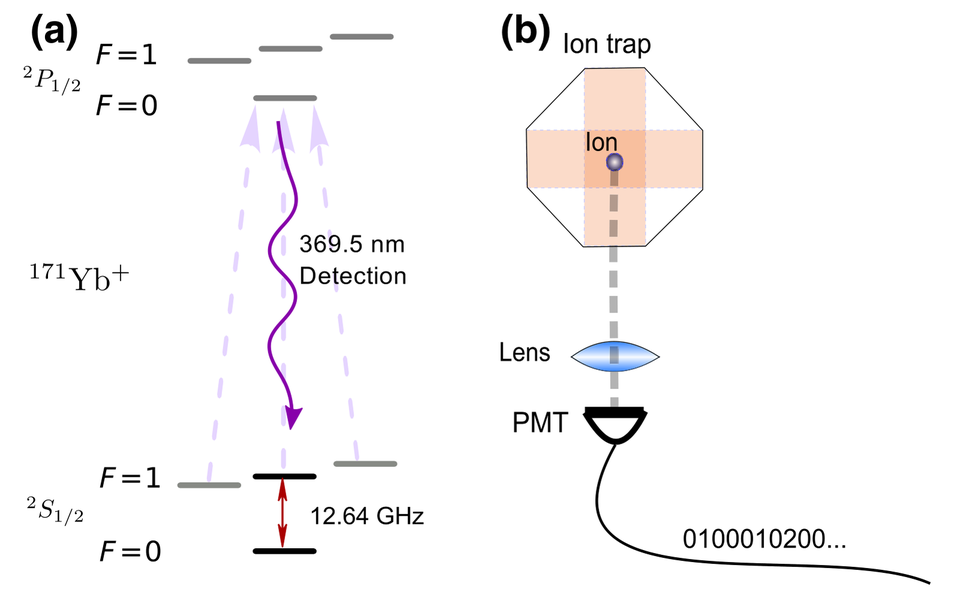
  • Zi-Han Ding, Jin-Ming Cui, Yun-Feng Huang, Chuan-Feng Li, Tao Tu, Guang-Can Guo. Fast High-Fidelity Readout of a Single Trapped-Ion Qubit via Machine-Learning Methods. Phys. Rev. Appl. 12, 014038 (2019). PDF URL DOI Bibtex
  • Xin-Xia Gao, Jin-Ming Cui, Yun-Feng Huang, Chuan-Feng Li, Guang-Can Guo. Thermal expanded core ultraviolet fiber for optical cavity mode matching. Chin. Opt. Lett. 17, 090601 (2019). PDF DOI Bibtex
  • Chang-Kang Hu, Jin-Ming Cui, Alan C. Santos, Yun-Feng Huang, Chuan-Feng Li, Guang-Can Guo, Frederico Brito, Marcelo S. Sarandy. Validation of quantum adiabaticity through non-inertial frames and its trapped-ion realization. Sci. Rep. 9, 10449 (2019). PDF DOI Bibtex
  • Chang-Kang Hu, Alan C. Santos, Jin-Ming Cui, Yun-Feng Huang, Marcelo S. Sarandy, Chuan-Feng Li, Guang-Can Guo. Adiabatic quantum dynamics under decoherence in a controllable trapped-ion setup. Phys. Rev. A 99, 062320 (2019). PDF URL DOI Bibtex
  • 2018
  • ChengKe Chen, YingShuang Mei, JinMing Cui, Xiao Li, MeiYan Jiang, ShaoHua Lu, XiaoJun Hu. Man-made synthesis of ultrafine photoluminescent nanodiamonds containing less than three silicon-vacancy colour centres. Carbon 139, 982–988 (2018). PDF URL DOI Bibtex
  • Jin-Ming Cui, Kun Zhou, Ming-Shu Zhao, Ming-Zhong Ai, Chang-Kang Hu, Qiang Li, Bi-Heng Liu, Jin-Lan Peng, Yun-Feng Huang, Chuan-Feng Li, Guang-Can Guo. Polarization nondegenerate fiber Fabry-Perot cavities with large tunable splittings. Appl. Phys. Lett. 112, 171105 (2018). PDF URL DOI Bibtex
  • Chang-Kang Hu, Jin-Ming Cui, Alan C. Santos, Yun-Feng Huang, Marcelo S. Sarandy, Chuan-Feng Li, Guang-Can Guo. Experimental implementation of generalized transitionless quantum driving. Opt. Lett. 43, 3136 (2018). PDF URL DOI Bibtex
  • Jian Wang, Yun-Feng Huang, Chao Zhang, Jin-Ming Cui, Zhi-Yuan Zhou, Bi-Heng Liu, Zong-Quan Zhou, Jian-Shun Tang, Chuan-Feng Li, Guang-Can Guo. Universal Photonic Quantum Interface for a Quantum Network. Phys. Rev. Appl 10, 054036 (2018). PDF URL DOI Bibtex
  • Ya Xiao, Zhen-Peng Xu, Qiang Li, Jin-Shi Xu, Kai Sun, Jin-Ming Cui, Zong-Quan Zhou, Hong-Yi Su, Adán Cabello, Jing-Ling Chen, others. Experimental observation of quantum state-independent contextuality under no-signaling conditions. Opt. Express 26, 32–50 (2018). PDF URL DOI Bibtex
  • Kun Zhou, Ming-Zhong Ai, Zhong-Hua Qian, Xin-Xia Gao, Zhi-Hao Hu, Qiang Li, Long Yuan, Zhao Wang, Yun-Feng Huang, Tao Tu, Jin-Ming Cui, Chuan-Feng Li, Guang-Can Guo. High-sensitivity strain sensor with an in-fiber air-bubble Fabry-Perot interferometer. Appl. Phys. Lett. 113, 181901 (2018). PDF URL DOI Bibtex
  • 2017
  • Kun Zhou, Jin-Ming Cui, Yun-Feng Huang, Zhao Wang, Zhong-Hua Qian, Qi-Ming Wu, Jian Wang, Ran He, Wei-Min Lv, Chang-Kang Hu, Yong-Jian Han, Chuan-Feng Li, Guang-Can Guo. An Ultraviolet Fiber Fabry-Pérot Cavity for Florescence Collection of Trapped Ions. Chin. Phys. Lett. 34, 013701 (2017). PDF URL DOI Bibtex
  • 2016
  • Jin-Ming Cui, Yun-Feng Huang, Zhao Wang, Dong-Yang Cao, Jian Wang, Wei-Min Lv, Le Luo, Adolfo del Campo, Yong-Jian Han, Chuan-Feng Li, Guang-Can Guo. Experimental Trapped-ion Quantum Simulation of the Kibble-Zurek dynamics in momentum space. Sci. Rep. 6, 33381 (2016). PDF URL DOI Bibtex
  • Zhao Wang, Le Luo, Karthik Thadasina, Kim Qian, Jinming Cui, Yunfeng Huang. Fabrication of ion-trap electrodes by self-terminated electrochemical etching. EPJ Tech. Instrum. 3, 3 (2016). PDF URL DOI Bibtex
  • 2015
  • Yong Lu, Jian-Qi Zhang, Jin-Ming Cui, Dong-Yang Cao, Shuo Zhang, Yun-Feng Huang, Chuan-Feng Li, Guang-Can Guo. Dark-state cooling of a trapped ion using microwave coupling. Phys. Rev. A 92, 023420 (2015). PDF URL DOI Bibtex
  • Jian Wang, Peng-YinJie Lv, Jin-Ming Cui, Bi-Heng Liu, Jian-Shun Tang, Yun-Feng Huang, Chuan-Feng Li, Guang-Can Guo. Generation of Nondegenerate Narrow-Band Photon Pairs for a Hybrid Quantum Network. Phys. Rev. Appl 4, 064011 (2015). PDF URL DOI Bibtex
BibTeX citation
@Article{ChenGuo2026QST,
    author = "Chen, Wei-Bin and Fang, Ding and Zhang, Cheng-Hao and Cui, Jin-Ming and Huang, Yun-Feng and Li, Chuan-Feng and Guo, Guang-Can",
    journal = "Quantum Sci. Technol.",
    title = "Design and fabrication of metal-shielded fiber-cavity mirrors for ion-trap systems",
    year = "2026",
    issn = "2058-9565",
    month = "January",
    number = "1",
    pages = "015045",
    volume = "11",
    abstract = "Trapped ions in micro-cavities constitute a key platform for advancing quantum information processing and quantum networking. By providing an efficient light–matter interface within a compact architecture, they serve as highly efficient quantum nodes with strong potential for a scalable quantum network. However, in such systems, ion trapping stability is often compromised by surface charging effects, and nearby dielectric materials are known to cause a dramatic increase in the ion heating rate by several orders of magnitude. These challenges significantly hinder the practical implementation of ion trap systems integrated with micro-cavities. To overcome these limitations, we present the design and fabrication of metal-shielded fiber-cavity mirrors, enabling the stable realization of ion trap systems integrated with fiber cavities. Using this method, we constructed a needle ion trap integrated with a fiber Fabry–Pérot cavity and successfully achieved stable trapping of a single ion within the cavity. The measured ion heating rate was reduced by more than an order of magnitude compared with unshielded configurations. This work establishes a key technique toward fully integrated ion–photon interfaces for scalable quantum networks.",
    creationdate = "2026-02-28T17:30:47",
    doi = "10.1088/2058-9565/ae379e",
    groups = "First/Corresponding, SCI1, Journal",
    keywords = "/unread",
    language = "en",
    owner = "jmcui",
    publisher = "IOP Publishing",
    url = "https://doi.org/10.1088/2058-9565/ae379e",
    urldate = "2026-01-29"
}
BibTeX citation
@Article{ChenLi2025COL,
    author = "Chen, Yan and Long, Quan and Zhou, Yifan and An, Enteng and He, Ran and Cui, Jinming and Huang, Yunfeng and Li, Chuanfeng",
    journal = "Chin. Opt. Lett.",
    title = "In-situ aberration correction for far-detuned laser systems via a trapped ion probe",
    year = "2026",
    issn = "1671-7694",
    month = "January",
    number = "1",
    pages = "010201",
    volume = "24",
    abstract = "An in-situ wavefront-correction method uses a trapped ion and a spatial light modulator to optimize tightly focused far-detuned light. The technique suppresses addressing crosstalk by a factor of 17, reaching a Rabi-frequency ratio of 0.031(4)\\%.",
    creationdate = "2026-01-05T09:50:33",
    doi = "10.3788/COL202624.010201",
    groups = "SCI1, First/Corresponding, SCI, Journal",
    keywords = "abbr",
    language = "EN",
    owner = "jmcui",
    url = "https://www.researching.cn/articles/OJ59a20f1fdd804b8e",
    urldate = "2025-12-25"
}
BibTeX citation
@Article{MengGuo2026NP,
    author = "Meng, Ruo-Ran and Liu, Pei-Xi and Liu, Xiao and Zhu, Tian-Xiang and Liang, Peng-Jun and Zhang, Chao and Tang, Zhong-Yang and Zhang, Hong-Zhe and Cui, Jin-Ming and Jin, Ming and Zhou, Zong-Quan and Li, Chuan-Feng and Guo, Guang-Can",
    journal = "Nat. Photon.",
    title = "Efficient integrated quantum memory for light",
    year = "2026",
    issn = "1749-4893",
    month = "February",
    pages = "437--443",
    abstract = "Scalable implementation of quantum networks and photonic processors demands integrated photonic memories with high efficiency, yet current integrated systems have been limited to storage efficiencies below 27.8\\%. Here we demonstrate highly efficient integrated quantum memories based on rare-earth-ion-doped crystals coupled with impedance-matched microcavities, realized in two novel architectures: 200-μm-thin membranes of Eu3+:Y2SiO5 integrated with fibre-based microcavities and waveguide-based cavities fabricated using femtosecond lasers. Our approach achieves reliable integrated quantum storage with record efficiencies of 80.3(7)\\% for weak coherent pulses and 69.8(1.6)\\% for telecom-heralded single photons, alongside the storage of 20 temporal modes with an average efficiency of 51.3(2)\\%. Moreover, the thin-membrane Eu3+:Y2SiO5 architecture enables spectrally tunable efficient quantum storage via variable strain, providing a flexible interface for quantum networks. By combining high efficiency, large multimode capacity and tunability, our devices establish a versatile hardware foundation for scalable quantum repeaters and chip-scale photonic processors.",
    copyright = "2026 The Author(s), under exclusive licence to Springer Nature Limited",
    creationdate = "2026-02-14T11:46:09",
    doi = "10.1038/s41566-026-01845-y",
    groups = "SCI, Journal",
    keywords = "/unread, Micro-optics, Quantum information, Quantum optics",
    language = "en",
    owner = "jmcui",
    publisher = "Nature Publishing Group",
    url = "https://www.nature.com/articles/s41566-026-01845-y",
    urldate = "2026-02-14",
    volume = "20"
}
BibTeX citation
@Article{YaoGuo2025c,
    author = "Yao, Qingquan and Wang, Chenxu and Li, Yuancong and Cui, Jinming and Huang, Yunfeng and Li, Chuanfeng and Guo, Guangcan",
    journal = "Chin. Opt. Lett.",
    title = "Polarization-preserving quantum frequency conversion to {VIS} via cross-band achromatic {UV}-{NIR} waveguide coupling",
    year = "2026",
    issn = "1671-7694",
    month = "December",
    number = "2",
    pages = "021901",
    volume = "24",
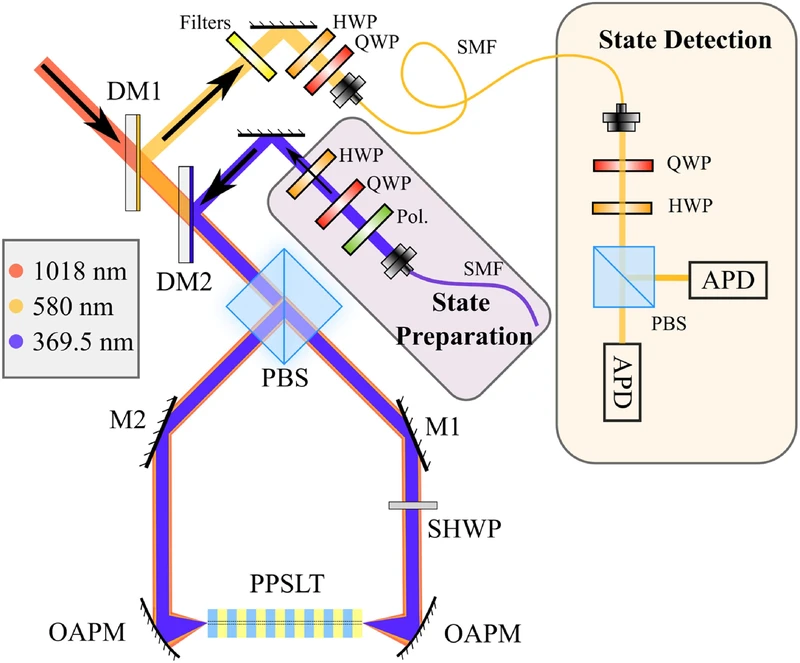
    abstract = "hotons are essential for interconnecting quantum systems in quantum networks, where polarization is a widely used degree of freedom for encoding quantum information. However, frequency bands suitable for different quantum systems often do not align. While polarization-preserving quantum frequency conversion (PPQFC) is essential for interconnecting heterogeneous quantum systems, existing solutions lack cross-band capability between ultraviolet (UV) and near-infrared (NIR) regimes. Here, we experimentally demonstrated a PPQFC method that exploits the low-loss, self-phase stabilization of polarization and facilitates cross-band achromatic waveguide coupling. Specifically, we demonstrated the polarization- preserving quantum frequency conversion from UV 369.5 nm to visible 580 nm with infrared pumping at 1018 nm, achieving long-term fidelity of 97.6\% ± 1.0\% at wavelengths relevant to trapped ions 171Yb+ and solid-state 153Eu3+:Y2SiO5 quantum systems. This work demonstrates a versatile PPQFC solution for future heterogeneous quantum networks.",
    creationdate = "2026-01-05T09:47:11",
    doi = "10.3788/COL202624.021901",
    groups = "SCI1, First/Corresponding, SCI, Journal",
    keywords = "/unread",
    language = "EN",
    owner = "jmcui",
    url = "https://www.researching.cn/articles/OJac5d7c8392f3989d",
    urldate = "2026-01-05"
}
BibTeX citation
@Article{BenbouzaGong2025CTP,
    author = "Benbouza, Asma and Lin, Xiaoshui and Cui, Jin Ming and Gong, Ming",
    journal = "Commun. Theor. Phys.",
    title = "Interacting {Mathieu} equation, synchronization dynamics and collision-induced velocity exchange in trapped ions",
    year = "2025",
    issn = "0253-6102, 1572-9494",
    month = "August",
    number = "8",
    pages = "085104",
    volume = "77",
    abstract = "Recently, large-scale trapped ion systems have been realized in experiments for quantum simulation and quantum computation. They are the simplest systems for dynamical stability and parametric resonance. In this model, the Mathieu equation plays the most fundamental role for us to understand the stability and instability of a single ion. In this work, we investigate the dynamics of trapped ions with the Coulomb interaction based on the Hamiltonian equation. We show that the many-body interaction will not influence the phase diagram for instability. Then, the dynamics of this model in the large damping limit will also be analytically calculated using few trapped ions. Furthermore, we find that in the presence of modulation, synchronization dynamics can be observed, showing an exchange of velocities between distant ions on the left side and on the right side of the trap. These dynamics resemble that of the exchange of velocities in Newton’s cradle for the collision of balls at the same time. These dynamics are independent of their initial conditions and the number of ions. As a unique feature of the interacting Mathieu equation, we hope this behavior, which leads to a quasi-periodic solution, can be measured in current experimental systems. Finally, we have also discussed the effect of anharmonic trapping potential, showing the desynchronization during the collision process. It is hoped that the dynamics in this many-body Mathieu equation with damping may find applications in quantum simulations. This model may also find interesting applications in dynamics systems as a pure mathematical problem, which may be beyond the results in the Floquet theorem.",
    creationdate = "2025-10-14T12:52:38",
    doi = "10.1088/1572-9494/adb946",
    groups = "SCI, Journal",
    language = "en",
    owner = "jmcui",
    url = "https://iopscience.iop.org/article/10.1088/1572-9494/adb946",
    urldate = "2025-10-14"
}
BibTeX citation
@Article{CuiGuo2025PRL,
    author = "Cui, Jin-Ming and Chen, Yan and Zhou, Yi-Fan and Long, Quan and An, En-Teng and He, Ran and Huang, Yun-Feng and Li, Chuan-Feng and Guo, Guang-Can",
    journal = "Phys. Rev. Lett.",
    title = "Transverse {Polarization} {Gradient} {Entangling} {Gates} for {Trapped}-{Ion} {Quantum} {Computation}",
    year = "2025",
    issn = "0031-9007, 1079-7114",
    month = "December",
    number = "26",
    pages = "260604",
    volume = "135",
    creationdate = "2025-12-25T17:44:06",
    doi = "10.1103/w5l6-wmrl",
    groups = "SCI, First/Corresponding, FirstAuthor, SCI1, Journal",
    keywords = "/unread",
    language = "en",
    owner = "jmcui",
    url = "https://link.aps.org/doi/10.1103/w5l6-wmrl",
    urldate = "2025-12-25"
}
BibTeX citation
@Article{CuiGuo2025PRA,
    author = "Cui, Jin-Ming and Sun, Shi-Jia and Luo, Xi-Wang and Huang, Yun-Feng and Li, Chuan-Feng and Guo, Guang-Can",
    journal = "Phys. Rev. Appl.",
    title = "Cold hybrid electrical-optical ion trap",
    year = "2025",
    month = "May",
    note = "Publisher: American Physical Society",
    number = "5",
    pages = "054044",
    volume = "23",
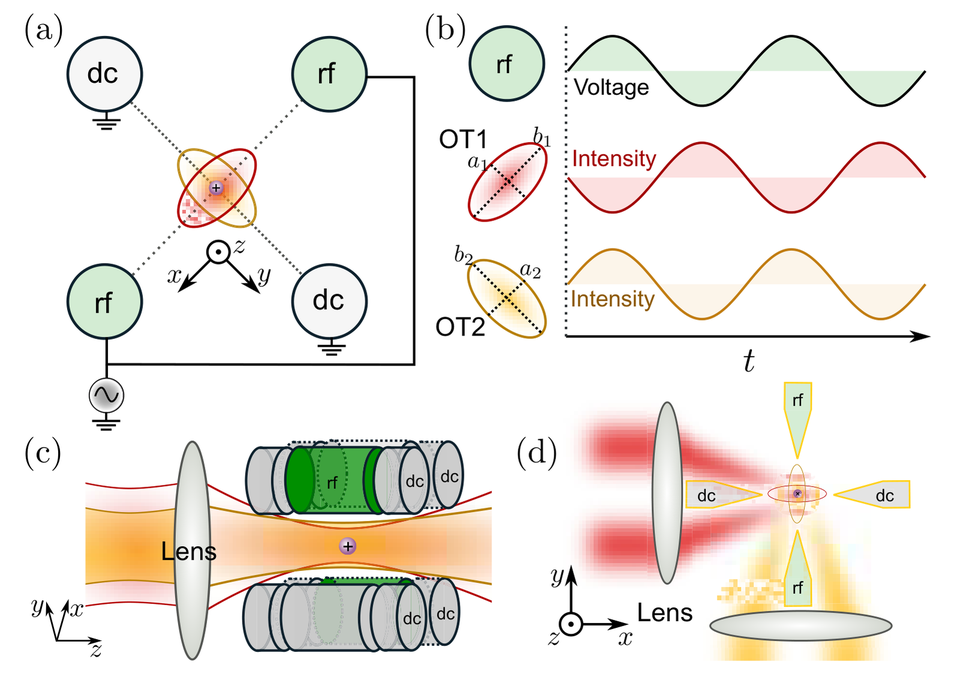
    abstract = "Advances in research in fields such as quantum information and quantum chemistry require subtle methods for trapping particles, including ions, neutral atoms, and molecules. Here, we propose a hybrid ion-trapping method that combines a Paul trap with optical tweezers. This trap incorporates both the deep-potential characteristic of the Paul trap and the micromotion-free nature of the optical dipole trap. By modulating the optical dipole trap synchronously with the radio-frequency voltage of the Paul trap, the alternating electrical force in the trap center is fully counteracted, and the micromotion temperature of a cold trapped ion can reach the nanokelvin scale, while the trap depth exceeds 300 K. These features will allow cold collisions between an ion and an atom in the 𝑠-wave regime and stably trap the produced molecular ion in the cold hybrid system. This provides a unique platform for probing the interactions between the ions and the surrounding neutral particles and enables the investigation of new reaction pathways and reaction products in the cold regime.",
    affiliations = "{ {Laboratory of Quantum Information, University of Science and Technology of China, Hefei 230026, China}, {Anhui Province Key Laboratory of Quantum Network, University of Science and Technology of China, Hefei 230026, China}, {CAS Center For Excellence in Quantum Information and Quantum Physics, University of Science and Technology of China, Hefei 230026, China}, {Hefei National Laboratory, University of Science and Technology of China, Hefei 230088, China} }, { {{Cui, Jin-Ming}{1,2,3,4}}, {{Sun, Shi-Jia}{1,3}}, {{Luo, Xi-Wang}{1,2,3,4}}, {{Huang, Yun-Feng}{1,2,3,4}}, {{Li, Chuan-Feng}{1,2,3,4}}, {{Guo, Guang-Can}{1,2,3}} }",
    copyright = "All rights reserved",
    corresauthor = "Cui, Jin-Ming and Luo, Xi-Wang and Huang, Yun-Feng",
    creationdate = "2025-05-30T15:49:43",
    doi = "10.1103/PhysRevApplied.23.054044",
    firstauthor = "Cui, Jin-Ming and Sun, Shi-Jia",
    groups = "SCI, SCI1, First/Corresponding, FirstAuthor, Journal",
    owner = "jmcui",
    url = "https://link.aps.org/doi/10.1103/PhysRevApplied.23.054044",
    urldate = "2025-05-30"
}
BibTeX citation
@Article{FangGuo2025PRA,
    author = "Fang, Ding and Chen, Wei-Bin and Zhang, Cheng-Hao and Cui, Jin-Ming and Huang, Yun-Feng and Li, Chuan-Feng and Guo, Guang-Can",
    journal = "Phys. Rev. Appl.",
    title = "Cavity-assisted thermometry for a single trapped ion",
    year = "2025",
    month = "August",
    note = "Publisher: American Physical Society",
    number = "2",
    pages = "024037",
    volume = "24",
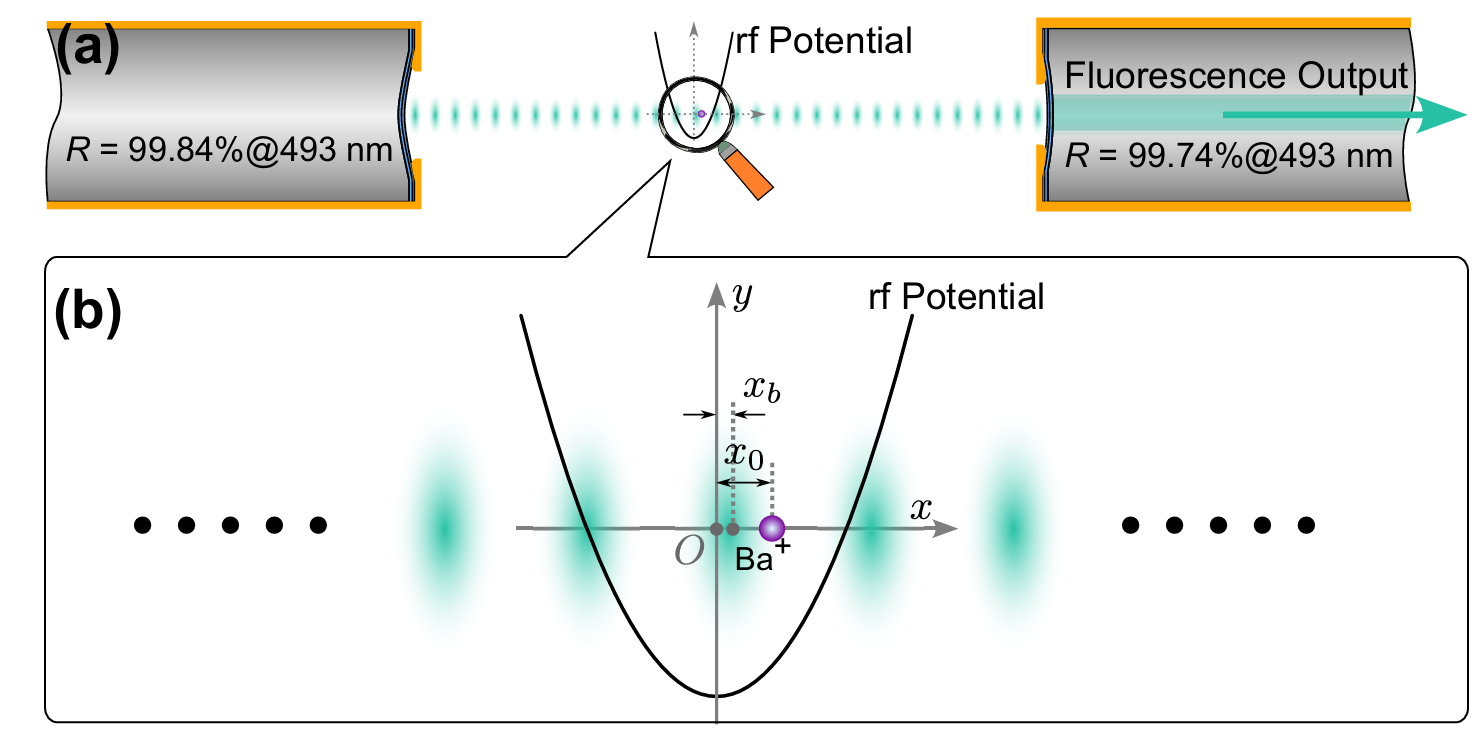
    abstract = "We propose and demonstrate two cavity-assisted thermometry methods that exploit the sensitivity of cavity radiation to the position of the ion in the cavity mode to achieve highly sensitive temperature measurements. Our analysis allows us to determine the relative positions of the rf null and the cavity mode by the change of cavity emission at different positions of the ion in the cavity mode. By analyzing the second-order correlation function of the cavity emission, temperature measurements from near the motional ground state to over tens of millikelvin can be achieved and motion patterns of different frequencies can be characterized. We demonstrate our approach by measuring the temperature of a single 138⁢Ba+ ion trapped in a fiber microcavity with a length of 230 μ⁢m using both proposed methods, achieving comparable results.",
    affiliations = "{ {Laboratory of Quantum Information, University of Science and Technology of China, Hefei 230026, China}, {Anhui Province Key Laboratory of Quantum Network, University of Science and Technology of China, Hefei 230026, China}, {CAS Center For Excellence in Quantum Information and Quantum Physics, University of Science and Technology of China, Hefei 230026, China}, {Hefei National Laboratory, University of Science and Technology of China, Hefei 230088, China} }, { {{Fang, Ding}{1,2,4}}, {{Chen, Wei-Bin}{1,2,4}}, {{Zhang, Cheng-Hao}{1,2,4}}, {{Cui, Jin-Ming}{1,2,3,4}}, {{Huang, Yun-Feng}{1,2,3,4}}, {{Li, Chuan-Feng}{1,2,3,4}}, {{Guo, Guang-Can}{1,2,3,4}} }",
    corresauthor = "Cui, Jin-Ming and Huang, Yun-Feng",
    creationdate = "2025-08-24T15:25:14",
    doi = "10.1103/vjl6-crbg",
    firstauthor = "Fang, Ding and Chen, Wei-Bin",
    groups = "SCI, SCI1, First/Corresponding, Journal",
    owner = "jmcui",
    url = "https://link.aps.org/doi/10.1103/vjl6-crbg",
    urldate = "2025-08-24"
}
BibTeX citation
@Article{FangGuo2025COL,
    author = "Fang, Ding and Zhang, Chenghao and Chen, Weibin and Cui, Jinming and Huang, Yunfeng and Li, Chuanfeng and Guo, Guangcan",
    journal = "Chin. Opt. Lett.",
    title = "A fast-tunable and stable fiber microcavity for coupling {Ba}$^{\textrm{+}}$ ions in quantum networks",
    year = "2025",
    month = "November",
    note = "Publisher: Editorial Office of Chinese Optics Letters",
    number = "12",
    pages = "120201",
    volume = "23",
    abstract = "We present the design, implementation, and characterization of a high-stability, fast-tunable fiber Fabry–Pérot microcavity system optimized for coupling with Ba+ ions to form quantum network nodes. The microcavity system integrates multi-wavelength single-mode transmission, rapid and broad-band tunability, high finesse, and exceptional passive mechanical stability. By incorporating a unique vibration isolation structure, the system enables the fiber-optic microcavity (with a finesse of 8000) to remain resonant with the laser for several minutes even without active feedback. Furthermore, we demonstrate active cavity length stabilization using the Pound–Drever–Hall method, which significantly suppresses low-frequency vibrations and enables the cavity length to remain stable for several days. Experimental results show that this fiber microcavity system offers outstanding stability and flexibility for practical quantum network applications, providing reliable technical support for the construction of large-scale quantum networks based on trapped ions.",
    copyright = "All rights reserved",
    creationdate = "2025-11-07T10:33:30",
    doi = "10.3788/COL202523.120201",
    fjournal = "Chinese Optics Letters",
    groups = "SCI1, First/Corresponding, SCI, Journal",
    keywords = "abbr",
    language = "en",
    owner = "jmcui",
    url = "https://www.opticsjournal.net/Articles/OJ1593bf2d19bfaf81/Abstract",
    urldate = "2025-11-07"
}
BibTeX citation
@Article{YeGuo2025O&LT,
    author = "Ye, Wei-Ran and Cui, Jin-Ming and Chen, Yan and Chen, Yi-Long and Li, Rui-Rui and Huang, Yun-Feng and Li, Chuan-Feng and Guo, Guang-Can",
    journal = "Optics \\& Laser Technology",
    title = "An integrated laser system for manipulating trapped ions qubits",
    year = "2025",
    issn = "0030-3992",
    month = "August",
    number = "2",
    pages = "112694",
    volume = "186",
    abstract = "In experiments with atomic qubits encoded in the hyperfine levels of cold atoms or ions, the generation and control of multiple laser frequencies are often required for laser cooling and qubit manipulation. In this work, we demonstrate a laser system that integrates laser cooling, qubit initialization and detection, and Raman operations into a single setup, utilizing fiber laser technology and nonlinear optics. Specifically, a 369 nm laser for preparing and detecting 171Yb+ ions, and a 554 nm laser for qubit Raman manipulation, are generated by modulating a seed laser at 1108 nm through a fiber electro-optic modulator (EOM), amplified by a Yb-doped fiber amplifier, and then converted to 369 nm and 554 nm using two sequentially placed periodically-poled nonlinear crystals. This method offers significant flexibility and scalability, as different laser frequencies can be generated by adding specific radio-frequency signals to the electronic system, without altering the optical setup. The switching time between laser frequency channels is measured at 6.5 ns. With a modulation bandwidth of 20 GHz, this approach can accommodate the hyperfine splittings of various ion species. Overall, This scheme optimizes the optical configuration for atom and ion operations, minimizes insertion losses, and provides an efficient multi-channel laser frequency generation solution, making it highly beneficial for atomic and ionic quantum information experiments.",
    afflications = "{{CAS Key Laboratory of Quantum Information, University of Science and Technology of China, Hefei 230026, China}, {Anhui Province Key Laboratory of Quantum Network, University of Science and Technology of China, Hefei 230026, China}, {CAS Center For Excellence in Quantum Information and Quantum Physics, University of Science and Technology of China, Hefei 230026, China}, {Hefei National Laboratory, University of Science and Technology of China, Hefei 230088, China}}, {{{Ye, Wei-Ran}{1,2,3,4}}, {{Cui, Jin-Ming}{1,2,3,4}}, {{Chen, Yan}{1,2,3}}, {{Chen, Yi-Long}{1,2,3,4}}, {{Li, Rui-Rui}{1,2,3}}, {{Huang, Yun-Feng}{1,2,3,4}}, {{Li, Chuan-Feng}{1,2,3,4}}, {{Guo, Guang-Can}{1,2,3}}}",
    corresauthor = "Cui, Jin-Ming and Huang, Yun-Feng",
    creationdate = "2025-03-10T16:31:45",
    doi = "10.1016/j.optlastec.2025.112694",
    firstauthor = "Ye, Wei-Ran",
    groups = "SCI, SCI1, First/Corresponding, Journal",
    keywords = "Atomic, Fast channel switch, Laser cooling, Molecular and optical physics, Qubit manipulation, Third harmonic generation, Trapped ions, Ultraviolet laser modulation",
    owner = "jmcui",
    url = "https://www.sciencedirect.com/science/article/pii/S0030399225002828",
    urldate = "2025-03-10"
}
BibTeX citation
@Article{ChenGuo2024PRA,
    author = "Chen, Yi-Long and Li, Rui-Rui and He, Ran and Chen, Shu-Qian and Qi, Wen-Hao and Cui, Jin-Ming and Huang, Yun-Feng and Li, Chuan-Feng and Guo, Guang-Can",
    journal = "Phys. Rev. Appl.",
    title = "Low-crosstalk optical addressing system for atomic qubits based on multiple objectives and acousto-optic deflectors",
    year = "2024",
    month = "November",
    note = "Publisher: American Physical Society",
    number = "5",
    pages = "054003",
    volume = "22",
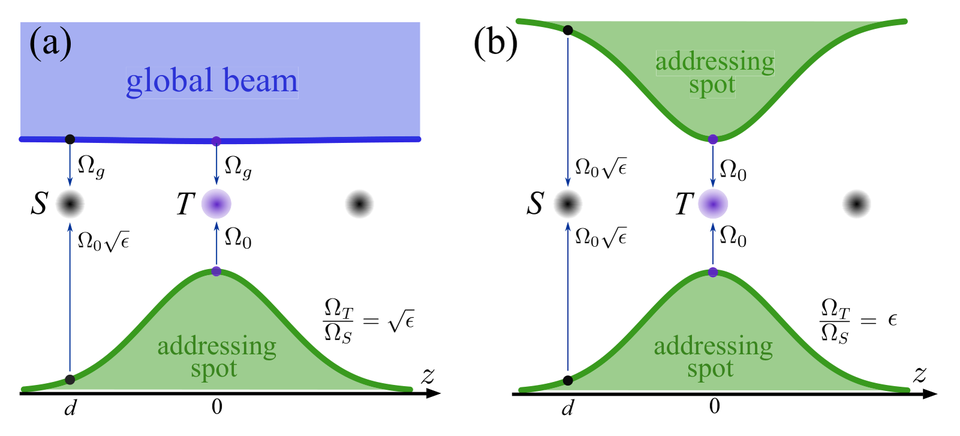
    abstract = "Large-scale programmable trapped ion hardware, featuring high gate fidelity and long coherence times, is promising for realizing a practical fault-tolerant quantum computer. However, individual addressing (IA) methods, which are useful for implementing programmable gates in near-term quantum devices, can lead to undesired errors between the target ions and neighboring ions. In this work, we present a low-crosstalk optical addressing system based on multiple optical objectives and acousto-optic deflectors (AODs) with a symmetrical configuration. Two counterpropagating Raman operation beams are both tightly focused, generating an overlapping spot with a waist radius of approximately 1 μ⁢m, to address the target ion. As a result, IA crosstalk, characterized by Rabi-rate crosstalk on the spectator ion, is measured to be 1.19⁢(5) ×10−3, with the two ions separated by approximately 5.5 μ⁢m. This low-crosstalk optical addressing system holds promise for high-fidelity entangling operations, and the symmetrically configured AODs in our method can be readily extended to two dimensions to address a two-dimensional ion crystal.",
    affiliations = "{ {CAS Key Laboratory of Quantum Information, University of Science and Technology of China, Hefei 230026, China}, {CAS Center For Excellence in Quantum Information and Quantum Physics, University of Science and Technology of China, Hefei 230026, China}, {Hefei National Laboratory, University of Science and Technology of China, Hefei 230088, China} }, { {{Chen, Yi-Long}{1,2,3}}, {{Li, Rui-Rui}{1,2,3}}, {{He, Ran}{1,2,3}}, {{Chen, Shu-Qian}{1,2,3}}, {{Qi, Wen-Hao}{1,2,3}}, {{Cui, Jin-Ming}{1,2,3}}, {{Huang, Yun-Feng}{1,2,3}}, {{Li, Chuan-Feng}{1,2,3}}, {{Guo, Guang-Can}{1,2,3}} }",
    copyright = "All rights reserved",
    corresauthor = "Cui, Jin-Ming and Huang, Yun-Feng",
    creationdate = "2025-03-10T16:31:57",
    doi = "10.1103/PhysRevApplied.22.054003",
    groups = "SCI, SCI1, First/Corresponding, Journal",
    language = "en-US",
    owner = "jmcui",
    url = "https://link.aps.org/doi/10.1103/PhysRevApplied.22.054003",
    urldate = "2024-12-25"
}
BibTeX citation
@Article{FangGuo2024OE,
    author = "Fang, Ding and Cui, Jin-Ming and Chen, Wei-Bin and Chen, Yan and Li, Rui-Rui and Zhang, Cheng-Hao and Huang, Yun-Feng and Li, Chuan-Feng and Guo, Guang-Can",
    journal = "Opt. Express",
    title = "Arc Discharge Method to Fabricate Large Concave Structures for Open-Access Fiber {{Fabry-P{\'e}rot}} Cavities",
    year = "2024",
    issn = "1094-4087",
    month = "January",
    number = "3",
    pages = "2906--2915",
    volume = "32",
    abstract = "We present a novel micro-fabrication technique for creating concave surfaces on the endfacets of photonic crystal fibers. A fiber fusion splicer is used to generate arc discharges to melt and reshape the fiber endfacet. This technique can produce large spherical concave surfaces with roughness as low as 0.12 nm in various types of photonic crystal fibers. The deviation of fabricated surface and a spherical profile in the region of 70 {\textmu}m in diameter is less than 50 nm. The center of the concave surface and the fiber mode field are highly coincident with a deviation less than 500 nm. Finesse measurements have shown that a Fabry-P{\'e}rot cavity composed of the fiber fabricated using this method and a plane mirror maintains finesse of 20000. This method is easy to replicate, making it a practical and efficient approach to fabricate concave surface on fibers for open-access fiber Fabry-P{\'e}rot cavities.",
    affiliations = "{ {CAS Key Laboratory of Quantum Information, University of Science and Technology of China, Hefei 230026, China}, {CAS Center For Excellence in Quantum Information and Quantum Physics, University of Science and Technology of China, Hefei 230026, China}, {Hefei National Laboratory, University of Science and Technology of China, Hefei 230088, China} }, { {{Fang, Ding}{1,2,3}}, {{Cui, Jin-Ming}{1,2,3}}, {{Chen, Wei-Bin}{1,2,3}}, {{Chen, Yan}{1,2,3}}, {{Li, Rui-Rui}{1,2,3}}, {{Zhang, Cheng-Hao}{1,2,3}}, {{Huang, Yun-Feng}{1,2,3}}, {{Li, Chuan-Feng}{1,2,3}}, {{Guo, Guang-Can}{1,2,3}} }",
    copyright = "{\copyright} 2024 Optica Publishing Group",
    corresauthor = "Cui, Jin-Ming and Huang, Yun-Feng and Li, Chuan-Feng",
    creationdate = "2024-09-06T11:31:38",
    doi = "10.1364/OE.501532",
    fjournal = "Optics Express",
    groups = "SCI, SCI1, First/Corresponding, Journal",
    keywords = "Cavity quantum electrodynamics,Light matter interactions,Multimode fibers,Optical filters,Photonic crystal fibers,Quantum light sources",
    langid = "english",
    owner = "jmcui",
    publisher = "Optica Publishing Group",
    urldate = "2024-09-02"
}
BibTeX citation
@Article{LiGuo2024COL,
    author = "Li, Rui-Rui and Ye, Wei-Ran and Chen, Yi-Long and Chen, Shu-Qian and Qi, Wen-Hao and Cui, Jin-Ming and Huang, Yun-Feng and Li, Chuan-Feng and Guo, Guang-Can",
    journal = "Chin. Opt. Lett.",
    title = "Generation of Visible {{Raman}} Operation Laser by a Fiber Electro-Optical Modulator Feedback Loop",
    year = "2024",
    month = "February",
    number = "2",
    pages = "022702",
    volume = "22",
    abstract = "Phase-coherent multi-tone lasers play a critical role in atomic, molecular, and optical physics. Among them, the Raman opeartion laser for manipulating atomic hyperfine qubits requires gigahertz bandwidth and low phase noise to retain long-term coherence. Raman operation lasers generated by directly modulated and frequency-multipled infrared lasers are compact and stable but lack feedback control to actively suppress the phase noise, which limits their performance in practical applications. In this work, we employ a fiber electro-optical modulator driven by a voltage-controlled oscillator (VCO) to modulate a monochromatic laser and employ a second-harmonic generation process to convert it to the visible domain, where the beat note of the Raman operation laser is stabilized by controlling the output frequency of VCO with a digital phase-locked loop (PLL). The low-frequency phase noise is effectively suppressed compared to the scheme without active feedback and it reaches -80 dBc/Hz@5 kHz with a 20 kHz loop bandwidth. Furthermore, this compact and robust scheme effectively reduces the system's complexity and cost, which is promising for extensive application in atomic, molecular, and optical physics.",
    copyright = "{\copyright} 2024 Chinese Laser Press",
    creationdate = "2024-09-06T11:31:38",
    fjournal = "Chinese Optics Letters",
    groups = "SCI, Journal",
    keywords = "Infrared lasers,Laser operation,Laser sources,Phase noise,Raman fiber lasers,Raman lasers",
    langid = "english",
    owner = "jmcui",
    publisher = "Chinese Optical Society",
    urldate = "2024-09-02",
    doi = "10.3788/COL202422.022702",
    url = "https://doi.org/10.3788/COL202422.022702"
}
BibTeX citation
@Article{ZhengGuo2024PRL,
    author = "Zheng, Yi and Liu, Zhao-Di and Miao, Rui-Heng and Cui, Jin-Ming and Yang, Mu and Xu, Xiao-Ye and Xu, Jin-Shi and Li, Chuan-Feng and Guo, Guang-Can",
    journal = "Phys. Rev. Lett.",
    title = "Characterizing {{Biphoton Spatial Wave Function Dynamics}} with {{Quantum Wavefront Sensing}}",
    year = "2024",
    month = "July",
    number = "3",
    pages = "033602",
    volume = "133",
    abstract = "With an extremely high dimensionality, the spatial degree of freedom of entangled photons is a key tool for quantum foundation and applied quantum techniques. To fully utilize the feature, the essential task is to experimentally characterize the multiphoton spatial wave function including the entangled amplitude and phase information at different evolutionary stages. However, there is no effective method to measure it. Quantum state tomography is costly, and quantum holography requires additional references. Here, we introduce quantum Shack-Hartmann wavefront sensing to perform efficient and reference-free measurement of the biphoton spatial wave function. The joint probability distribution of photon pairs at the back focal plane of a microlens array is measured and used for amplitude extraction and phase reconstruction. In the experiment, we observe that the biphoton amplitude correlation becomes weak while phase correlation shows up during free-space propagation. Our work is a crucial step in quantum physical and adaptive optics and paves the way for characterizing quantum optical fields with high-order correlations or topological patterns.",
    copyright = "All rights reserved",
    creationdate = "2024-09-06T11:31:38",
    doi = "10.1103/PhysRevLett.133.033602",
    fjournal = "Physical Review Letters",
    groups = "SCI, Journal",
    owner = "jmcui",
    publisher = "American Physical Society",
    urldate = "2024-09-02"
}
BibTeX citation
@Article{BaoGuo2023J,
    author = "Bao, Xing-Yu and Cui, Jin-Ming and Fang, Ding and Chen, Wei-Bin and Wang, Jian and Huang, Yun-Feng and Li, Chuan-Feng and Guo, Guang-Can",
    journal = "JUSTC",
    title = "Design of a Fiber Cavity Ion Trap for a High-Efficiency and High-Rate Quantum Network Node",
    year = "2023",
    issn = "0253-2778",
    number = "7",
    pages = "0705--10",
    volume = "53",
    affiliations = "{ {CAS Key Laboratory of Quantum Information, University of Science and Technology of China, Hefei 230026, China}, {CAS Center For Excellence in Quantum Information and Quantum Physics, University of Science and Technology of China, Hefei 230026, China}, {Hefei National Laboratory, University of Science and Technology of China, Hefei 230088, China} }, { {{Bao, Xing-Yu}{1,2,3}}, {{Cui, Jin-Ming}{1,2,3}}, {{Fang, Ding}{1,2,3}}, {{Chen, Wei-Bin}{1,2,3}}, {{Wang, Jian}{1,2,3}}, {{Huang, Yun-Feng}{1,2,3}}, {{Li, Chuan-Feng}{1,2,3}}, {{Guo, Guang-Can}{1,2,3}} }",
    copyright = "http://creativecommons.org/licenses/by/3.0/",
    corresauthor = "Cui, Jin-Ming",
    creationdate = "2024-09-06T11:31:38",
    doi = "10.52396/JUSTC-2023-0005",
    groups = "CSCD, First/Corresponding, Journal",
    langid = "english",
    owner = "jmcui",
    publisher = "JUSTC",
    urldate = "2023-08-27"
}
BibTeX citation
@Article{HuKwek2023nQI,
    author = "Hu, Xiao-Min and Xie, Yi and Arora, Atul Singh and Ai, Ming-Zhong and Bharti, Kishor and Zhang, Jie and Wu, Wei and Chen, Ping-Xing and Cui, Jin-Ming and Liu, Bi-Heng and Huang, Yun-Feng and Li, Chuan-Feng and Guo, Guang-Can and Roland, J{\'e}r{\'e}mie and Cabello, Ad{\'a}n and Kwek, Leong-Chuan",
    journal = "npj Quantum Inf.",
    title = "Self-Testing of a Single Quantum System from Theory to Experiment",
    year = "2023",
    issn = "2056-6387",
    month = "October",
    number = "1",
    pages = "1--11",
    volume = "9",
    abstract = "Self-testing allows one to characterise quantum systems under minimal assumptions. However, existing schemes rely on quantum nonlocality and cannot be applied to systems that are not entangled. Here, we introduce a robust method that achieves self-testing of individual systems by taking advantage of contextuality. The scheme is based on the simplest contextuality witness for the simplest contextual quantum system---the Klyachko-Can-Binicio{\u g}lu-Shumovsky inequality for the qutrit. We establish a lower bound on the fidelity of the state and the measurements as a function of the value of the witness under a pragmatic assumption on the measurements. We apply the method in an experiment on a single trapped 40Ca+ using randomly chosen measurements and perfect detection efficiency. Using the observed statistics, we obtain an experimental demonstration of self-testing of a single quantum system.",
    copyright = "All rights reserved",
    creationdate = "2024-09-06T11:31:38",
    doi = "10.1038/s41534-023-00769-7",
    fjournal = "npj Quantum Information",
    groups = "SCI, Journal",
    keywords = "Information theory and computation,Quantum information",
    langid = "english",
    owner = "jmcui",
    publisher = "Nature Publishing Group",
    urldate = "2024-09-02"
}
BibTeX citation
@Article{AiGuo2022SCPM&A,
    author = "Ai, Ming-Zhong and Ding, Yongcheng and Ban, Yue and Martín-Guerrero, José D. and Casanova, Jorge and Cui, Jin-Ming and Huang, Yun-Feng and Chen, Xi and Li, Chuan-Feng and Guo, Guang-Can",
    journal = "Science China Physics, Mechanics \\& Astronomy",
    title = "Experimentally realizing efficient quantum control with reinforcement learning",
    year = "2022",
    issn = "1869-1927",
    month = "March",
    number = "5",
    pages = "250312",
    volume = "65",
    abstract = "We experimentally investigate deep reinforcement learning (DRL) as an artificial intelligence approach to control a quantum system. We verify that DRL explores fast and robust digital quantum controls with operation time analytically hinted by shortcuts to adiabaticity. In particular, the protocol’s robustness against both over-rotations and off-resonance errors can still be achieved simultaneously without any priori input. For the thorough comparison, we choose the task as single-qubit flipping, in which various analytical methods are well-developed as the benchmark, ensuring their feasibility in the quantum system as well. Consequently, a gate operation is demonstrated on a trapped 171Yb+ ion, significantly outperforming analytical pulses in the gate time and energy cost with hybrid robustness, as well as the fidelity after repetitive operations under time-varying stochastic errors. Our experiments reveal a framework of computer-inspired quantum control, which can be extended to other complicated tasks without loss of generality.",
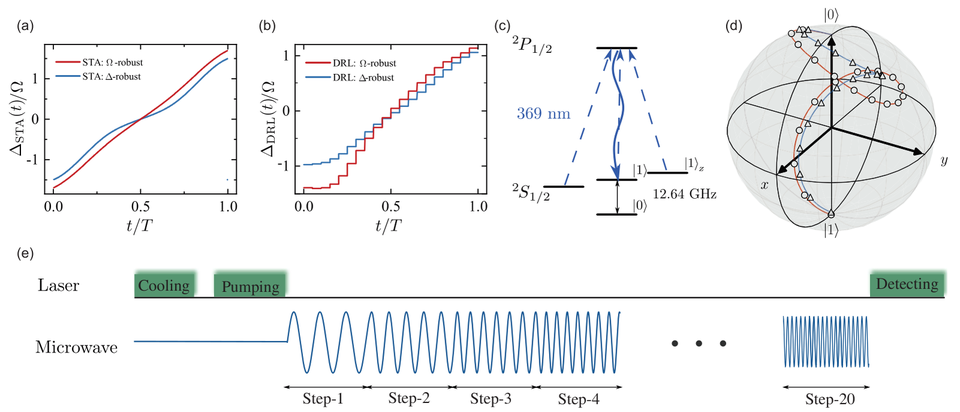
    affiliations = "{{CAS Key Laboratory of Quantum Information, University of Science and Technology of China, Hefei 230026, China}, {CAS Center For Excellence in Quantum Information and Quantum Physics, University of Science and Technology of China, Hefei 230026, China}, {International Center of Quantum Artificial Intelligence for Science and Technology (QuArtist) and Department of Physics, Shanghai University, Shanghai 200444, China}, {Department of Physical Chemistry, University of the Basque Country UPV/EHU, Bilbao 48080, Spain}, {School of Materials Science and Engineering, Shanghai University, Shanghai 200444, China}, {IDAL, Electronic Engineering Department, University of Valencia, Valencia 46100, Spain}, {IKERBASQUE, Basque Foundation for Science, Bilbao 48009, Spain} }, { {{Ai, Ming-Zhong}{1,2}}, {{Ding, Yongcheng}{3,4}}, {{Ban, Yue}{4,5}}, {{Martín-Guerrero, José D.}{6}}, {{Casanova, Jorge}{4,7}}, {{Cui, Jin-Ming}{1,2}}, {{Huang, Yun-Feng}{1,2}}, {{Chen, Xi}{3,4}}, {{Li, Chuan-Feng}{1,2}}, {{Guo, Guang-Can}{1,2}} }",
    copyright = "All rights reserved",
    corresauthor = "Cui, Jin-Ming and Huang, Yun-Feng and Chen, Xi",
    doi = "10.1007/s11433-021-1841-2",
    groups = "SCI, SCI1, First/Corresponding, Journal",
    keywords = "noise robustness, quantum computing, quantum control, reinforcement learning, trapped ion",
    language = "en",
    url = "https://doi.org/10.1007/s11433-021-1841-2",
    urldate = "2022-08-16"
}
BibTeX citation
@Article{AiGuo2022FR,
    author = "Ai, Ming-Zhong and Li, Sai and He, Ran and Xue, Zheng-Yuan and Cui, Jin-Ming and Huang, Yun-Feng and Li, Chuan-Feng and Guo, Guang-Can",
    journal = "Fundamental Research",
    title = "Experimental realization of nonadiabatic holonomic single‐qubit quantum gates with two dark paths in a trapped ion",
    year = "2022",
    issn = "2667-3258",
    month = "December",
    pages = "661-666",
    volume = "2",
    abstract = "For circuit-based quantum computation, experimental implementation of a universal set of quantum logic gates with high-fidelity and strong robustness is essential and central. Quantum gates induced by geometric phases, which depend only on global properties of the evolution paths, have built-in noise-resilience features. Here, we propose and experimentally demonstrate nonadiabatic holonomic single-qubit quantum gates on two dark paths in a trapped 171Yb+ ion based on four-level systems with resonant drives. We confirm the implementation with measured gate fidelity through both quantum process tomography and randomized benchmarking methods. Meanwhile, we find that nontrivial holonomic two-qubit quantum gates can also be realized within current experimental technologies. Compared with previous implementations, our experiments share both the advantages of fast nonadiabatic evolution and robustness against systematic errors. Therefore, our experiments confirm a promising method for fast and robust holonomic quantum computation.",
    copyright = "All rights reserved",
    corresauthor = "Xue, Zheng-Yuan and Cui, Jin-Ming and Huang, Yun-Feng and Li, Chuan-Feng",
    doi = "10.1016/j.fmre.2021.11.031",
    groups = "First/Corresponding, Journal",
    keywords = "Geometric phase, Ion trap, Noise robustness, Nonadiabatic evolution, Quantum computation",
    language = "en",
    url = "https://www.sciencedirect.com/science/article/pii/S2667325821003034",
    urldate = "2022-08-16"
}
BibTeX citation
@Article{ChenCasanova2022nQI,
    author = "Chen, Yan and Ban, Yue and He, Ran and Cui, Jin-Ming and Huang, Yun-Feng and Li, Chuan-Feng and Guo, Guang-Can and Casanova, Jorge",
    journal = "npj Quantum Inf.",
    title = "A neural network assisted {171Yb}+ quantum magnetometer",
    year = "2022",
    issn = "2056-6387",
    month = "December",
    note = "Number: 1 Publisher: Nature Publishing Group",
    number = "1",
    pages = "152",
    volume = "8",
    abstract = "A versatile magnetometer must deliver a readable response when exposed to target fields in a wide range of parameters. In this work, we experimentally demonstrate that the combination of171Yb+ atomic sensors with adequately trained neural networks enables us to investigate target fields in distinct challenging scenarios. In particular, we characterize radio frequency (RF) fields in the presence of large shot noise, including the limit case of continuous data acquisition via single-shot measurements. Furthermore, by incorporating neural networks we significantly extend the working regime of atomic magnetometers into scenarios in which the RF driving induces responses beyond their standard harmonic behavior. Our results indicate the benefits to integrate neural networks at the data processing stage of general quantum sensing tasks to decipher the information contained in the sensor responses.",
    affiliations = "{ {CAS Key Laboratory of Quantum Information, University of Science and Technology of China, Hefei 230026, China}, {CAS Center For Excellence in Quantum Information and Quantum Physics, University of Science and Technology of China, Hefei 230026, China}, {Department of Physical Chemistry, University of the Basque Country UPV/EHU, Apartado 644, 48080 Bilbao, Spain}, {EHU Quantum Center, University of the Basque Country UPV/EHU, Barrio Sarriena, s/n, 48940 Leioa, Biscay, Spain}, {STECNALIA, Basque Research and Technology Alliance (BRTA), 48160 Derio, Spain}, {Hefei National Laboratory, University of Science and Technology of China, Hefei 230088, China}, {IKERBASQUE, Basque Foundation for Science, Plaza Euskadi 5, 48009 Bilbao, Spain} }, { {{Chen, Yan}{1,2,6}}, {{Ban, Yue}{1,2,6}}, {{He, Ran}{1,2,6}}, {{ Cui, Jin-Ming}{1,2,6}}, {{Huang, Yun-Feng}{1,2,6}}, {{Li, Chuan-Feng}{1,2,6}}, {{Guo, Guang-Can}{1,2,6}}, {{Casanova, Jorge}{1,2,6}}}",
    copyright = "2022 The Author(s)",
    corresauthor = "Cui, Jin-Ming and Huang, Yun-Feng",
    creationdate = "2023-02-15T20:47:27",
    doi = "10.1038/s41534-022-00669-2",
    fjournal = "npj Quantum Information",
    groups = "SCI, SCI1, First/Corresponding, Journal",
    keywords = "Quantum information, Quantum metrology",
    language = "en",
    owner = "jmcui",
    url = "https://www.nature.com/articles/s41534-022-00669-2",
    urldate = "2023-02-15"
}
BibTeX citation
@Article{LiGuo2022OE,
    author = "Li, Rui-Rui and He, Ran and Cui, Jin-Ming and Chen, Yan and Ye, Wei-Ran and Chen, Yi-Long and Huang, Yun-Feng and Li, Chuan-Feng and Guo, Guang-Can",
    journal = "Opt. Express",
    title = "A versatile multi-tone laser system for manipulating atomic qubits based on a fiber {Mach}–{Zehnder} modulator and second harmonic generation",
    year = "2022",
    issn = "1094-4087",
    month = "August",
    note = "Publisher: Optica Publishing Group",
    number = "17",
    pages = "30098--30107",
    volume = "30",
    abstract = "Stimulated Raman transition is a fundamental method to coherently manipulate quantum states in different physical systems. Phase-coherent dichromatic radiation fields matching the energy level splitting are the key to realizing stimulated Raman transition. Here we demonstrate a flexible-tuning, spectrum-clean and fiber-compatible method to generate a highly phase-coherent and high-power multi-tone laser. This method features the utilization of a broadband fiber Mach–Zehnder modulator working at carrier suppression condition and second harmonic generation. We generate a multi-tone continuous-wave 532 nm laser with a power of 1.5 Watts and utilize it to manipulate the spin and motional states of a trapped 171Yb+ ion via stimulated Raman transition. For spin state manipulation, we acquire an effective Rabi frequency of 2π × 662.3 kHz. Due to the broad bandwidth of the fiber modulator and nonlinear crystal, the frequency gap between tones can be flexibly tuned. Benefiting from the features above, this method can manipulate 171Yb+ and 137Ba+ simultaneously in the multi-species ion trap and has potential to be widely applied in atomic, molecular and optical physics.",
    affiliations = "{ {CAS Key Laboratory of Quantum Information, University of Science and Technology of China, Hefei 230026, China}, {CAS Center For Excellence in Quantum Information and Quantum Physics, University of Science and Technology of China, Hefei 230026, China}, {Hefei National Laboratory, University of Science and Technology of China, Hefei 230088, China} }, { {{Li, Rui-Rui}{1,2,3}}, {{He, Ran}{1,2,3}}, {{Cui, Jin-Ming}{1,2,3}}, {{Chen, Yan}{1,2,3}}, {{Ye, Wei-Ran}{1,2,3}}, {{Chen, Yi-Long}{1,2,3}}, {{Huang, Yun-Feng}{1,2,3}}, {{Li, Chuan-Feng}{1,2,3}}, {{Guo, Guang-Can}{1,2,3}} }",
    copyright = "\\&\\#169; 2022 Optica Publishing Group",
    corresauthor = "Cui, Jin-Ming and Huang, Yun-Feng and Li, Chuan-Feng",
    doi = "10.1364/OE.462737",
    fjournal = "Optics Express",
    groups = "SCI, SCI1, First/Corresponding, Journal",
    language = "EN",
    url = "https://opg.optica.org/oe/abstract.cfm?uri=oe-30-17-30098",
    urldate = "2022-08-16"
}
BibTeX citation
@Article{王晨旭郭光灿2022物,
    author = "王晨旭 and 贺冉 and 李睿睿 and 陈炎 and 房鼎 and 崔金明 and 黄运锋 and 李传锋 and 郭光灿",
    journal = "物理学报",
    title = "量子计算与量子模拟中离子阱结构研究进展",
    year = "2022",
    issn = "1000-3290",
    month = "July",
    note = "Publisher: 物理学报",
    number = "13",
    pages = "133701",
    volume = "71",
    abstract = "离子阱系统是实现量子计算和量子模拟的主要体系之一. 世界范围内的各个离子阱研究小组共同推动着离子阱结构的丰富化发展, 开发出一系列高性能的三维离子阱、二维离子芯片、以及具有集成器件的离子阱系统. 离子阱的结构逐渐向小型化、高通光性和集成化方向发展, 并表现出卓越的量子操控能力—对多离子的囚禁能力和精确控制能力越来越高. 本综述将总结过去的十几年里离子阱在结构上的演化历程, 以及离子阱在量子计算与量子模拟实验研究中的最新进展. 通过分析具有代表性的离子阱结构, 总结离子阱系统在加工工艺、鲁棒性和多功能性等方面取得的进步, 并对基于离子阱系统的可扩展量子计算与模拟作出展望.",
    affiliations = "{ {中国科学技术大学,中国科学院量子信息重点实验室,合肥 230026}, {中国科学技术大学,量子信息与量子科技前沿协同创新中心,合肥 230026}, {合肥师范学院物理与材料工程学院,合肥 230601} }, { {{王晨旭}{1,2}}, {{贺冉}{1,2,3}}, {{李睿睿}{1,2}}, {{陈炎}{1,2}}, {{房鼎}{1,2}}, {{崔金明}{1,2}}, {{黄运锋}{1,2}}, {{李传锋}{1,2}}, {{郭光灿}{1,2}} }",
    copyright = "http://creativecommons.org/licenses/by/3.0/",
    corresauthor = "贺冉 and 崔金明",
    doi = "10.7498/aps.70.20220224",
    groups = "SCI, SCI1, First/Corresponding, Journal",
    language = "zh",
    url = "https://wulixb.iphy.ac.cn/cn/article/doi/10.7498/aps.70.20220224",
    urldate = "2022-08-16"
}
BibTeX citation
@Article{AiGuo2021PRA,
    author = "Ai, Ming-Zhong and Cui, Jin-Ming and He, Ran and Qian, Zhong-Hua and Gao, Xin-Xia and Huang, Yun-Feng and Li, Chuan-Feng and Guo, Guang-Can",
    journal = "Phys. Rev. A",
    title = "Experimental verification of anti--{Kibble}-{Zurek} behavior in a quantum system under a noisy control field",
    year = "2021",
    month = "January",
    note = "Publisher: American Physical Society",
    number = "1",
    pages = "012608",
    volume = "103",
    abstract = "The Kibble-Zurek (KZ) mechanism is a universal framework that can in principle describe nonequilibrium phase transition phenomena in any system with the required symmetry properties. However, a conflicting phenomenon termed anti-KZ behavior has been reported in the study of ferroelectric phase transitions, in which slower driving results in more topological defects [S. M. Griffin et al., Phys. Rev. X 2, 041022 (2012)]. Although this finding is significant, related experimental work remains scarce. In this work, we experimentally demonstrate anti-KZ behavior under a noisy control field in three different quantum phase transition protocols using a single trapped 171Yb+ ion. The density of defects is studied as a function of the quench time and the noise intensity. We experimentally verify that the optimal quench time to minimize excitations scales as a universal power law of the noise intensity. Our work provides an experimental verification of anti-KZ behavior in a two-level system.",
    affiliations = "{ {CAS Key Laboratory of Quantum Information and CAS Center for Excellence in Quantum Information and Quantum Physics, University of Science and Technology of China, Hefei 230026, People’s Republic of China} }, { {{Ai, Ming-Zhong}{1}}, {{Cui, Jin-Ming}{1}}, {{He, Ran}{1}}, {{Qian, Zhong-Hua}{1}}, {{Gao, Xin-Xia}{1}}, {{Huang, Yun-Feng}{1}}, {{Li, Chuan-Feng}{1}}, {{Guo, Guang-Can}{1}} }",
    copyright = "All rights reserved",
    corresauthor = "Cui, Jin-Ming and Huang, Yun-Feng and Li, Chuan-Feng",
    doi = "10/gjh7tx",
    fjournal = "Physical Review A",
    groups = "SCI, SCI1, First/Corresponding, Journal",
    owner = "jmcui",
    timestamp = "2021-05-04",
    url = "https://link.aps.org/doi/10.1103/PhysRevA.103.012608",
    urldate = "2021-03-23"
}
BibTeX citation
@Article{HeCreffield2021nQI,
    author = "He, Ran and Ai, Ming-Zhong and Cui, Jin-Ming and Huang, Yun-Feng and Han, Yong-Jian and Li, Chuan-Feng and Guo, Guang-Can and Sierra, G. and Creffield, C. E.",
    journal = "npj Quantum Inf.",
    title = "Riemann zeros from {Floquet} engineering a trapped-ion qubit",
    year = "2021",
    issn = "2056-6387",
    month = "December",
    number = "1",
    pages = "109",
    volume = "7",
    abstract = "Abstract The non-trivial zeros of the Riemann zeta function are central objects in number theory. In particular, they enable one to reproduce the prime numbers. They have also attracted the attention of physicists working in random matrix theory and quantum chaos for decades. Here we present an experimental observation of the lowest non-trivial Riemann zeros by using a trapped-ion qubit in a Paul trap, periodically driven with microwave fields. The waveform of the driving is engineered such that the dynamics of the ion is frozen when the driving parameters coincide with a zero of the real component of the zeta function. Scanning over the driving amplitude thus enables the locations of the Riemann zeros to be measured experimentally to a high degree of accuracy, providing a physical embodiment of these fascinating mathematical objects in the quantum realm.",
    affiliations = "{ {CAS Key Laboratory of Quantum Information, University of Science and Technology of China, Hefei, China}, {CAS Center For Excellence in Quantum Information and Quantum Physics, University of Science and Technology of China, Hefei, China}, {Instituto de Fisica Teórica, UAM-CSIC, Madrid, Spain}, {Departamento de Fisica de Materiales, Universidad Complutense de Madrid, Madrid, Spain} }, { {{He, Ran}{1,2}}, {{Ai, Ming-Zhong}{1,2}}, {{Cui, Jin-Ming}{1,2}}, {{Huang, Yun-Feng}{1,2}}, {{Han, Yong-Jian}{1,2}}, {{Li, Chuan-Feng}{1,2}}, {{Guo, Guang-Can}{1,2}}, {{Sierra, G.}{3}}, {{Creffield, C. E.}{4}} }",
    comment = "中国科大郭光灿院士团队在基于离子阱系统寻找黎曼函数零点的研究中取得重要进展。该团队李传锋、黄运锋、崔金明等人联合西班牙理论物理学家Charles Creffield教授和German Sierra教授,利用周期性地驱动囚禁离子的量子状态,成功在实验上测量到黎曼函数的前80个零点。该研究成果7月14日发表在国际知名学术期刊《NPJ Quantum Information》上。 伯恩哈德·黎曼于1859年提出了黎曼猜想,其核心内容为:黎曼ζ函数的非平凡零点的实数部分都是1/2。黎曼猜想是千禧年七大难题之一,其证明将极大地促进人们对于质数分布规律的认识。虽然数学家们孜孜以求,至今黎曼猜想仍然悬而未决。在所有可能的解决方案中,一个非常有趣的想法是希尔伯特-波利亚猜想,它将黎曼函数与量子理论结合起来。希尔伯特-波利亚猜想认为存在一个量子系统,其哈密顿量的本征值与黎曼函数的零点一一对应。很多物理学家被这个猜想所吸引,并发现了许多有潜力的静态哈密顿量。但是这些静态哈密顿量难以在实验上实现。 该联合研究团队在国际上首次提出了一种准静态哈密顿量方法。通过设计一种驱动函数周期性地驱动量子比特,能够实现量子态的准静态演化,使得当系统的准能量等于黎曼函数零点时,该量子系统在整数周期节点保持不变,即发生相干隧穿抑制(Coherent destruction of tunneling)。该团队在自主研发的囚禁离子阱中率先实现了该方案。得益于该离子阱系统的长相干时间,研究团队实现了30个周期的高保真度驱动,并测量到了黎曼函数的前80个零点,比该领域此前的工作提升了近两个量级。该实验结果对于人们研究希尔伯特-波利亚猜想,并深入理解黎曼猜想与量子系统的联系提供了重要的实验依据。 审稿人对该工作做出高度评价:“基于以下原因我推荐发表:实现该方案需要高度的实验独创性,理论和实验描述得很清晰,得到的黎曼零点数量大而且准确度高(I am recommending publication, for several reasons: the high level of experimental ingenuity required to make the scheme work; the clear description of theory and experiment; and the large numbers and high accuracy of the measured zeros)。” 论文的第一作者是中科院量子信息重点实验室的博士后贺冉。该研究得到了科技部,国家自然科学基金委、中国科学院和安徽省的资助。 论文链接:https://doi.org/10.1038/s41534-021-00446-7",
    copyright = "All rights reserved",
    doi = "10.1038/s41534-021-00446-7",
    fjournal = "npj Quantum Information",
    groups = "SCI, SCI1, First/Corresponding, Journal",
    language = "en",
    owner = "jmcui",
    url = "http://www.nature.com/articles/s41534-021-00446-7",
    urldate = "2021-08-18"
}
BibTeX citation
@Article{HeGuo2021RSI,
    author = "He, Ran and Cui, Jin-Ming and Li, Rui-Rui and Qian, Zhong-Hua and Chen, Yan and Ai, Ming-Zhong and Huang, Yun-Feng and Li, Chuan-Feng and Guo, Guang-Can",
    journal = "Rev. Sci. Instrum.",
    title = "An ion trap apparatus with high optical access in multiple directions",
    year = "2021",
    issn = "0034-6748",
    month = "July",
    note = "Publisher: American Institute of Physics",
    number = "7",
    pages = "073201",
    volume = "92",
    abstract = "Optical controls provided by lasers are the most important and essential techniques in trapped ion and cold atom systems. It is crucial to increase the optical accessibility of the setup to enhance these optical capabilities. Here, we present the design and construction of a new segmented-blade ion trap integrated with a compact glass vacuum cell, in place of the conventional bulky metal vacuum chamber. The distance between the ion and four outside surfaces of the glass cell is 15 mm, which enables us to install four high-numerical-aperture (NA) lenses (with two NA ⩽ 0.32 lenses and two NA ⩽ 0.66 lenses) in two orthogonal transverse directions, while leaving enough space for laser beams in the oblique and longitudinal directions. The high optical accessibility in multiple directions allows the application of small laser spots for addressable Raman operations, programmable optical tweezer arrays, and efficient fluorescence collection simultaneously. We have successfully loaded and cooled a string of 174Yb+ and 171Yb+ ions in the trap, which verifies the trapping stability. This compact high-optical-access trap setup not only can be used as an extendable module for quantum information processing but also facilitates experimental studies on quantum chemistry in a cold hybrid ion-atom system.",
    affiliations = "{{CAS Key Laboratory of Quantum Information, University of Science and Technology of China, Hefei 230026, China}, {CAS Center for Excellence in Quantum Information and Quantum Physics, University of Science and Technology of China, Hefei 230026, China} }, { {{He, Ran}{1,2}}, {{Cui, Jin-Ming}{1,2}}, {{Li, Rui-Rui}{1,2}}, {{Qian, Zhong-Hua}{1,2}}, {{Chen, Yan}{1,2}}, {{Ai, Ming-Zhong}{1,2}}, {{Huang, Yun-Feng}{1,2}}, {{Li, Chuan-Feng}{1,2}}, {{Guo, Guang-Can}{1,2}}}",
    comment = "冷离子-原子混合系统将囚禁离子与冷原子集成到一个实验装置,以期实现冷原子-离子碰撞、冷原子-离子量子化学等科学研究,近年来成为原子、分子和光物理领域的研究前沿热点。作为尚待发展的新型的量子物理研究平台,冷离子-原子混合系统实验研究还面临众多问题,譬如离子阱中的微运动加热,控制和探测离子与原子碰撞和反应过程等问题。同时,近年来中性原子的光镊技术发展迅速,已实现了原子阵列囚禁和控制异核原子反应等重要研究,而离子光镊有望解决离子阱加热离子的问题,这充分证明光镊操控的灵活性。针对上述科学问题和研究进展,项目申请人设计并实现了一种具有高通光性的离子阱装置,创造性地将小型刀片离子阱安置到方形玻璃腔体中, 充分结合了刀片阱和玻璃腔体的高通光特性,可在玻璃腔周围配置四个大数值孔径物镜(一对NA=0.66,一对NA=0.32),从而可同时满足离子寻址操控、多波长的光镊操控,高效荧光收集等要求。由于玻璃腔体很好的兼容现有的冷原子技术,多个方向的斜入射光束可以提供磁光阱、偶极阱等工具,在该装置上也可以实现中性原子光镊。因此,该实验装置为冷原子领域发展新型的冷离子-原子混合光镊体系开创了基础,有望在此基础上开展冷离子-原子量子信息和量子化学研究。",
    copyright = "All rights reserved",
    corresauthor = "Cui, Jin-Ming and Huang, Yun-Feng and Li, Chuan-Feng",
    doi = "10.1063/5.0043985",
    fjournal = "Review of Scientific Instruments",
    groups = "SCI, SCI1, First/Corresponding, Journal",
    owner = "jmcui",
    url = "https://aip.scitation.org/doi/full/10.1063/5.0043985",
    urldate = "2021-08-04"
}
BibTeX citation
@Article{HuKosloff2021NJP,
    author = "Hu, Chang-Kang and Dann, Roie and Cui, Jin-Ming and Huang, Yun-Feng and Li, Chuan-Feng and Guo, Guang-Can and Santos, Alan C. and Kosloff, Ronnie",
    journal = "New J. Phys.",
    title = "Experimental verification of the inertial theorem control protocols",
    year = "2021",
    issn = "1367-2630",
    month = "September",
    note = "Publisher: IOP Publishing",
    number = "9",
    pages = "093048",
    volume = "23",
    abstract = "An experiment based on a trapped ytterbium ion validates the inertial theorem for the SU(2) algebra. The qubit is encoded within the hyperfine states of the atom and controlled by RF fields. The inertial theorem generates analytical solutions for non-adiabatically driven systems that are ‘accelerated’ slowly, bridging the gap between the sudden and adiabatic limits. These solutions are shown to be stable to small deviations, both experimentally and theoretically. By encoding a two-level system into hyperphine structure of a trapped ytterbium, we explore the high control over the system dynamics in order to validate range of applicability of the inertial theorem in our system. For large deviations from the inertial condition, the experimental results show that the phase remains accurate while the amplitude diverges, so the inertial theorem has good robustness in the phase estimate. As a result, we experimentally showed that the inertial solutions pave the way to rapid quantum control of closed, as well as open quantum systems.",
    affiliations = "{ {CAS Key Laboratory of Quantum Information, University of Science and Technology of China, Hefei 230026, People’s Republic of China}, {CAS Center For Excellence in Quantum Information and Quantum Physics, University of Science and Technology of China, Hefei 230026, People’s Republic of China}, {The Institute of Chemistry, The Hebrew University of Jerusalem, Jerusalem 9190401, Israel}, {Kavli Institute for Theoretical Physics, University of California, Santa Barbara, CA 93106, United States of America}, {Instituto de Fisica, Universidade Federal Fluminense, Av. Gal. Milton Tavares de Souza s/n, Gragoata, 24210-346 Niterói, Rio de Janeiro, Brazil}, {Departamento de Fisica, Universidade Federal de Sao Carlos, Rodovia Washington Luis, km 235 - SP-310, 13565-905 São Carlos, SP, Brazil} }, { {{Hu, Chang-Kang}{1,2}}, {{Dann, Roie}{3,4}}, {{Cui, Jin-Ming}{1,2}}, {{Huang, Yun-Feng}{1,2}}, {{Li, Chuan-Feng}{1,2}}, {{Guo, Guang-Can}{1,2}}, {{Santos, Alan C.}{5,6}}, {{Kosloff, Ronnie}{3,4}} }",
    copyright = "All rights reserved",
    corresauthor = "Dann, Roie and Cui, Jin-Ming and Huang, Yun-Feng and Li, Chuan-Feng and Santos, Alan C. and Kosloff, Ronnie",
    doi = "10.1088/1367-2630/ac2710",
    fjournal = "New Journal of Physics",
    groups = "SCI, SCI1, First/Corresponding, Journal",
    language = "en",
    owner = "jmcui",
    url = "https://doi.org/10.1088/1367-2630/ac2710",
    urldate = "2021-12-09"
}
BibTeX citation
@Article{QianGuo2021PRL,
    author = "Qian, Zhong-Hua and Cui, Jin-Ming and Luo, Xi-Wang and Zheng, Yong-Xiang and Huang, Yun-Feng and Ai, Ming-Zhong and He, Ran and Li, Chuan-Feng and Guo, Guang-Can",
    journal = "Phys. Rev. Lett.",
    title = "Super-resolved {Imaging} of a {Single} {Cold} {Atom} on a {Nanosecond} {Timescale}",
    year = "2021",
    month = "December",
    note = "Publisher: American Physical Society",
    number = "26",
    pages = "263603",
    volume = "127",
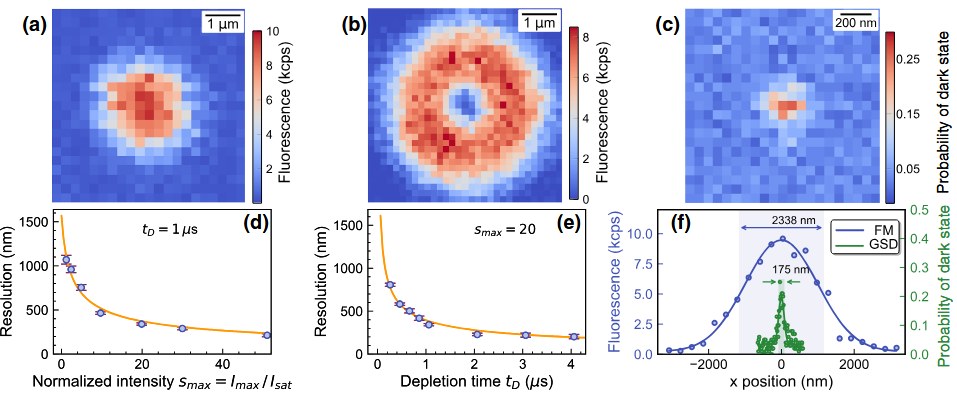
    abstract = "In cold atomic systems, fast and high-resolution microscopy of individual atoms is crucial, since it can provide direct information on the dynamics and correlations of the system. Here, we demonstrate nanosecond-scale two-dimensional stroboscopic pictures of a single trapped ion beyond the optical diffraction limit, by combining the main idea of ground-state depletion microscopy with quantum-state transition control in cold atoms. We achieve a spatial resolution up to 175 nm using a NA=0.1 objective in the experiment, which represents a more than tenfold improvement compared with direct fluorescence imaging. To show the potential of this method, we apply it to observe the secular motion of the trapped ion; we demonstrate a temporal resolution up to 50 ns with a displacement detection sensitivity of 10 nm. Our method provides a powerful tool for probing particle positions, momenta, and correlations, as well as their dynamics in cold atomic systems.",
    affiliations = "{ {CAS Key Laboratory of Quantum Information, University of Science and Technology of China, Hefei 230026, China}, {CAS Center For Excellence in Quantum Information and Quantum Physics, University of Science and Technology of China, Hefei 230026, China} }, { {{Qian, Zhong-Hua}{1,2}}, {{Cui, Jin-Ming}{1,2}}, {{Luo, Xi-Wang}{1,2}}, {{Zheng, Yong-Xiang}{1,2}}, {{Huang, Yun-Feng}{1,2}}, {{Ai, Ming-Zhong}{1,2}}, {{He, Ran}{1,2}}, {{Li, Chuan-Feng}{1,2}}, {{Guo, Guang-Can}{1,2}} }",
    copyright = "All rights reserved",
    corresauthor = "Cui, Jin-Ming and Huang, Yun-Feng and Li, Chuan-Feng",
    doi = "10.1103/PhysRevLett.127.263603",
    firstauthor = "Qian, Zhong-Hua and Cui, Jin-Ming",
    fjournal = "Physical Review Letters",
    groups = "SCI, SCI1, First/Corresponding, FirstAuthor, Journal",
    owner = "jmcui",
    timestamp = "2021-12-24",
    url = "https://link.aps.org/doi/10.1103/PhysRevLett.127.263603",
    urldate = "2021-12-24"
}
BibTeX citation
@Article{ZhangGuo2021PRA,
    author = "Zhang, Hao-Qing and Ai, Ming-Zhong and Cui, Jin-Ming and Han, Yong-Jian and Li, Chuan-Feng and Guo, Guang-Can",
    journal = "Phys. Rev. A",
    title = "Investigating the quench dynamics of the bound states in a spin-orbital-coupling system using a trapped ion",
    year = "2021",
    month = "August",
    note = "Publisher: American Physical Society",
    number = "2",
    pages = "022213",
    volume = "104",
    abstract = "The quantum walk, as the quantum analog of the classical random walk, provides a feasible platform to study the topological phenomenon and nonequilibrium dynamics. Here we propose a scheme to realize the quantum walk with a single trapped ion where the Fock states provides the walk space and the zero-phonon state {\textbar}n=0⟩ serves as its natural boundary. Thus, our scheme offers an opportunity to investigate the dynamics of the bound states of the corresponding topological systems. In particular, the quench dynamics of the bound states can be extensively studied by tuning the bulk parameters and the local boundary operator, which are experimentally accessible. Our proposal not only offers an alternative approach to exploring the character of the bound states of the topological systems, but also offers a way to determine different phases through the dynamical processes.",
    copyright = "All rights reserved",
    doi = "10.1103/PhysRevA.104.022213",
    fjournal = "Physical Review A",
    groups = "SCI, Journal",
    owner = "jmcui",
    url = "https://link.aps.org/doi/10.1103/PhysRevA.104.022213",
    urldate = "2021-12-09"
}
BibTeX citation
@Article{ZhengGuo2021OE,
    author = "Zheng, Yong-Xiang and Cui, Jin-Ming and Ai, Ming-Zhong and Qian, Zhong-hua and Cao, Huan and Huang, Yun-Feng and Jia, Xiao-Jun and Li, Chuan-Feng and Guo, Guang-Can",
    journal = "Opt. Express",
    title = "Large-tuning-range frequency stabilization of an ultraviolet laser by an open-loop piezoelectric ceramic controlled {Fabry}–{Pérot} cavity",
    year = "2021",
    issn = "1094-4087",
    month = "August",
    note = "FirstAuthor={Zheng, Yong-Xiang}; CorrespondingAuthor={ Cui, Jin-Ming; Li, Chuan-Feng}",
    number = "16",
    pages = "24674",
    volume = "29",
    abstract = "We demonstrate a laser frequency stabilization method with large tuning range to stabilize a UV laser by installing piezoelectric ceramic actuators into a Fabry–Pérot cavity with an ultra-low expansion spacer. To suppress piezoelectric drift, a two-layer symmetrical structure is adopted for the piezoelectric actuator, and a 14.7 GHz tuning range is achieved. The short-term drift of the piezoelectric ceramics caused by temperature and creep is eliminated, and the long-term drift is 0.268 MHz/h when the Fabry–Pérot cavity is sealed in a chamber without a vacuum environment. The long-term frequency drift is mainly caused by stress release and is eliminated by compensating the cavity voltage with an open loop. Without the need for an external reference or a vacuum environment, the laser frequency stabilization system is greatly simplified, and it can be extended to wavelengths ranging from ultraviolet to infrared. Owing to its simplicity, stability, and large tuning range, it is applicable in cold atom and trapped ion experiments.",
    affiliations = "{ {CAS Key Laboratory of Quantum Information, University of Science and Technology of China, Hefei 230026, China}, {CAS Center For Excellence in Quantum Information and Quantum Physics, University of Science and Technology of China, Hefei 230026, China}, {State Key Laboratory of Quantum Optics and Quantum Optics Devices, Institute of Opto-Electronics, Collaborative Innovation Center of Extreme Optics, Shanxi University, Taiyuan 030006, China} }, { {{Zheng, Yong-Xiang}{1,2}}, {{Cui, Jin-Ming}{1,2}}, {{Ai, Ming-Zhong}{1,2}}, {{Qian, Zhong-Hua}{1,2}}, {{Cao, Huan}{1,2}}, {{Huang, Yun-Feng}{1,2}}, {{Jia, Xiao-Jun}{3}}, {{Li, Chuan-Feng}{1,2}}, {{Guo, Guang-Can}{1,2}} }",
    copyright = "All rights reserved",
    corresauthor = "Cui, Jin-Ming and Huang, Yun-Feng and Li, Chuan-Feng",
    doi = "10.1364/OE.433207",
    fjournal = "Optics Express",
    groups = "SCI, SCI1, First/Corresponding, Journal",
    language = "en",
    owner = "jmcui",
    url = "https://www.osapublishing.org/abstract.cfm?URI=oe-29-16-24674",
    urldate = "2021-08-19"
}
BibTeX citation
@Article{ZhengGuo2021OEa,
    author = "Zheng, Yong-xiang and Cui, Jin-ming and Ai, Ming-zhong and Qian, Zhong-hua and Ye, Wei-ran and Huang, Yun-feng and Li, Chuan-feng and Guo, Guang-can",
    journal = "Opt. Express",
    title = "Quantum frequency conversion from ultraviolet to visible band through waveguides in a period-poled MgO:LiTaO3 crystal",
    year = "2021",
    month = "Nov",
    number = "23",
    pages = "38488--38496",
    volume = "29",
    abstract = "In research on hybrid quantum networks, visible or near-infrared frequency conversion has been realized. However, technical limitations mean that there have been few studies involving the ultraviolet band, and unfortunately the wavelengths of the rare-earth or alkaline-earth metal atoms or ions that are used widely in research on quantum information are often in the UV band. Therefore, frequency conversion of the ultraviolet band is very important. In this paper, we demonstrate a quantum frequency conversion between ultraviolet and visible wavelengths by fabricating waveguides in a period-poled MgO:LiTaO3 crystal with a laser writing system, which will be used to connect the wavelength of the dipole transition of 171Yb$+$ at 369.5 nm and the absorption wavelength of Eu3$+$ at 580 nm in a solid-state quantum memory system. An external conversion efficiency of 0.85\\% and a signal-to-noise ratio of greater than 500 are realized with a pumping power of 3.28 W at 1018 nm. Furthermore, we complete frequency conversion of the classical polarization state by means of a symmetric optical setup based on the fabricated waveguide, and the process fidelity of the conversion is (96.13 {\textpm} 0.021)\\%. This converter paves the way for constructing a hybrid quantum network and realizing a quantum router in the ultraviolet band in the future.",
    affiliations = "{ {CAS Key Laboratory of Quantum Information, University of Science and Technology of China, Hefei 230026, China}, {CAS Center For Excellence in Quantum Information and Quantum Physics, University of Science and Technology of China, Hefei 230026, China} }, { {{Zheng, Yong-Xiang}{1,2}}, {{Cui, Jin-Ming}{1,2}}, {{Ai, Ming-Zhong}{1,2}}, {{Qian, Zhong-Hua}{1,2}}, {{Ye, Wei-Ran}{1,2}}, {{Huang, Yun-Feng}{1,2}}, {{Li, Chuan-Feng}{1,2}}, {{Guo, Guang-Can}{1,2}} }",
    corresauthor = "Cui, Jin-Ming and Huang, Yun-Feng and Li, Chuan-Feng",
    doi = "10.1364/OE.439513",
    fjournal = "Optics Express",
    groups = "SCI, SCI1, First/Corresponding, Journal",
    keywords = "Laser crystals; Nonlinear optical crystals; Quantum information; Quantum memories; Quantum memory; Quantum networks",
    owner = "jmcui",
    publisher = "OSA",
    url = "http://www.osapublishing.org/oe/abstract.cfm?URI=oe-29-23-38488"
}
BibTeX citation
@Article{AiGuo2020PRA,
    author = "Ai, Ming-Zhong and Li, Sai and Hou, Zhibo and He, Ran and Qian, Zhong-Hua and Xue, Zheng-Yuan and Cui, Jin-Ming and Huang, Yun-Feng and Li, Chuan-Feng and Guo, Guang-Can",
    journal = "Phys. Rev. Appl.",
    title = "Experimental {Realization} of {Nonadiabatic} {Holonomic} {Single}-{Qubit} {Quantum} {Gates} with {Optimal} {Control} in a {Trapped} {Ion}",
    year = "2020",
    month = "November",
    note = "Publisher: American Physical Society",
    number = "5",
    pages = "054062",
    volume = "14",
    abstract = "Quantum computation with quantum gates induced by geometric phases is regarded as a promising strategy in fault-tolerant quantum computation, owing to its robustness against operational noise. However, because of the parametric restrictions in previous schemes, the main robust advantage of holonomic quantum gates is reduced. Here, we experimentally demonstrate a solution scheme, obtaining nonadiabatic holonomic single-qubit quantum gates with optimal control in a trapped 171Yb+ ion based on a three-level system with resonant driving, which also has the advantages of rapid evolution and convenient implementation. Compared with previous geometric gates and conventional dynamical gates, the superiority of our scheme is that it is more robust against control amplitude errors, which is confirmed by the gate infidelity as measured by both quantum-process tomography and random benchmarking methods. In addition, we outline how nontrivial two-qubit holonomic gates can also be realized using currently available experimental technology. Thus, our experiment confirms the feasibility of this robust and fast holonomic quantum-computation strategy.",
    copyright = "All rights reserved",
    corresauthor = "Xue, Zheng-Yuan and Cui, Jin-Ming and Huang, Yun-Feng and Li, Chuan-Feng",
    doi = "10/gjh7tw",
    fjournal = "Physical Review Applied",
    groups = "SCI, SCI1, First/Corresponding, Journal",
    owner = "jmcui",
    timestamp = "2021-03-23",
    url = "https://link.aps.org/doi/10.1103/PhysRevApplied.14.054062",
    urldate = "2021-03-23"
}
BibTeX citation
@Article{ChenGuo2020PRA,
    author = "Chen, Zhe and Cui, Jin-Ming and Ai, Ming-Zhong and He, Ran and Huang, Yun-Feng and Han, Yong-Jian and Li, Chuan-Feng and Guo, Guang-Can",
    journal = "Phys. Rev. A",
    title = "Experimentally detecting dynamical quantum phase transitions in a slowly quenched {Ising}-chain model",
    year = "2020",
    month = "October",
    note = "Publisher: American Physical Society",
    number = "4",
    pages = "042222",
    volume = "102",
    abstract = "Recently, research on nonequilibrium dynamics sparked a great amount of topics. One of particular concern is the dynamical quantum phase transition in quenched systems. In this work, we experimentally simulated the slow quenches in a quantum transverse-field Ising model crossing two quantum critical points. We studied the relationship between the appearance of the dynamical quantum phase transition and the quench rate, using the discontinuity of the dynamical topological order parameter (DTOP). In addition, an oscillation of the DTOP is also observed in our experiment. These results provide more insight into the topological aspect of the nonequilibrium dynamics.",
    corresauthor = "Cui, Jin-Ming and Huang, Yun-Feng and Han, Yong-Jian and Li, Chuan-Feng",
    doi = "10.1103/PhysRevA.102.042222",
    fjournal = "Physical Review A",
    groups = "SCI, SCI1, First/Corresponding, Journal",
    owner = "jmcui",
    timestamp = "2020-11-10",
    url = "https://link.aps.org/doi/10.1103/PhysRevA.102.042222",
    urldate = "2020-11-10"
}
BibTeX citation
@Article{CuiCampo2020CP,
    author = "Cui, Jin-Ming and G\'{o}mez-Ruiz, Fernando Javier and Huang, Yun-Feng and Li, Chuan-Feng and Guo, Guang-Can and del Campo, Adolfo",
    journal = "Commun. Phys.",
    title = "Experimentally testing quantum critical dynamics beyond the {Kibble}-{Zurek} mechanism",
    year = "2020",
    issn = "2399-3650",
    month = "March",
    note = "Number: 1 Publisher: Nature Publishing Group",
    number = "1",
    pages = "1--7",
    volume = "3",
    abstract = "Pioneered in the cosmological setting, the Kibble-Zurek mechanism (KZM) describes the universal dynamics across a phase transition, leading to the breakdown of adiabatic dynamics and the formation of topological defects. The authors present an experimental study of the universal critical dynamics of a 1D quantum Ising chain driven across the paramagnet-to-ferromagnet phase transition using a trapped-ion quantum simulator, and characterize the probability distribution of topological defects, which is found in excellent agreement with theoretical predictions.",
    affiliations = "{ {CAS Key Laboratory of Quantum Information, University of Science and Technology of China, Hefei 230026, China}, {CAS Center For Excellence in Quantum Information and Quantum Physics, University of Science and Technology of China, Hefei 230026, China}, {Donostia International Physics Center, E-20018 San Sebastian, Spain}, {Departamento de Física, Universidad de los Andes, A.A. 4976 Bogotá D. C., Colombia}, {Department of Physics, University of Massachusetts Boston, 100 Morrissey Boulevard, Boston, MA 02125, USA}, {IKERBASQUE, Basque Foundation for Science, E-48013 Bilbao, Spain}, {Theoretical Division, Los Alamos National Laboratory, MS-B213, Los Alamos, NM 87545, USA} }, { {{Cui, Jin-Ming}{1,2}}, {{Gómez-Ruiz, Fernando Javier}{3,4,5}}, {{Huang, Yun-Feng}{1,2}}, {{Li, Chuan-Feng}{1,2}}, {{Guo, Guang-Can}{1,2}}, {{del Campo, Adolfo}{3,5,6,7}} }",
    copyright = "2020 The Author(s)",
    corresauthor = "Huang, Yun-Feng and Li, Chuan-Feng and del Campo, Adolfo",
    doi = "10.1038/s42005-020-0306-6",
    groups = "SCI, SCI1, First/Corresponding, FirstAuthor, Journal",
    language = "en",
    owner = "jmcui",
    timestamp = "2021-04-01",
    url = "https://www.nature.com/articles/s42005-020-0306-6",
    urldate = "2020-03-16"
}
BibTeX citation
@Article{GaoGuo2020S,
    author = "Gao, Xin-Xia and Cui, Jin-Ming and Ai, Ming-Zhong and Huang, Yun-Feng and Li, Chuan-Feng and Guo, Guang-Can",
    journal = "Sens.",
    title = "An {Acoustic} {Sensor} {Based} on {Active} {Fiber} {Fabry}–{Pérot} {Microcavities}",
    year = "2020",
    month = "January",
    note = "Number: 20 Publisher: Multidisciplinary Digital Publishing Institute",
    number = "20",
    pages = "5760",
    volume = "20",
    abstract = "We demonstrate an active acoustic sensor based on a high-finesse fiber Fabry\\–P\\érot micro-cavity with a gain medium. The sensor is a compacted device lasing around 1535 nm by external optical pumping. The acoustic pressure acting on the sensor disturbs the emitted laser frequency, which is subsequently transformed to beat signals through a delay-arm interferometer, and directly detected by a photo-detector. In this configuration, the sensing device exhibits a high sensitivity of 2.6 V/Pa and a noise equivalent acoustic signal level of 230 \\μPa/Hz1/2 at a frequency of 4 kHz. Experimental results provide a wide frequency response from 100 Hz to 18 kHz. As the sensor works at communication wavelength and the output laser can be electrically tuned in the 10 nm range, a multi-sensor network can be easily constructed with the dense wavelength division multiplexing devices. Extra lasers or demodulators are unnecessary thus the proposed sensor is low cost and easy fabrication. The proposed sensor shows broad applications prospect in remote oil and gas leakage exploration, photo-acoustic spectrum detection, and sound source location.",
    affiliations = "{ {CAS Key Laboratory of Quantum Information, University of Science and Technology of China, Hefei 230026, China}, {CAS Center For Excellence in Quantum Information and Quantum Physics, University of Science and Technology of China, Hefei 230026, China} }, { {{Gao, Xin-Xia}{1,2}}, {{Cui, Jin-Ming}{1,2}}, {{Ai, Ming-Zhong}{1,2}}, {{Huang, Yun-Feng}{1,2}}, {{Li, Chuan-Feng}{1,2}}, {{Guo, Guang-Can}{1,2}} }",
    copyright = "http://creativecommons.org/licenses/by/3.0/",
    corresauthor = "Cui, Jin-Ming",
    doi = "10.3390/s20205760",
    fjournal = "Sensors",
    groups = "SCI, SCI1, First/Corresponding, Journal",
    keywords = "acoustic sensor, fiber Fabry–Pérot cavity, micro-laser",
    language = "en",
    owner = "jmcui",
    ranking = "rank5",
    timestamp = "2020-11-10",
    url = "https://www.mdpi.com/1424-8220/20/20/5760",
    urldate = "2020-11-10"
}
BibTeX citation
@Article{GaoGuo2020PR,
    author = "Gao, Xin-Xia and Cui, Jin-Ming and Hu, Zhi-Hao and Dong, Chun-Hua and Wang, Jian and Huang, Yun-Feng and Li, Chuan-Feng and Guo, Guang-Can",
    journal = "Photonics Res.",
    title = "Fast and wide-band tuning single-mode microlaser based on fiber {Fabry}-{Pérot} microcavities",
    year = "2020",
    issn = "2327-9125",
    month = "October",
    note = "Publisher: Optical Society of America",
    number = "10",
    pages = "1642--1647",
    volume = "8",
    abstract = "A narrow-linewidth laser operating at the telecommunications band combined with both fast and wide-band tuning features will have promising applications. Here we demonstrate a single-mode (both transverse and longitudinal mode) continuous microlaser around 1535\\&\\#x00A0;nm based on a fiber Fabry\\&\\#x2013;P\\&\\#x00E9;rot microcavity, which achieves wide-band tuning without mode hopping to the 1.3\\&\\#x00A0;THz range and fast tuning rate to 60\\&\\#x00A0;kHz and yields a frequency scan rate of 1.6\\&\\#x00D7;1017\\&\\#x2009;\\&\\#x2009;Hz/s. Moreover, the linewidth of the laser is measured as narrow as 3.1\\&\\#x00A0;MHz. As the microlaser combines all these features into one fiber component, it can serve as the seed laser for versatile applications in optical communication, sensing, frequency-modulated continuous-wave radar, and high-resolution imaging.",
    affiliations = "{ {CAS Key Laboratory of Quantum Information, University of Science and Technology of China, Hefei 230026, China}, {CAS Center for Excellence in Quantum Information and Quantum Physics, University of Science and Technology of China, Hefei 230026, China} }, { {{Gao, Xin-Xia}{1,2}}, {{Cui, Jin-Ming}{1,2}}, {{Hu, Zhi-Hao}{1,2}}, {{Dong, Chun-Hua}{1,2}}, {{Wang, Jian}{1,2}}, {{Huang, Yun-Feng}{1,2}}, {{Li, Chuan-Feng}{1,2}}, {{Guo, Guang-Can}{1,2}} }",
    copyright = "\\&\\#169; 2020 Chinese Laser Press",
    corresauthor = "Cui, Jin-Ming and Li, Chuan-Feng",
    doi = "10.1364/PRJ.400710",
    fjournal = "Photonics Research",
    groups = "SCI, SCI1, First/Corresponding, Journal",
    language = "EN",
    owner = "jmcui",
    timestamp = "2021-04-01",
    url = "https://www.osapublishing.org/prj/abstract.cfm?uri=prj-8-10-1642",
    urldate = "2020-11-10"
}
BibTeX citation
@Article{GuoChiribella2020PRL,
    author = "Guo, Yu and Hu, Xiao-Min and Hou, Zhi-Bo and Cao, Huan and Cui, Jin-Ming and Liu, Bi-Heng and Huang, Yun-Feng and Li, Chuan-Feng and Guo, Guang-Can and Chiribella, Giulio",
    journal = "Phys. Rev. Lett.",
    title = "Experimental {Transmission} of {Quantum} {Information} {Using} a {Superposition} of {Causal} {Orders}",
    year = "2020",
    month = "January",
    note = "Publisher: American Physical Society",
    number = "3",
    pages = "030502",
    volume = "124",
    abstract = "Communication in a network generally takes place through a sequence of intermediate nodes connected by communication channels. In the standard theory of communication, it is assumed that the communication network is embedded in a classical spacetime, where the relative order of different nodes is well defined. In principle, a quantum theory of spacetime could allow the order of the intermediate points between sender and receiver to be in a coherent superposition. Here we experimentally realize a tabletop simulation of this exotic possibility on a photonic system, demonstrating high-fidelity transmission of quantum information over two noisy channels arranged in a superposition of two alternative causal orders.",
    copyright = "All rights reserved",
    doi = "10.1103/PhysRevLett.124.030502",
    fjournal = "Physical Review Letters",
    groups = "SCI, Journal",
    owner = "jmcui",
    timestamp = "2021-05-04",
    url = "https://link.aps.org/doi/10.1103/PhysRevLett.124.030502",
    urldate = "2020-03-16"
}
BibTeX citation
@Article{HeGuo2020PRA,
    author = "He, Ran and Ai, Ming-Zhong and Cui, Jin-Ming and Huang, Yun-Feng and Han, Yong-Jian and Li, Chuan-Feng and Tu, Tao and Creffield, C. E. and Sierra, G. and Guo, Guang-Can",
    journal = "Phys. Rev. A",
    title = "Identifying the {Riemann} zeros by periodically driving a single qubit",
    year = "2020",
    month = "April",
    note = "Publisher: American Physical Society",
    number = "4",
    pages = "043402",
    volume = "101",
    abstract = "The Riemann hypothesis, one of the most important open problems in pure mathematics, implies the most profound secret of prime numbers. One of the most interesting approaches to solving this hypothesis is to connect the problem with the spectrum of the physical Hamiltonian of a quantum system. However, none of the proposed quantum Hamiltonians has been experimentally feasible. Here we report an experiment using a Floquet method to identify the first nontrivial zero of the Riemann ζ function and the first two zeros of Pólya's function. Through properly designed periodically driving functions, the zeros of these functions are characterized by the occurrence of crossings of quasienergies when the dynamics of the system is frozen. The experimentally obtained zeros are in good agreement with their exact values. Our study provides the experimental realization of the Riemann zeros in a quantum system, which may provide insights into the connection between the Riemann function and quantum physics.",
    affiliations = "{ {CAS Key Laboratory of Quantum Information, University of Science and Technology of China, Hefei 230026, People’s Republic of China}, {CAS Center For Excellence in Quantum Information and Quantum Physics, University of Science and Technology of China, Hefei 230026, People’s Republic of China}, {Departamento de Física de Materiales, Universidad Complutense de Madrid, 28040 Madrid, Spain}, {Instituto de Física Teórica, UAM, CSIC, 28049 Madrid, Spain} }, { {{He, Ran}{1,2}}, {{Ai, Ming-Zhong}{1,2}}, {{Cui, Jin-Ming}{1,2}}, {{Huang, Yun-Feng}{1,2}}, {{Han, Yong-Jian}{1,2}}, {{Li, Chuan-Feng}{1,2}}, {{Tu, Tao}{1,2}}, {{Creffield, C. E.}{3}}, {{Sierra, G.}{4}}, {{Guo, Guang-Can}{1,2}} }",
    corresauthor = "Cui, Jin-Ming and Huang, Yun-Feng and Han, Yong-Jian and Li, Chuan-Feng",
    doi = "10.1103/PhysRevA.101.043402",
    fjournal = "Physical Review A",
    groups = "SCI, SCI1, First/Corresponding, Journal",
    owner = "jmcui",
    timestamp = "2021-05-04",
    url = "https://link.aps.org/doi/10.1103/PhysRevA.101.043402",
    urldate = "2020-05-11"
}
BibTeX citation
@Article{HuGuo2020nQI,
    author = "Hu, Chang-Kang and Santos, Alan C. and Cui, Jin-Ming and Huang, Yun-Feng and Soares-Pinto, Diogo O. and Sarandy, Marcelo S. and Li, Chuan-Feng and Guo, Guang-Can",
    journal = "npj Quantum Inf.",
    title = "Quantum thermodynamics in adiabatic open systems and its trapped-ion experimental realization",
    year = "2020",
    issn = "2056-6387",
    month = "August",
    note = "Number: 1 Publisher: Nature Publishing Group",
    number = "1",
    pages = "1--11",
    volume = "6",
    abstract = "Quantum thermodynamics aims at investigating both the emergence and the limits of the laws of thermodynamics from a quantum mechanical microscopic approach. In this scenario, thermodynamic processes with no heat exchange, namely, adiabatic transformations, can be implemented through quantum evolutions in closed systems, even though the notion of a closed system is always an idealization and approximation. Here, we begin by theoretically discussing thermodynamic adiabatic processes in open quantum systems, which evolve non-unitarily under decoherence due to its interaction with its surrounding environment. From a general approach for adiabatic non-unitary evolution, we establish heat and work in terms of the underlying Liouville superoperator governing the quantum dynamics. As a consequence, we derive the conditions that an adiabatic open-system quantum dynamics implies in the absence of heat exchange, providing a connection between quantum and thermal adiabaticity. Moreover, we determine families of decohering systems exhibiting the same maximal heat exchange, which imply in classes of thermodynamic adiabaticity in open systems. We then approach the problem experimentally using a hyperfine energy-level quantum bit of an Ytterbium 171Yb+ trapped ion, which provides a work substance for thermodynamic processes, allowing for the analysis of heat and internal energy throughout a controllable engineered dynamics.",
    affiliations = "{ {CAS Key Laboratory of Quantum Information, University of Science and Technology of China, Hefei 230026, China}, {Shenzhen Institute for Quantum Science and Engineering, Southern University of Science and Technology, Shenzhen 518055, China}, {CAS Center For Excellence in Quantum Information and Quantum Physics, University of Science and Technology of China, Hefei 230026, China}, {Instituto de Fisica, Universidade Federal Fluminense, Av. Gal. Milton Tavares de Souza s/n, Gragoatá, Niterói, Rio de Janeiro 24210-346, Brazil}, {Instituto de Fisica de São Carlos, Universidade de São Paulo, CP 369, São Carlos, SP 13560-970, Brazil} }, { {{Hu, Chang-Kang}{1,2,3}}, {{Santos, Alan C.}{4,8}}, {{Cui, Jin-Ming}{1,3}}, {{Huang, Yun-Feng}{1,3}}, {{Soares-Pinto, Diogo O.}{5}}, {{Sarandy, Marcelo S.}{5}}, {{Li, Chuan-Feng}{1,3}}, {{Guo, Guang-Can}{1,3}} }",
    comment = "我实验室在量子热力学领域中取得重要研究进展:李传锋、黄运锋、崔金明等人与巴西合作者建立了绝热开放系统量子热力学一般公式,在量子绝热过程和热力学绝热过程之间建立了联系,并基于囚禁离子进行实验验证。该研究成果以Quantum thermodynamics in adiabatic open systems and its trapped-ion experimental realization为题8月26日发表在国际学术期刊《npj Quantum Information》上。 热力学是通过研究物质的宏观现象而得到的唯象理论,自建立以来取得了巨大的成功,在许多系统中都得到了广泛的应用。近年来量子技术的发展使得精确制备和控制量子系统成为可能,人们开始考虑一个重要的问题,即在量子尺度下热力学定律是否依然适用?量子热力学由此逐步发展起来,它旨在从量子力学微观角度研究热力学定律的产生及其极限,解决麦克斯韦妖等长期以来困扰人们的问题。同时人们也期望量子热力学能揭示出超越经典热力学范畴的新机制,从而促进科学和技术的发展。 量子绝热过程和热力学绝热过程分别是量子理论和热力学理论的重要组成部分。探讨量子绝热过程和热力学绝热过程之间的联系是量子热力学中一个非常有趣而复杂的问题。李传锋研究组与巴西合作者通过讨论开放量子系统中的热力学绝热过程,给出了热、功、内能和熵等的一般公式,明确了量子力学中的绝热动力学与量子热力学中的绝热过程一般是不相关的,热绝热性的充分条件可以由在稳态轨迹下绝热演化的量子系统满足。 为了验证以上结论,研究组采用了囚禁离子系统开展实验。囚禁离子具有相干时间长、拥有自旋及运动等多个自由度且易于操控,是进行量子信息处理的理想量子系统。然而离子和环境的耦合主要由背景磁场决定,难以实时控制,所以如何实现含时的退相干信道是实验难点所在。研究组开创性的提出了一种有效的解决方案,通过使用噪声对载波进行频率调制,很好的模拟了量子系统退相干信道,保真度优于99.5\%,由此可以在完全可控的动力学过程中分析热量和内能。而高保真的量子态调控和信道,则保证了实验结果的高度可信性。 该工作得到了审稿人的高度评价:” The present work would be one of the very few, and probably the most convincing, theoretical and experimental discussion on the relation between thermodynamical adiabatic processes and quantum adiabatic processed in open quantum systems (对于开放量子系统的热力学绝热过程和量子绝热过程之间的关系,该工作是目前为数不多的,而且可能是最有说服力的理论和实验讨论之一)”。本成果提供了一个精确研究量子热力学问题的囚禁离子实验平台。 中科院量子信息重点实验室已毕业博士研究生胡长康为论文第一作者。该工作得到了科技部、国家基金委、中国科学院、安徽省以及博士后科学基金的资助。",
    copyright = "2020 The Author(s)",
    corresauthor = "Santos, Alan C. and Cui, Jin-Ming and Huang, Yun-Feng and Li, Chuan-Feng",
    doi = "10.1038/s41534-020-00300-2",
    fjournal = "npj Quantum Information",
    groups = "SCI, SCI1, First/Corresponding, Journal",
    language = "en",
    owner = "jmcui",
    timestamp = "2021-05-06",
    url = "https://www.nature.com/articles/s41534-020-00300-2",
    urldate = "2020-11-10"
}
BibTeX citation
@Article{CuiGuo2019SB,
    author = "Cui, Jin-Ming and Ai, Ming-Zhong and He, Ran and Qian, Zhong-Hua and Qin, Xiao-Ke and Huang, Yun-Feng and Zhou, Zheng-Wei and Li, Chuan-Feng and Tu, Tao and Guo, Guang-Can",
    journal = "Science Bulletin",
    title = "Experimental demonstration of suppressing residual geometric dephasing",
    year = "2019",
    issn = "2095-9273",
    month = "September",
    number = "23",
    pages = "1757-1763",
    volume = "64",
    abstract = "The geometric phase is regarded as a promising strategy in fault tolerance quantum information processing (QIP) domain due to its phase only depending on the geometry of the path executed. However, decoherence caused by environmental noise will destroy the geometric phase. Traditional dynamic decoupling sequences can eliminate dynamic dephasing but can not reduce residual geometric dephasing, which is still vital for high-precision quantum manipulation. In this work, we experimentally demonstrate effective suppression of residual geometric dephasing with modified dynamic decoupling schemes, using a single trapped 171Yb+ ion. The experiment results show that the modified schemes can reduce dephasing rate up to more than one order of magnitude compared with traditional dynamic decoupling schemes, when residual geometric dephasing dominates. Besides, we also investigate the impact of intensity and correlation time of the low-frequency noise on coherence of the quantum system. And we confirm these methods can be used in many cases.",
    comment = "(1)在囚禁离子上实现了抑制几何相位门退相干方案。 几何相位在量子信息领域有着许多重要应用。在过去十多年中,在离子阱体系中,保真度超过容错量子计算最低阈值的几何相位门已经在实验上得以实现,其中相位消相干仍然是主要错误来源之一。因此,进一步抑制相位消相干和提高控制精度就成为容错量子计算的重要任务。相位消相干的一部分来源于动力学消相干而另一部分来源于几何消相干。动力学消相干可以通过动力学解耦合的方法抑制,然而剩余的几何消相干却难以消除。在我们的工作中,利用单个囚禁离子,首次实验演示了剩余几何消相干的抑制。通过人工加入的Ornstein-Uhlenbeck起伏场,我们研究了剩余几何消相干的行为,证明了采用我们修改后的动力学解耦合序列可以抑制剩余的几何消相干。实验上,采用新方法导致的剩余几何消相干速率比原方法降低了超过一个量级。我们的实验结果为精确量子操控和容错量子计算提供了一种潜在的方法,尤其是该方法为进一步提高几何相位门保真度提供了一条有效路径。相关工作已发表 [Sci. Bull. 64,1757(2019)]。",
    corresauthor = "Huang, Yun-Feng and Zhou, Zheng-Wei and Li, Chuan-Feng",
    doi = "10.1016/j.scib.2019.09.007",
    groups = "SCI, SCI1, First/Corresponding, FirstAuthor, Journal",
    keywords = "Berry phase, Dynamic decoupling, Geometric dephasing, Ion trap",
    timestamp = "2021-03-24",
    url = "http://www.sciencedirect.com/science/article/pii/S2095927319305481",
    urldate = "2019-10-14"
}
BibTeX citation
@Article{DingGuo2019PRA,
    author = "Ding, Zi-Han and Cui, Jin-Ming and Huang, Yun-Feng and Li, Chuan-Feng and Tu, Tao and Guo, Guang-Can",
    journal = "Phys. Rev. Appl.",
    title = "Fast High-Fidelity Readout of a Single Trapped-Ion Qubit via Machine-Learning Methods",
    year = "2019",
    month = "July",
    number = "1",
    pages = "014038",
    volume = "12",
    abstract = "In this work, we introduce machine-learning (ML) methods to implement fast and high-fidelity readout of a trapped-ion qubit on a hardware module, which is based on field-programmable gate arrays (FPGAs) and an ARM (Advanced RISC Machines) processor. An average readout fidelity of 99.5\\% (with 105 magnitude trials) within 171μs is achieved in experiments. Different ML architectures including convolutional neural networks and fully connected neural networks are implemented to compare with traditional methods, demonstrating higher fidelity and more robust readout results in a relatively short time with the proposed methods. Our hardware implementation of the proposed ML methods with FPGAs improves the readout efficiency to a higher level, through reducing the communication time between the trapped-ion system and central processing units (CPUs) in general personal computer (PCs) and the hardware can be devolved to a functional module, which is compatible with the real-time readout and feedback control of qubit states.",
    comment = "Submission Editor Letter: In this work, we introduce machine learning methods to implement fast and high-fidelity readout of a single qubit on $^{171}\mathrm{Yb^{+}}$ trapped ions with computational hardware including field-programmable gate arrays (FPGA) and an ARM processor. An average readout fidelity of 99.5\\% (with $10^5$ magnitude trials) within 171 $\mu$s is achieved in experiments, which is compatible with real-time readout and feedback control of qubit states. Different machine learning architectures including convolutional neural networks and fully-connected neural networks are implemented to compare with traditional methods, demonstrating higher fidelity and more robust readout results in a relatively short time with proposed methods. To obtain a 99\\% readout fidelity, neural networks only take half of the detection time needed by traditional threshold or maximum likelihood methods. Furthermore, our hardware implementation of proposed machine learning methods with FPGA improves the readout efficiency to a higher level, through reducing the communication time between the trapped-ion system and CPUs in general PC.",
    corresauthor = "Cui, Jin-Ming and Li, Chuan-Feng",
    doi = "10.1103/PhysRevApplied.12.014038",
    fjournal = "Physical Review Applied",
    groups = "SCI, SCI1, First/Corresponding, Journal",
    timestamp = "2021-03-25",
    url = "https://link.aps.org/doi/10.1103/PhysRevApplied.12.014038",
    urldate = "2019-10-14"
}
BibTeX citation
@Article{GaoGuo2019COL,
    author = "Gao, Xin-Xia and Cui, Jin-Ming and Huang, Yun-Feng and Li, Chuan-Feng and Guo, Guang-Can",
    journal = "Chin. Opt. Lett.",
    title = "Thermal expanded core ultraviolet fiber for optical cavity mode matching",
    year = "2019",
    issn = "1671-7694",
    month = "September",
    note = "WOS:000486571700002",
    number = "9",
    pages = "090601",
    volume = "17",
    abstract = "We have demonstrated a mode matching method between two different fibers by a hybrid thermal expanded core technique, which can be applied to match the modes of fiber-based Fabry-Perot cavities. Experimentally, this method has achieved an expansion of the ultraviolet fiber core by 3.5 times while keeping fundamental mode propagation. With the experiment parameters, the fundamental mode coupling efficiency between the fiber and micro-cavity can reach 95\\% for a plano-concave cavity with a length of 400 mu m. This method can not only have potential in quantum photonics research but also can be applied in classical optical fields.",
    corresauthor = "Cui, Jin-Ming",
    doi = "10.3788/COL201917.090601",
    groups = "SCI, SCI1, First/Corresponding, Journal",
    keywords = "diffusion, fabrication, laser, propagation characteristics",
    language = "English",
    timestamp = "2020-04-17"
}
BibTeX citation
@Article{HuSarandy2019SR,
    author = "Hu, Chang-Kang and Cui, Jin-Ming and Santos, Alan C. and Huang, Yun-Feng and Li, Chuan-Feng and Guo, Guang-Can and Brito, Frederico and Sarandy, Marcelo S.",
    journal = "Sci. Rep.",
    title = "Validation of quantum adiabaticity through non-inertial frames and its trapped-ion realization",
    year = "2019",
    issn = "2045-2322",
    month = "July",
    note = "WOS:000475845400053",
    pages = "10449",
    volume = "9",
    abstract = "Validity conditions for the adiabatic approximation are useful tools to understand and predict the quantum dynamics. Remarkably, the resonance phenomenon in oscillating quantum systems has challenged the adiabatic theorem. In this scenario, inconsistencies in the application of quantitative adiabatic conditions have led to a sequence of new approaches for adiabaticity. Here, by adopting a different strategy, we introduce a validation mechanism for the adiabatic approximation by driving the quantum system to a non-inertial reference frame. More specifically, we begin by considering several relevant adiabatic approximation conditions previously derived and show that all of them fail by introducing a suitable oscillating Hamiltonian for a single quantum bit (qubit). Then, by evaluating the adiabatic condition in a rotated non-inertial frame, we show that all of these conditions, including the standard adiabatic condition, can correctly describe the adiabatic dynamics in the original frame, either far from resonance or at a resonant point. Moreover, we prove that this validation mechanism can be extended for general multi-particle quantum systems, establishing the conditions for the equivalence of the adiabatic behavior as described in inertial or non-inertial frames. In order to experimentally investigate our method, we consider a hyperfine qubit through a single trapped Ytterbium ion Yb-171+, where the ion hyperfine energy levels are used as degrees of freedom of a two-level system. By monitoring the quantum evolution, we explicitly show the consistency of the adiabatic conditions in the non-inertial frame.",
    corresauthor = "Cui, Jin-Ming and Santos, Alan C. and Huang, Yun-Feng",
    doi = "10.1038/s41598-019-46754-z",
    groups = "SCI, SCI1, First/Corresponding, Journal",
    language = "English",
    timestamp = "2020-04-17"
}
BibTeX citation
@Article{HuGuo2019PRA,
    author = "Hu, Chang-Kang and Santos, Alan C. and Cui, Jin-Ming and Huang, Yun-Feng and Sarandy, Marcelo S. and Li, Chuan-Feng and Guo, Guang-Can",
    journal = "Phys. Rev. A",
    title = "Adiabatic quantum dynamics under decoherence in a controllable trapped-ion setup",
    year = "2019",
    month = "June",
    number = "6",
    pages = "062320",
    volume = "99",
    abstract = "Suppressing undesired nonunitary effects is a major challenge in quantum computation and quantum control. In this paper, by considering the adiabatic dynamics in the presence of a surrounding environment, we theoretically and experimentally analyze the robustness of adiabaticity in open quantum systems. More specifically, by considering a decohering scenario, we exploit the validity conditions of the adiabatic approximation as well as its sensitiveness to the resonance situation, which typically harm adiabaticity in closed systems. As an illustration, we implement an oscillating Landau-Zener Hamiltonian, which shows that decoherence may drive the resonant system with high fidelities to the adiabatic behavior of open systems. Moreover we also implement the adiabatic quantum algorithm for the Deutsch problem, where a distinction is established between the open system adiabatic density operator and the target pure state expected in the computation process. Preferred time windows for obtaining the desired outcomes are then analyzed. We experimentally realize these systems through a single trapped ytterbium ion 171Yb+, where the ion hyperfine energy levels are used as degrees of freedom of a two-level system, with both driven field and decohering strength efficiently controllable.",
    corresauthor = "Santos, Alan C. and Cui, Jin-Ming and Huang, Yun-Feng and Sarandy, Marcelo S. and Li, Chuan-Feng",
    doi = "10.1103/PhysRevA.99.062320",
    fjournal = "Physical Review A",
    groups = "SCI, SCI1, First/Corresponding, Journal",
    timestamp = "2020-04-17",
    url = "https://link.aps.org/doi/10.1103/PhysRevA.99.062320",
    urldate = "2019-12-20"
}
BibTeX citation
@Article{ChenHu2018C,
    author = "Chen, ChengKe and Mei, YingShuang and Cui, JinMing and Li, Xiao and Jiang, MeiYan and Lu, ShaoHua and Hu, XiaoJun",
    journal = "Carbon",
    title = "Man-made synthesis of ultrafine photoluminescent nanodiamonds containing less than three silicon-vacancy colour centres",
    year = "2018",
    issn = "00086223",
    month = "November",
    pages = "982--988",
    volume = "139",
    abstract = "Silicon-vacancy (SiV) centred diamond exhibits near infrared emission at 738 nm with narrower zerophonon line and shorter lifetime comparative with nitrogen-vacancy (NV) centre, considered as a promising room-temperature single-photon source. However, unlike NV centred nanodiamonds easily obtained by detonation, man-made synthesis of ultrafine SiV nanodiamonds is a key challenge. Here, we provide a controllably method for synthesizing nanodiamonds with one or few SiV emitters by reducing their size to the near minimum via oxygen plasma treatments. The size of nanodiamond is uniformly reduced from 11 to 1.7 nm under different treatment durations. It is found that nanodiamonds of a size between 2.1 and 4 nm contain fewer than three emitters. Size dependence of microstructure and photoluminescence suggests that SiV centres exist in the outer shell of nanodiamonds with diameter larger than {\textasciitilde}2 nm. This material has significant applications in nanophotonics platform, quantum communications and quantum photonics.",
    doi = "10.1016/j.carbon.2018.08.013",
    groups = "SCI, Journal",
    language = "en",
    owner = "jmcui",
    publisher = "Elsevier",
    timestamp = "2020-04-17",
    url = "https://linkinghub.elsevier.com/retrieve/pii/S0008622318307371",
    urldate = "2022-03-03"
}
BibTeX citation
@Article{CuiGuo2018APL,
    author = "Cui, Jin-Ming and Zhou, Kun and Zhao, Ming-Shu and Ai, Ming-Zhong and Hu, Chang-Kang and Li, Qiang and Liu, Bi-Heng and Peng, Jin-Lan and Huang, Yun-Feng and Li, Chuan-Feng and Guo, Guang-Can",
    journal = "Appl. Phys. Lett.",
    title = "Polarization nondegenerate fiber Fabry-Perot cavities with large tunable splittings",
    year = "2018",
    number = "17",
    pages = "171105",
    volume = "112",
    corresauthor = "Huang, Yun-Feng and Li, Chuan-Feng",
    fjournal = "Applied Physics Letters",
    groups = "SCI, SCI1, First/Corresponding, FirstAuthor, Journal",
    publisher = "AIP Publishing",
    timestamp = "2020-04-17",
    doi = "10.1063/1.5024798",
    url = "https://doi.org/10.1063/1.5024798"
}
BibTeX citation
@Article{HuGuo2018OL,
    author = "Hu, Chang-Kang and Cui, Jin-Ming and Santos, Alan C. and Huang, Yun-Feng and Sarandy, Marcelo S. and Li, Chuan-Feng and Guo, Guang-Can",
    journal = "Opt. Lett.",
    title = "Experimental implementation of generalized transitionless quantum driving",
    year = "2018",
    issn = "0146-9592, 1539-4794",
    month = "July",
    number = "13",
    pages = "3136",
    volume = "43",
    corresauthor = "Cui, Jin-Ming and Huang, Yun-Feng and Li, Chuan-Feng",
    doi = "10.1364/OL.43.003136",
    firstauthor = "Hu, Chang-Kang and Cui, Jin-Ming",
    fjournal = "Optics Letters",
    groups = "SCI, SCI1, First/Corresponding, FirstAuthor, Journal",
    language = "en",
    timestamp = "2020-04-17",
    url = "https://www.osapublishing.org/abstract.cfm?URI=ol-43-13-3136",
    urldate = "2019-10-14"
}
BibTeX citation
@Article{WangGuo2018PRA,
    author = "Wang, Jian and Huang, Yun-Feng and Zhang, Chao and Cui, Jin-Ming and Zhou, Zhi-Yuan and Liu, Bi-Heng and Zhou, Zong-Quan and Tang, Jian-Shun and Li, Chuan-Feng and Guo, Guang-Can",
    journal = "Phys. Rev. Appl",
    title = "Universal Photonic Quantum Interface for a Quantum Network",
    year = "2018",
    number = "5",
    pages = "054036",
    volume = "10",
    groups = "SCI, Journal",
    publisher = "APS",
    timestamp = "2021-05-04",
    doi = "10.1103/PhysRevApplied.10.054036",
    url = "https://doi.org/10.1103/PhysRevApplied.10.054036"
}
BibTeX citation
@Article{Xiaoothers2018OE,
    author = "Xiao, Ya and Xu, Zhen-Peng and Li, Qiang and Xu, Jin-Shi and Sun, Kai and Cui, Jin-Ming and Zhou, Zong-Quan and Su, Hong-Yi and Cabello, Ad{\'a}n and Chen, Jing-Ling and others",
    journal = "Opt. Express",
    title = "Experimental observation of quantum state-independent contextuality under no-signaling conditions",
    year = "2018",
    number = "1",
    pages = "32--50",
    volume = "26",
    fjournal = "Optics Express",
    groups = "SCI, Journal",
    publisher = "Optical Society of America",
    timestamp = "2021-05-04",
    doi = "10.1364/OE.26.000032",
    url = "https://doi.org/10.1364/OE.26.000032"
}
BibTeX citation
@Article{ZhouGuo2018APL,
    author = "Zhou, Kun and Ai, Ming-Zhong and Qian, Zhong-Hua and Gao, Xin-Xia and Hu, Zhi-Hao and Li, Qiang and Yuan, Long and Wang, Zhao and Huang, Yun-Feng and Tu, Tao and Cui, Jin-Ming and Li, Chuan-Feng and Guo, Guang-Can",
    journal = "Appl. Phys. Lett.",
    title = "High-sensitivity strain sensor with an in-fiber air-bubble Fabry-Perot interferometer",
    year = "2018",
    number = "18",
    pages = "181901",
    volume = "113",
    corresauthor = "Cui, Jin-Ming and Li, Chuan-Feng",
    fjournal = "Applied Physics Letters",
    groups = "SCI, SCI1, First/Corresponding, Journal",
    publisher = "AIP Publishing",
    timestamp = "2020-04-17",
    doi = "10.1063/1.5058200",
    url = "https://doi.org/10.1063/1.5058200"
}
BibTeX citation
@Article{ZhouGuo2017CPL,
    author = "Zhou, Kun and Cui, Jin-Ming and Huang, Yun-Feng and Wang, Zhao and Qian, Zhong-Hua and Wu, Qi-Ming and Wang, Jian and He, Ran and Lv, Wei-Min and Hu, Chang-Kang and Han, Yong-Jian and Li, Chuan-Feng and Guo, Guang-Can",
    journal = "Chin. Phys. Lett.",
    title = "An Ultraviolet Fiber Fabry-P\'{e}rot Cavity for Florescence Collection of Trapped Ions",
    year = "2017",
    number = "1",
    pages = "013701",
    volume = "34",
    corresauthor = "Huang, Yun-Feng and Han, Yong-Jian and Li, Chuan-Feng",
    doi = "10.1088/0256-307X/34/1/013701",
    eid = "013701",
    firstauthor = "Zhou, Kun and Cui,Jin-Ming",
    fjournal = "Chinese Physics Letters",
    groups = "Jounals, SCI, SCI1, First/Corresponding, FirstAuthor, Journal",
    numpages = "0",
    publisher = "Chin. Phys. Lett.",
    timestamp = "2020-04-18",
    url = "http://cpl.iphy.ac.cn/EN/abstract/article\_69326.shtml"
}
BibTeX citation
@Article{CuiGuo2016SR,
    author = "Cui, Jin-Ming and Huang, Yun-Feng and Wang, Zhao and Cao, Dong-Yang and Wang, Jian and Lv, Wei-Min and Luo, Le and Campo, Adolfo del and Han, Yong-Jian and Li, Chuan-Feng and Guo, Guang-Can",
    journal = "Sci. Rep.",
    title = "Experimental Trapped-ion Quantum Simulation of the Kibble-Zurek dynamics in momentum space",
    year = "2016",
    issn = "2045-2322",
    pages = "33381",
    volume = "6",
    corresauthor = "Luo, Le and Han, Yong-Jian and Li, Chuan-Feng",
    date = "2016-09-16",
    doi = "10.1038/srep33381",
    firstauthor = "Cui, Jin-Ming and Huang, Yun-Feng",
    fjournal = "Scientific Reports",
    groups = "SCI, SCI1, First/Corresponding, FirstAuthor, Journal",
    rights = "2016 Nature Publishing Group",
    timestamp = "2020-04-17",
    url = "https://www.nature.com/articles/srep33381",
    urldate = "2017-10-08"
}
BibTeX citation
@Article{WangHuang2016ETI,
    author = "Wang, Zhao and Luo, Le and Thadasina, Karthik and Qian, Kim and Cui, Jinming and Huang, Yunfeng",
    journal = "EPJ Tech. Instrum.",
    title = "Fabrication of ion-trap electrodes by self-terminated electrochemical etching",
    year = "2016",
    number = "1",
    pages = "3",
    volume = "3",
    fjournal = "EPJ Techniques and Instrumentation",
    groups = "Jounals, EI, Journal",
    publisher = "Springer Berlin Heidelberg",
    timestamp = "2020-04-17",
    doi = "10.1140/epjti/s40485-016-0030-5",
    url = "https://doi.org/10.1140/epjti/s40485-016-0030-5"
}
BibTeX citation
@Article{LuGuo2015PRA,
    author = "Lu, Yong and Zhang, Jian-Qi and Cui, Jin-Ming and Cao, Dong-Yang and Zhang, Shuo and Huang, Yun-Feng and Li, Chuan-Feng and Guo, Guang-Can",
    journal = "Phys. Rev. A",
    title = "Dark-state cooling of a trapped ion using microwave coupling",
    year = "2015",
    number = "2",
    pages = "023420",
    volume = "92",
    fjournal = "Physical Review A",
    groups = "Jounals, SCI, Journal",
    publisher = "APS",
    timestamp = "2021-05-04",
    doi = "10.1103/PhysRevA.92.023420",
    url = "https://doi.org/10.1103/PhysRevA.92.023420"
}
BibTeX citation
@Article{WangGuo2015PRA,
    author = "Wang, Jian and Lv, Peng-YinJie and Cui, Jin-Ming and Liu, Bi-Heng and Tang, Jian-Shun and Huang, Yun-Feng and Li, Chuan-Feng and Guo, Guang-Can",
    journal = "Phys. Rev. Appl",
    title = "Generation of Nondegenerate Narrow-Band Photon Pairs for a Hybrid Quantum Network",
    year = "2015",
    number = "6",
    pages = "064011",
    volume = "4",
    groups = "Jounals, SCI, Journal",
    publisher = "APS",
    timestamp = "2021-05-04",
    doi = "10.1103/PhysRevApplied.4.064011",
    url = "https://doi.org/10.1103/PhysRevApplied.4.064011"
}

Theses

  • 2026
  • Yilong Chen. Experimental Realization and Characterization of High-Fidelity Addressed Quantum Gates and Quantum Circuits in a Trapped-Ion System. Doctoral dissertation, University of Science and Technology of China, (2026). PDF Bibtex
  • Chen-Xu Wang. Experimental Research on Hybrid Quantum Networks Based on Trapped Ions and Solid-State Quantum Memories. Doctoral dissertation, University of Science and Technology of China, (2026). PDF Bibtex
  • 2025
  • Yan Chen. Application of tightly focused light fields in ion trap systems. Doctoral dissertation, University of Science and Technology of China, (2025). PDF Bibtex
  • Weiran Ye. Ytterbium Ion Trap Optoelectronic Measurement and Control System and Its Engineering Development. Engineering doctoral dissertation, University of Science and Technology of China, (2025). PDF Bibtex
  • 2024
  • Ding Fang. Research on Cavity Enhanced Quantum Network Nodes Based on Trapped Ions. Doctoral dissertation, University of Science and Technology of China, (2024). PDF Bibtex
  • Zhesheng Liu. Research on Laser Stability Optimization Based on Machine Learning. Master's thesis, University of Science and Technology of China, (2024). PDF Bibtex
  • 2023
  • Rui-Rui Li. Experimental Research on Quantum Control Based on High Optical-access Ion Trap. Doctoral dissertation, University of Science and Technology of China, (2023). PDF Bibtex
  • 2022
  • Xinxia Gao. Experimental research on fiber Fabry-Perot microcavity laser and its application. Doctoral dissertation, University of Science and Technology of China, (2022). PDF Bibtex
  • Yong-Xiang Zheng. Experimental study on photonic interface in hybrid quantum networks. Doctoral dissertation, University of Science and Technology of China, (2022). PDF Bibtex
  • 2021
  • Ming-Zhong Ai. Experimentally Investigation of Quantum Control Based on Trapped Ion System. Doctoral dissertation, University of Science and Technology of China, (2021). PDF Bibtex
  • Ran He. A high-optical-access ion trap and its application. Doctoral dissertation, University of Science and Technology of China, (2021). PDF Bibtex
  • Zhonghua Qian. Super-resolved imaging of trapped ions. Doctoral dissertation, University of Science and Technology of China, (2021). PDF Bibtex
  • 2019
  • Chang-Kang Hu. Experimental research on adiabatic quantum control based on trapped ion. Doctoral dissertation, University of Science and Technology of China, (2019). PDF Bibtex
  • Kun Zhou. Experimental fabrication and application research of ultra-high finesse fiber Fabry-Perot cavities. Doctoral dissertation, University of Science and Technology of China, (2019). PDF Bibtex
BibTeX citation
@PhdThesis{Chen2026PhDThesis,
    author = "Chen, Yilong",
    school = "University of Science and Technology of China",
    title = "Experimental Realization and Characterization of High-Fidelity Addressed Quantum Gates and Quantum Circuits in a Trapped-Ion System",
    year = "2026",
    date = "2026-05-25",
    type = "Doctoral dissertation",
    authorcn = "陈一龙",
    groups = "Thesis",
    language = "zh",
    schoolcn = "中国科学技术大学",
    titlecn = "离子阱高保真度寻址量子门与量子线路的实现与表征"
}
BibTeX citation
@PhdThesis{Wang2026PhDThesis,
    author = "Wang, Chen-Xu",
    school = "University of Science and Technology of China",
    title = "Experimental Research on Hybrid Quantum Networks Based on Trapped Ions and Solid-State Quantum Memories",
    year = "2026",
    date = "2026-09-23",
    type = "Doctoral dissertation",
    authorcn = "王晨旭",
    groups = "Thesis",
    language = "zh",
    schoolcn = "中国科学技术大学",
    titlecn = "基于离子阱和固态量子存储器的混合量子网络实验研究"
}
BibTeX citation
@PhdThesis{Chen2025PhDThesis,
    author = "Chen, Yan",
    school = "University of Science and Technology of China",
    title = "Application of tightly focused light fields in ion trap systems",
    year = "2025",
    type = "Doctoral dissertation",
    authorcn = "陈炎",
    groups = "Thesis",
    language = "zh",
    schoolcn = "中国科学技术大学",
    titlecn = "紧聚焦光场在离子阱系统中的应用"
}
BibTeX citation
@PhdThesis{Ye2025PhDThesis,
    author = "Ye, Weiran",
    school = "University of Science and Technology of China",
    title = "Ytterbium Ion Trap Optoelectronic Measurement and Control System and Its Engineering Development",
    year = "2025",
    type = "Engineering doctoral dissertation",
    authorcn = "叶蔚然",
    groups = "Thesis",
    language = "zh",
    schoolcn = "中国科学技术大学",
    titlecn = "镱离子阱光电测控系统的研制及其工程化探索"
}
BibTeX citation
@PhdThesis{Fang2024PhDThesis,
    author = "Fang, Ding",
    school = "University of Science and Technology of China",
    title = "Research on Cavity Enhanced Quantum Network Nodes Based on Trapped Ions",
    year = "2024",
    type = "Doctoral dissertation",
    authorcn = "房鼎",
    groups = "Thesis",
    language = "zh",
    schoolcn = "中国科学技术大学",
    titlecn = "基于被囚禁离子的腔增强量子网络节点研究"
}
BibTeX citation
@MastersThesis{Liu2024MastersThesis,
    author = "Liu, Zhesheng",
    school = "University of Science and Technology of China",
    title = "Research on Laser Stability Optimization Based on Machine Learning",
    year = "2024",
    type = "Master's dissertation",
    authorcn = "刘哲生",
    groups = "Thesis",
    language = "zh",
    schoolcn = "中国科学技术大学",
    titlecn = "基于机器学习的激光稳定优化研究"
}
BibTeX citation
@PhdThesis{Li2023PhDThesis,
    author = "Li, Rui-Rui",
    school = "University of Science and Technology of China",
    title = "Experimental Research on Quantum Control Based on High Optical-access Ion Trap",
    year = "2023",
    type = "Doctoral dissertation",
    authorcn = "李睿睿",
    groups = "Thesis",
    language = "zh",
    schoolcn = "中国科学技术大学",
    titlecn = "基于高通光离子阱的量子操控实验研究"
}
BibTeX citation
@PhdThesis{Gao2022PhDThesis,
    author = "Gao, Xinxia",
    school = "University of Science and Technology of China",
    title = "Experimental research on fiber Fabry-Perot microcavity laser and its application",
    year = "2022",
    type = "Doctoral dissertation",
    authorcn = "高新霞",
    groups = "Thesis",
    language = "zh",
    schoolcn = "中国科学技术大学",
    titlecn = "光纤法珀微腔激光器及其应用的实验研究"
}
BibTeX citation
@PhdThesis{Zheng2022PhDThesis,
    author = "Zheng, Yong-Xiang",
    school = "University of Science and Technology of China",
    title = "Experimental study on photonic interface in hybrid quantum networks",
    year = "2022",
    type = "Doctoral dissertation",
    authorcn = "郑永祥",
    groups = "Thesis",
    language = "zh",
    schoolcn = "中国科学技术大学",
    titlecn = "混合量子网络中的光子接口实验研究"
}
BibTeX citation
@PhdThesis{Ai2021PhDThesis,
    author = "Ai, Ming-Zhong",
    school = "University of Science and Technology of China",
    title = "Experimentally Investigation of Quantum Control Based on Trapped Ion System",
    year = "2021",
    type = "Doctoral dissertation",
    authorcn = "艾铭忠",
    groups = "Thesis",
    language = "zh",
    schoolcn = "中国科学技术大学",
    titlecn = "基于离子阱系统的量子控制实验研究"
}
BibTeX citation
@PhdThesis{He2021PhDThesis,
    author = "He, Ran",
    school = "University of Science and Technology of China",
    title = "A high-optical-access ion trap and its application",
    year = "2021",
    type = "Doctoral dissertation",
    authorcn = "贺冉",
    groups = "Thesis",
    language = "zh",
    schoolcn = "中国科学技术大学",
    titlecn = "高通光离子阱的搭建和应用"
}
BibTeX citation
@PhdThesis{Qian2021PhDThesis,
    author = "Qian, Zhonghua",
    school = "University of Science and Technology of China",
    title = "Super-resolved imaging of trapped ions",
    year = "2021",
    type = "Doctoral dissertation",
    authorcn = "钱忠华",
    groups = "Thesis",
    language = "zh",
    schoolcn = "中国科学技术大学",
    titlecn = "囚禁离子的超分辨成像研究"
}
BibTeX citation
@PhdThesis{Hu2019PhDThesis,
    author = "Hu, Chang-Kang",
    school = "University of Science and Technology of China",
    title = "Experimental research on adiabatic quantum control based on trapped ion",
    year = "2019",
    type = "Doctoral dissertation",
    authorcn = "胡长康",
    groups = "Thesis",
    language = "zh",
    schoolcn = "中国科学技术大学",
    titlecn = "基于囚禁离子系统的绝热量子调控实验研究"
}
BibTeX citation
@PhdThesis{Zhou2019PhDThesis,
    author = "Zhou, Kun",
    school = "University of Science and Technology of China",
    title = "Experimental fabrication and application research of ultra-high finesse fiber Fabry-Perot cavities",
    year = "2019",
    type = "Doctoral dissertation",
    authorcn = "周坤",
    groups = "Thesis",
    language = "zh",
    schoolcn = "中国科学技术大学",
    titlecn = "超高精细度光纤法珀微腔的实验制备与应用研究"
}