Quantum gates & phonons
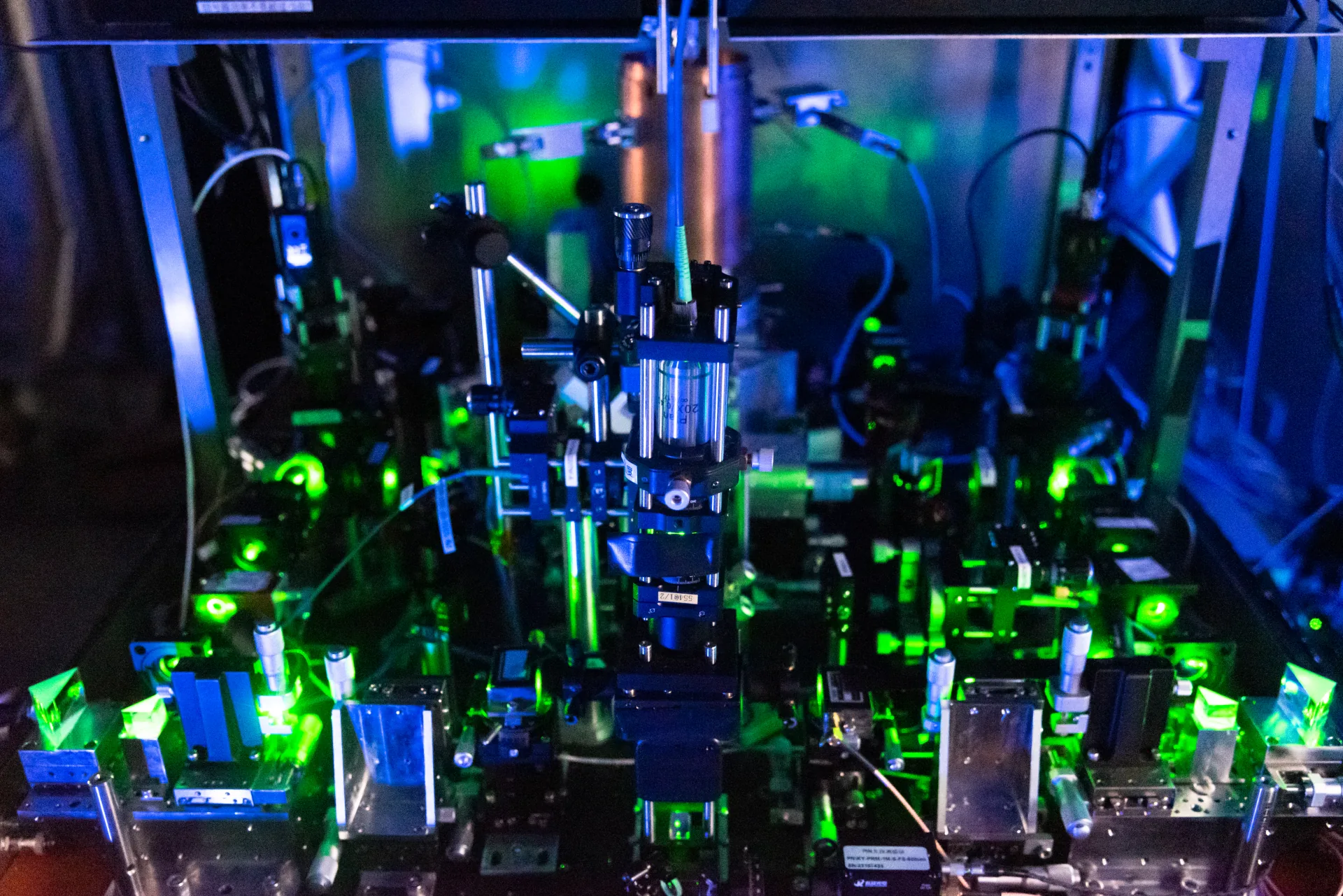
Use tightly focused light to control ions, implement high-fidelity quantum logic gates and shape their motional modes.
USTC IONQNET GROUP
Undergraduate research & postdoctoral opportunities
Store and process quantum information with ions. Connect quantum nodes with photons. Join us in bringing quantum networks and distributed quantum computing into practical use.
OUR RESEARCH
Use tightly focused light to control ions, implement high-fidelity quantum logic gates and shape their motional modes.
Enhance ion–photon interactions to develop quantum-network interfaces that combine high efficiency with high bandwidth.
Use quantum frequency conversion to connect ion processors with solid-state quantum memories across physical platforms.
01 / CURRENT USTC UNDERGRADUATES
We welcome USTC students in Years 1–4. Together, we will choose a project suited to your background, interests and stage of study, building research experience through concrete problems.
Start with literature surveys, numerical simulations, data analysis or experimental control programming. Gradually take part in optical alignment, instrument testing and quantum experiments, developing physical intuition and problem-solving skills along the way.
Our group is at an important stage of development, and we welcome inventive researchers who can turn ideas into experiments. With sufficient personnel, we will consider exploring optical-tweezer-controlled hybrid systems of cold atoms and ions, including ultracold collisions and chemical reactions between a single ion and neutral atoms.
02 / POSTDOCTORAL OPPORTUNITIES
We welcome early-career researchers interested in experimental trapped-ion quantum information to help advance quantum computing nodes, microcavity photonic interfaces and hybrid quantum networks.
Develop research questions, build and improve experimental systems, and investigate quantum control and measurement methods. Work with us to turn ideas into experimental tests across the group’s research directions.
We value independent thinking, strong experimental skills and open scientific discussion. We also welcome new ideas that connect with our research.
NEXT STEP
Tell us about your background, research interests and availability for the opportunity that interests you.
Subject: Undergraduate research — Name — Year
Contact the research mentorSubject: Postdoctoral application — Name — Research area
Enquire about postdoctoral research