We develop fiber microcavities for ion–photon quantum interfaces that combine high bandwidth with high efficiency. Efficiency increases the probability of obtaining a usable photon in each remote-entanglement attempt, while bandwidth supports rapid photon output. Together, they determine a node’s ability to communicate. Our approach brings optical design, in-house fiber-cavity fabrication, and ion-trap integration together to build Ba⁺-ion nodes for quantum networks.
Combining efficiency with bandwidth
The short length and small mode volume of a fiber Fabry–Pérot cavity increase ion–cavity coupling. This allows useful Purcell enhancement to be maintained at a suitable, larger cavity linewidth that supports rapid photon output. We jointly optimize the mode volume, mirror transmission, and fiber coupling to direct ion emission into a selected optical mode and extract it efficiently into a fiber. Our node design in JUSTC (2023) brings photon extraction, the trapping potential, and mechanical stability into the same framework, defining a system architecture that targets both high efficiency and high bandwidth.
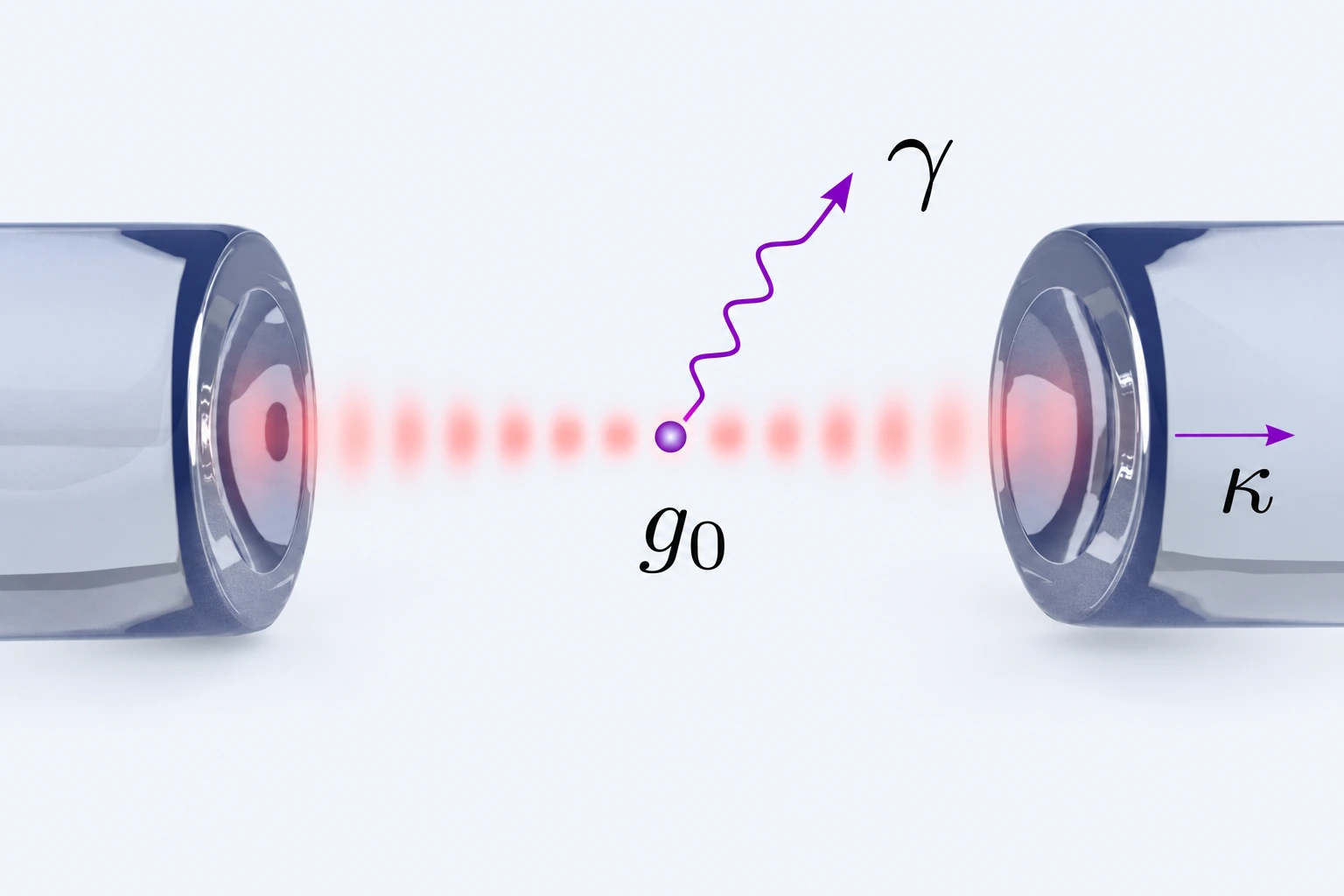
An ion interacts with the field between two fiber mirrors. The cavity directs emission into an optical mode that connects the ion to a fiber channel.
Fiber-cavity fabrication and mode matching
Microcavity performance depends on the mirror profile and its match to the fiber mode. We developed CO₂-laser machining of concave fiber end faces and fabricated an ultraviolet fiber cavity for the fluorescence wavelength of Yb⁺ ions, reported in Chinese Physics Letters (2017). We subsequently introduced an arc-discharge method for shaping photonic-crystal fiber end faces, published in Optics Express (2024). This method produces large, smooth concave surfaces aligned with the fiber core, expanding the available geometries for open-access microcavities.
To reduce the loss between the cavity mode and the transmission fiber, we also developed a thermally expanded-core technique for ultraviolet fibers, reported in Chinese Optics Letters (2019). It enlarges the fiber mode while preserving fundamental-mode propagation. These capabilities allow mirror fabrication, optical confinement, and output coupling to be designed around the same interface requirements.
From a microcavity to an ion network node
Bringing the mirrors close to an ion increases the coupling, but also exposes the ion to surface charging and electric-field noise from nearby dielectrics. We developed metal-shielded fiber mirrors that cover the fiber sides and the outer part of each end face, leaving the central optical aperture open. The metal layer provides electrical shielding and allows the mirrors to serve as trap electrodes. This approach connects microcavity fabrication directly with ion-trap design.
Using these mirrors in a needle-trap geometry, we achieved stable single-ion trapping inside a fiber cavity. The measured heating rate was reduced by more than an order of magnitude relative to unshielded configurations. This work in Quantum Science and Technology (2026) establishes a practical way to place ions near optical microstructures while limiting the accompanying motional heating.
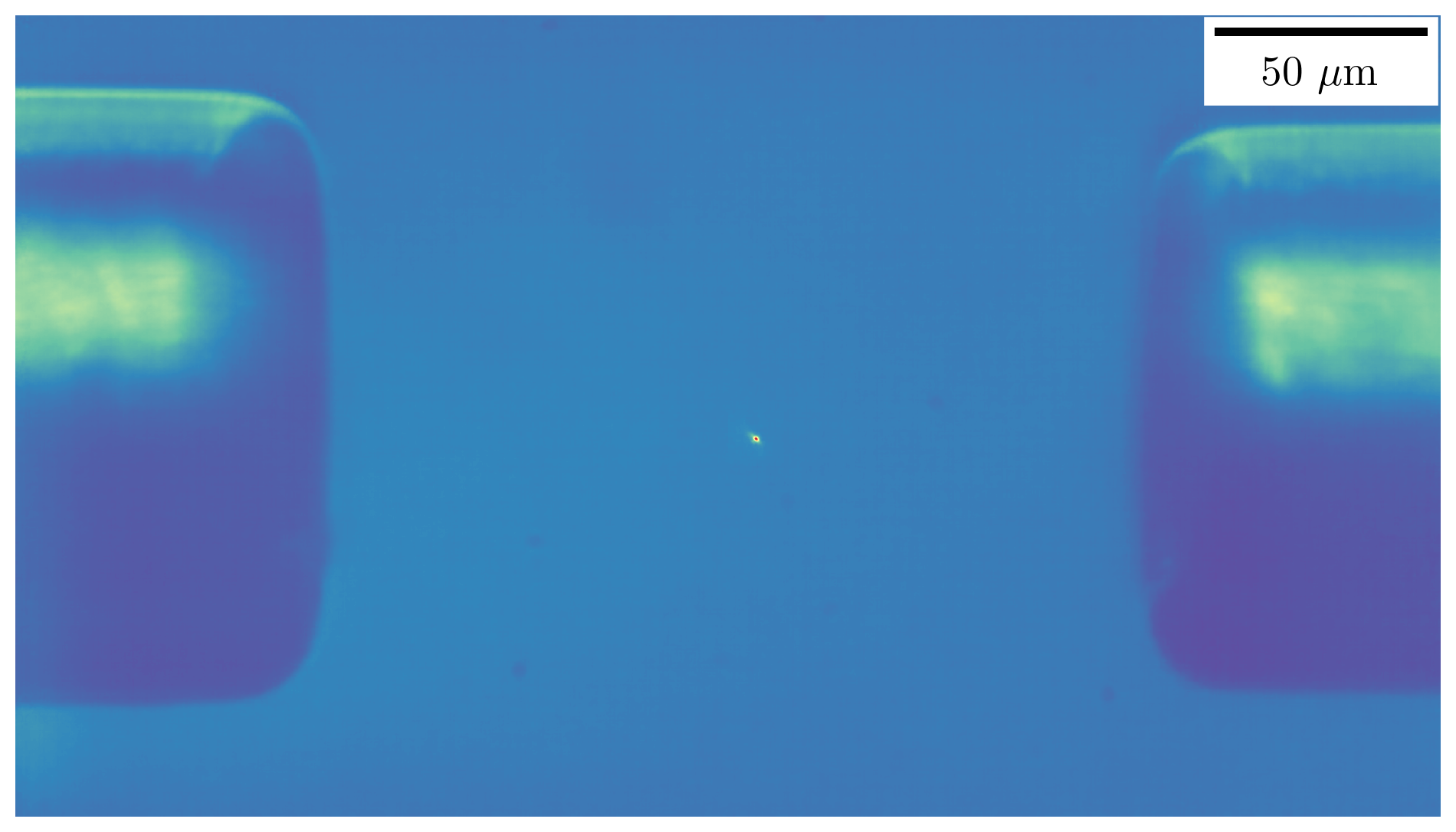
A fluorescence image of a single Ba⁺ ion between the fiber mirrors. Scale bar: 50 μm.
Reliable photon generation also requires a cavity that stays on resonance and can be tuned when needed. We developed a stable, fast-tunable microcavity combining passive vibration isolation with active cavity-length stabilization, reported in Chinese Optics Letters (2025). These capabilities provide the frequency control needed to operate the interface over extended measurements.
We also demonstrated two cavity-assisted thermometry methods, published in Physical Review Applied (2025), using the spatial dependence and second-order correlations of cavity emission to diagnose ion motion and optimize cooling. From microcavity fabrication and fiber output to low-heating trapping and stable cavity control, these technologies support our development of high-bandwidth, high-efficiency interfaces for remote ion entanglement and modular quantum networks.