We build quantum interfaces between trapped ions and other physical systems, using the long coherence times and high-fidelity control of ions as a foundation. In a hybrid network, each node contributes complementary capabilities: ions perform precise quantum operations, solid-state memories buffer photonic states, and neutral-atom arrays offer another scalable processing platform. Starting from ion–photon entanglement, we address differences in wavelength, bandwidth and encoding to develop distributed quantum computing across physical systems.
Coherent ion nodes for local control and remote entanglement
An ion node must preserve spin coherence while a photon is transmitted, stored and retrieved, while supporting high-fidelity operations on the qubit retained locally. Our modular ytterbium-ion platform combines high optical access, active and passive magnetic shielding, microwave control and high-numerical-aperture photon collection. These capabilities support stable operation and joint measurements across laboratories. Following picosecond-pulse excitation, spontaneous emission entangles the ion spin with the polarization of a photon. This resource extends local quantum control into an optical channel and provides the starting point for connecting different types of nodes.
A polarization-preserving interface from ions to crystals
The 369.5 nm ultraviolet emission of ytterbium ions is far from the 580 nm storage transition of europium-doped yttrium orthosilicate (Eu:YSO). We first demonstrated ultraviolet-to-visible frequency conversion in periodically poled MgO:LiTaO₃ waveguides (Optics Express, 2021), then developed a polarization-preserving interface. A long-wavelength pump at 1018 nm reduces conversion noise, a Sagnac loop stabilizes the relative phase of the polarization components, and off-axis parabolic mirrors provide achromatic coupling across the wavelength bands (Chinese Optics Letters, 2026). We subsequently verified entanglement between the ion and the converted photon, establishing that the interface can carry quantum correlations between dissimilar nodes.
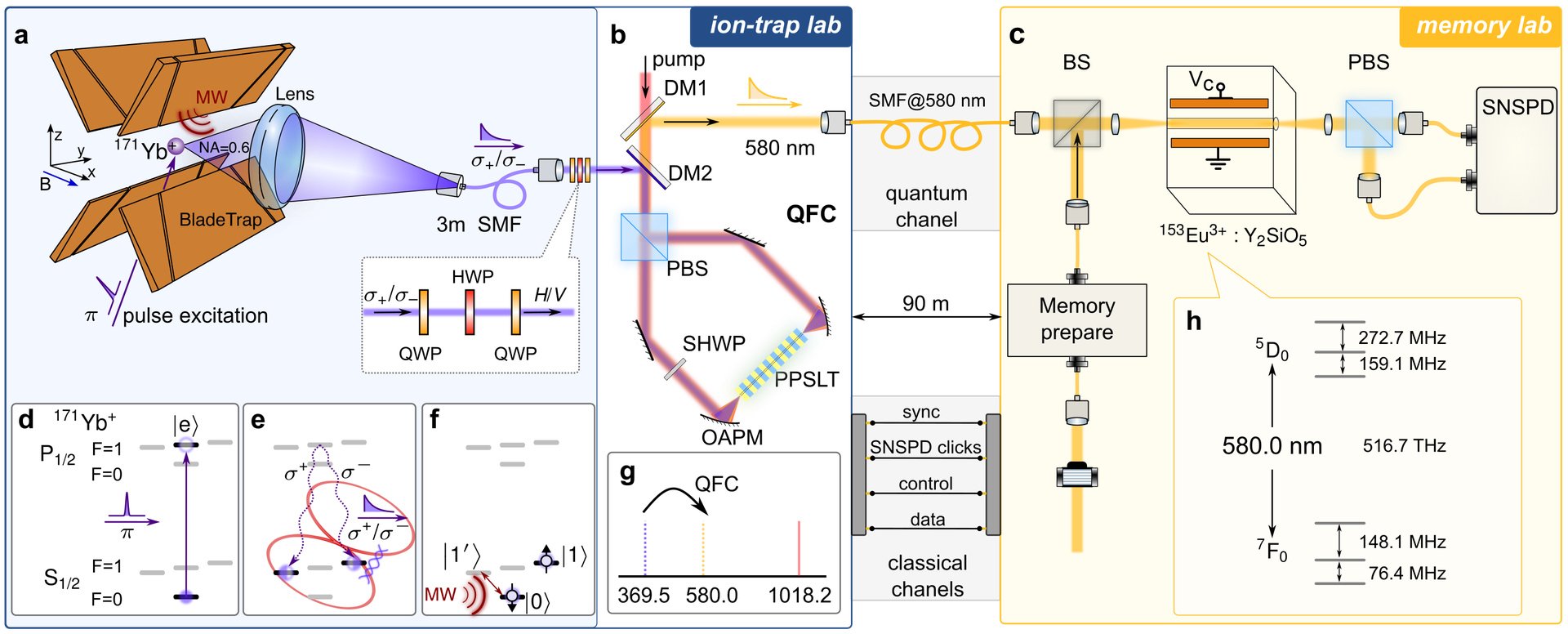
The link combines a ytterbium-ion node, a polarization-preserving frequency converter and a Eu:YSO memory. The laboratories are separated by 75 m and connected by 90 m of single-mode fiber. Classical channels coordinate timing and joint measurements.
Ion–memory entanglement across laboratories
Working with Professor Zong-Quan Zhou’s team, we connected the ion node to a solid-state quantum memory to establish a prototype hybrid quantum network. The converted photon’s quantum state is mapped onto a collective excitation in the crystal. A Stark-modulated atomic frequency comb then enables electrical pulses to select discrete retrieval times. This process transfers ion–photon entanglement into entanglement between the ion and the remote memory node.
After 1 μs of storage, joint measurements reconstructed an entangled state with a fidelity of 89.2 ± 2.3%. A CHSH test conditioned on successful photon detection yielded S = 2.328 ± 0.054, exceeding the classical bound by approximately six standard deviations. The experiment demonstrates that quantum correlations survive the complete heterogeneous link through the ion trap, frequency converter, optical fiber and solid-state memory, providing an experimental foundation for processing and memory nodes to work together.
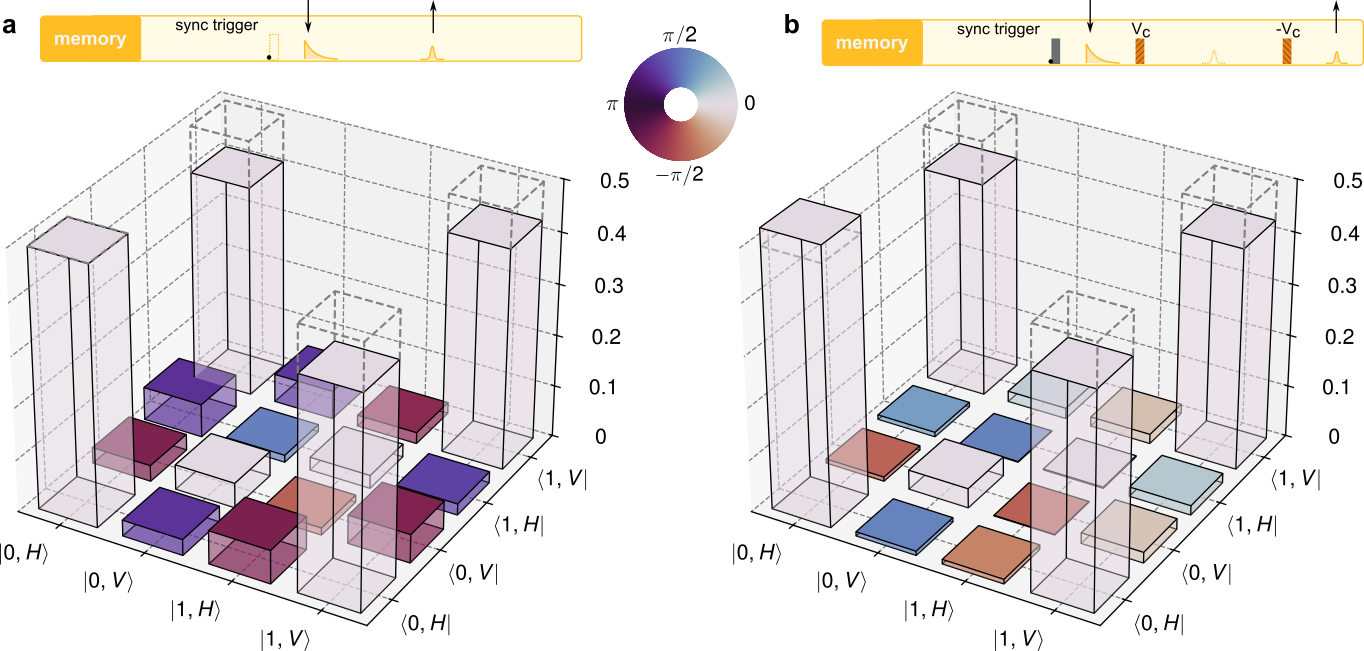
Reconstructed ion–memory density matrices for storage times of 0.5 μs and 1 μs. Dashed outlines indicate the ideal Bell state. Joint measurements of the retrieved photon and ion spin verify entanglement after storage.
Experimental source: Chen-Xu Wang, PhD thesis, “Experimental Research on Hybrid Quantum Networks Based on Trapped Ions and Solid-State Quantum Memories” (2026), Chapters 4–6.
Towards quantum computing across physical systems
Our next steps combine cavity-enhanced photon collection, more efficient frequency conversion and multimode storage to increase heterogeneous entanglement rates and develop quantum-state transfer and operations between nodes. Building on the solid-state memory interface, we also plan to develop interfaces between trapped ions and neutral atoms. Combining long ion coherence and high-fidelity operations with scalable neutral-atom arrays will allow us to explore distributed architectures in which different physical systems jointly execute quantum tasks.