Tightly focused light is our central tool for building trapped-ion quantum processors. Starting with low-crosstalk addressing from both sides of the trap, we have developed addressed Raman entangling gates based on the optical Magnus effect that require optical access from only one side. We combine this approach with in-situ aberration correction, axial motional modes and optical-tweezer control of phonons to pursue high-fidelity, flexible operations in larger ion crystals.
Low-crosstalk addressing with two focused beams
We first demonstrated a dual-sided Raman addressing scheme in which two counter-propagating beams are tightly focused onto the target ion, suppressing unwanted driving of spectator ions. Objectives and acousto-optic deflectors on both sides of the trap allow the spots to follow the nonuniform positions of ions in a chain. At an ion spacing of approximately 5.5 μm, we measured a spectator-to-target Rabi-frequency ratio of 1.19(5) × 10⁻³. This corresponds to an estimated unwanted-excitation probability on the 10⁻⁶ scale for a π pulse on the target ion, providing a basis for meeting the low-crosstalk requirements of fault-tolerant quantum computing. The result was reported in Physical Review Applied 22, 054003 (2024).
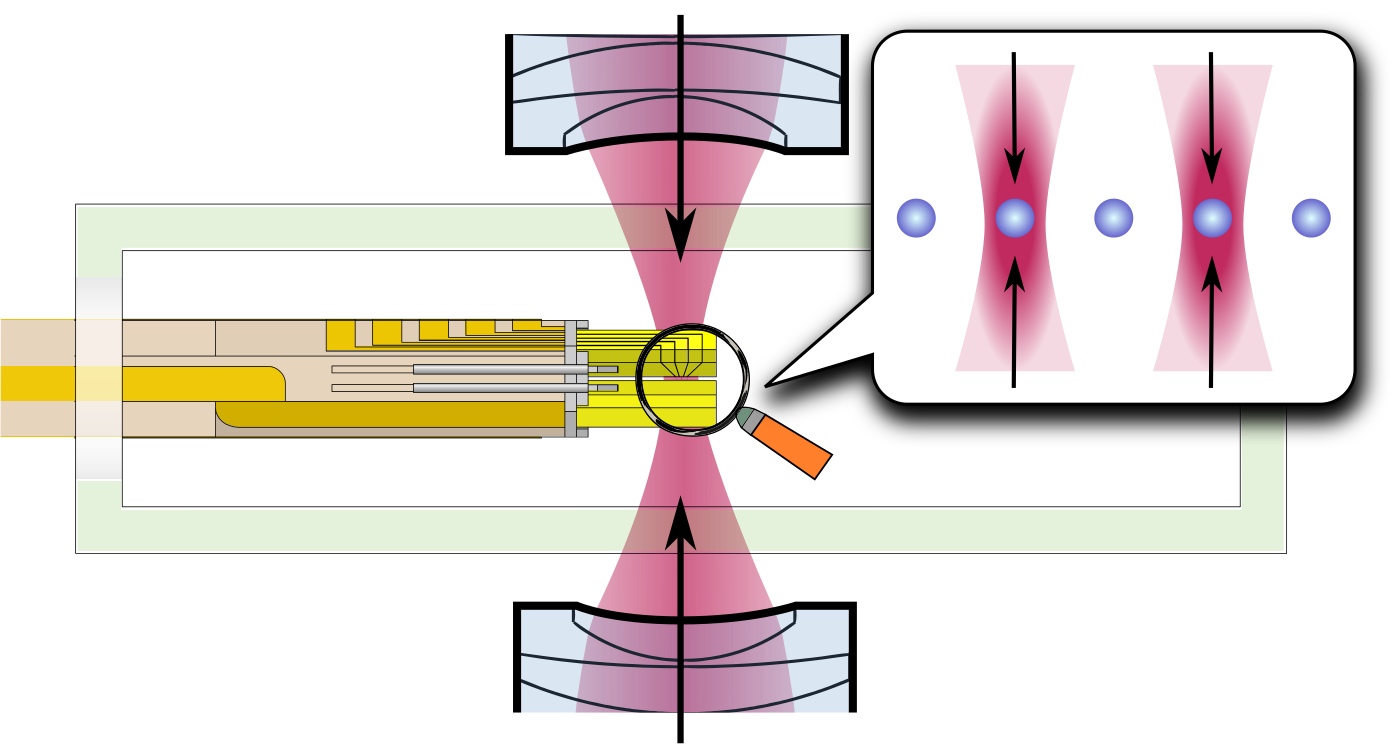
Two counter-propagating Raman beams are tightly focused onto a selected ion to suppress driving of its neighbours. Acousto-optic deflectors control the addressing positions.
Simplifying gates to single-sided addressing with the Magnus effect
Building on low-crosstalk addressing, we developed an entangling-gate scheme using the polarization gradient of tightly focused light. Focusing with a high-numerical-aperture objective introduces a longitudinal electric-field component and creates a transverse polarization gradient near the focus. This gradient allows co-propagating Raman frequency components to generate a spin-dependent force. The addressing light for the gate can therefore enter from one side of the trap through a single objective. A shared optical path also supports Raman phase stability, while acousto-optic deflectors select the ion pair to be addressed.
We pioneered an experimental implementation of these addressed entangling gates based on the optical Magnus effect, reported in Physical Review Letters 135, 260604 (2025). In two- and four-ion chains, we measured Bell-state fidelities of 98.7(1)% and 97.2(4)%, respectively, after correcting for state-preparation and measurement errors.
To maintain low crosstalk with tightly focused light from one side, we also developed in-situ aberration correction using a trapped ion as a probe and a spatial light modulator to correct the wavefront. For far-detuned light, this method reduced the lowest measured spectator-to-target Rabi-frequency ratio to 0.031(4)%, as reported in In-situ aberration correction for far-detuned laser systems via a trapped ion probe, Chinese Optics Letters 24, 010201 (2026). Combining high-quality focal spots with single-sided polarization-gradient control provides a foundation for gates with low crosstalk, high fidelity and flexible addressing.
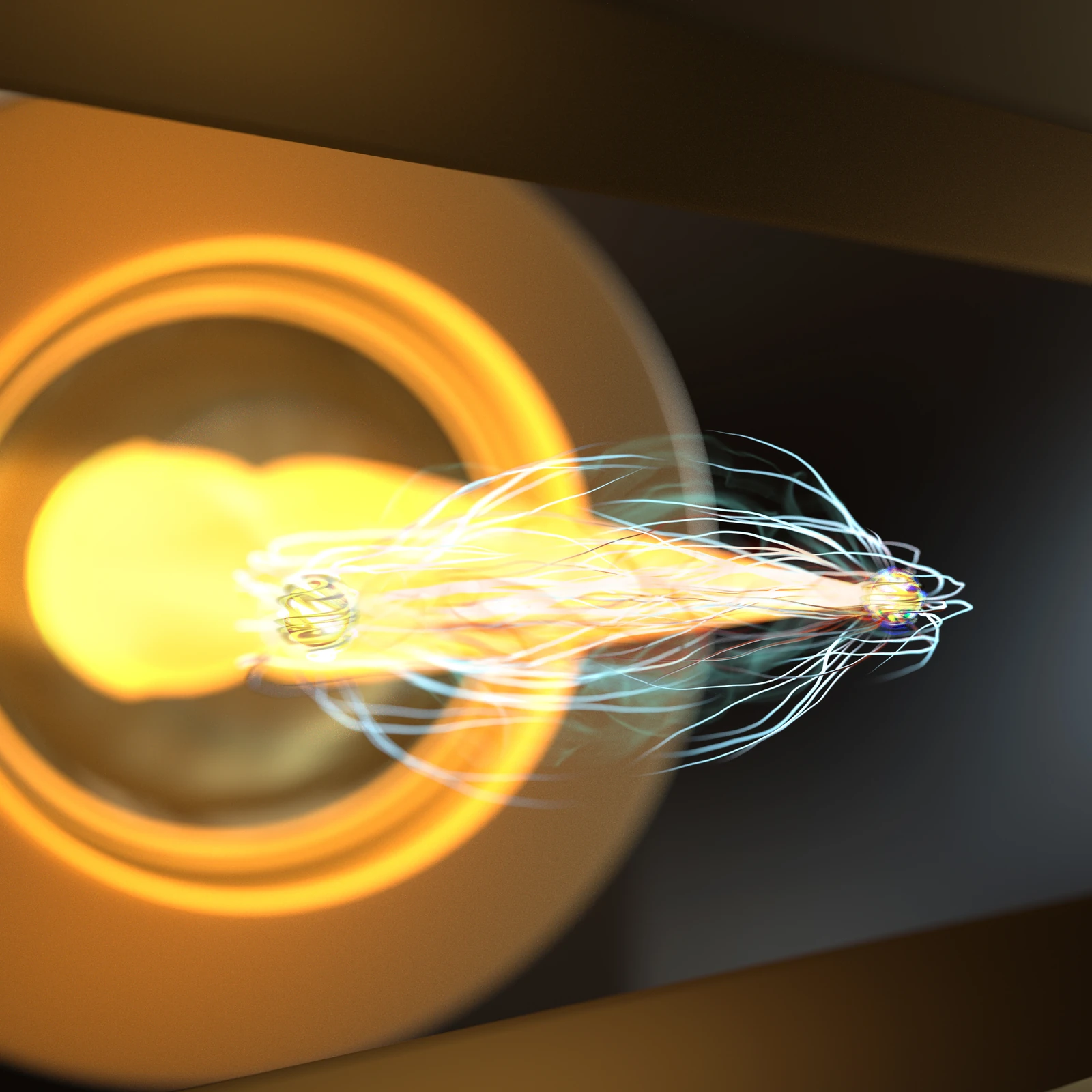
The transverse polarization gradient of focused light produces a spin-dependent force, enabling addressed entangling gates with co-propagating Raman light.
Axial modes for less crowded motional spectra
The polarization-gradient force acts perpendicular to the direction of light propagation. Light incident from the side of the chain can therefore couple to axial phonon modes along the chain. We have used axial motion to implement entangling gates while retaining independent optical addressing of the ions.
In the regime of strong radial confinement used for linear ion chains, axial modes typically have larger frequency separations than radial modes. This more widely spaced spectrum eases mode crowding. At comparable gate speeds and mode-resolution requirements, it offers room to address more ions while limiting unwanted excitation of spectator modes. Combining the simpler optical geometry, precise wavefront correction and axial-mode coupling is an important part of our approach to scaling ion processors.
Further control of crystal phonons with optical tweezers
We also use local optical-tweezer potentials to tune the effective confinement of selected ions and investigate how to reshape the frequencies and spatial structure of a crystal’s phonon modes. We have experimentally verified that optical tweezers can shift an ion’s vibrational frequency, as documented in Yan Chen’s doctoral thesis (2025), Section 4.3.3. Building on this result, we are developing phonon-mode engineering within ion crystals to strengthen the motional coupling needed by a target pair, reduce the participation of spectator modes and ions, and pursue high-fidelity entangling gates directly within the crystal.
Combining this control of crystal phonons with ion transport and operations in separate zones of a quantum charge-coupled device (QCCD) architecture is a further research direction toward more efficient trapped-ion processors.