Our work “Riemann zeros from Floquet engineering a trapped-ion qubit” was published in npj Quantum Information on July 14, 2021. This work bridges quantum physics and number theory by experimentally measuring the zeros of the Riemann zeta function using a trapped-ion quantum system.
Background
The Riemann Hypothesis, proposed by Bernhard Riemann in 1859, conjectures that all non-trivial zeros of the Riemann zeta function have their real parts equal to 1/2. As one of the seven Millennium Prize Problems, its proof would profoundly advance our understanding of prime number distribution. An intriguing approach to this problem is the Hilbert-Pólya conjecture, which proposes the existence of a quantum system whose Hamiltonian eigenvalues correspond one-to-one with the Riemann zeros.
Our Approach
We proposed, for the first time internationally, a quasi-static Hamiltonian method. By designing a periodic driving function to modulate a trapped-ion qubit, we realized quasi-static evolution of the quantum state. When the driving parameter corresponds to a Riemann zero, the engineered quasienergies become degenerate and the quantum state remains frozen at integer multiples of the driving period — a phenomenon known as coherent destruction of tunneling. This is described by Floquet theory, where the quasienergies of the periodically driven system are regulated by the driving parameters. By scanning over the driving amplitude, the locations of the Riemann zeros can be measured to a high degree of accuracy.
Results
Using our self-developed trapped-ion system with long coherence times, we implemented 30-period high-fidelity driving and successfully measured the first 80 non-trivial Riemann zeros — improving upon previous work in this field by nearly two orders of magnitude. Our experimental results provide important evidence for studying the Hilbert-Pólya conjecture and deepening the connection between the Riemann Hypothesis and quantum systems.
Reviewers commented: “I am recommending publication, for several reasons: the high level of experimental ingenuity required to make the scheme work; the clear description of theory and experiment; and the large numbers and high accuracy of the measured zeros.”
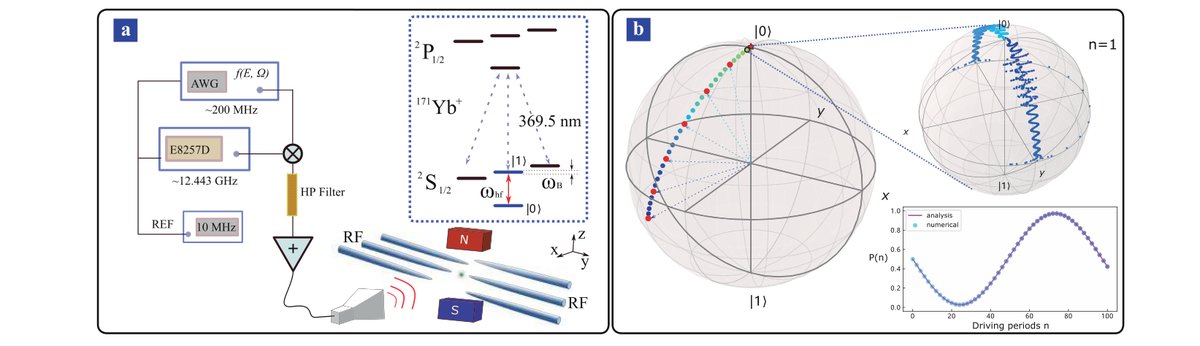
Fig. 1. Experimental procedure to measure Floquet dynamics in a trapped-ion system. (a) The qubit is periodically driven by a microwave field generated by an AWG. (b) On the Bloch sphere, the qubit is initialized to |0⟩ and evolves to U(nT)|0⟩ after n periods of driving, with the freezing of dynamics revealing the Riemann zeros.
The first author of this paper is Dr. Ran He from our laboratory. This work was supported by the Ministry of Science and Technology, NSFC, CAS, and Anhui Province.
Find the article here: https://doi.org/10.1038/s41534-021-00446-7