Our work “Quantum thermodynamics in adiabatic open systems and its trapped-ion experimental realization” has been published in npj Quantum Information. In collaboration with our Brazilian colleagues, we established general formulas for quantum thermodynamics in adiabatic open systems, bridging quantum adiabatic processes and thermodynamic adiabatic processes, and verified our theory experimentally using trapped ions.
Motivation
Thermodynamics, built upon macroscopic observations of matter, has achieved tremendous success across many systems. With the development of quantum technology enabling precise preparation and control of quantum systems, a fundamental question emerges: do the laws of thermodynamics still apply at the quantum scale? Quantum thermodynamics has thus gradually developed, aiming to study the emergence and limits of thermodynamic laws from the microscopic perspective of quantum mechanics, addressing long-standing puzzles such as Maxwell’s demon.
Key Contributions
Quantum adiabatic processes and thermodynamic adiabatic processes are fundamental components of quantum theory and thermodynamics, respectively. Exploring the relationship between them is a fascinating and complex problem. We derived general formulas for heat, work, internal energy, and entropy in open quantum systems, and established that quantum mechanical adiabaticity and thermodynamic adiabaticity are generally not equivalent — thermal adiabaticity requires a sufficient condition satisfied by quantum systems adiabatically evolving under a steady-state trajectory.
Experimental Verification
We implemented the experiment using our trapped-ion system. The trapped ion offers long coherence times, multiple controllable degrees of freedom (spin and motion), and serves as an ideal platform for quantum information processing. We developed an innovative solution to simulate time-dependent decoherence channels by using noise-modulated carrier frequency, achieving a fidelity of over 99.5% in simulating the quantum decoherence channel. This enabled us to analyze heat and internal energy in a fully controllable dynamical process with high-fidelity quantum state manipulation.
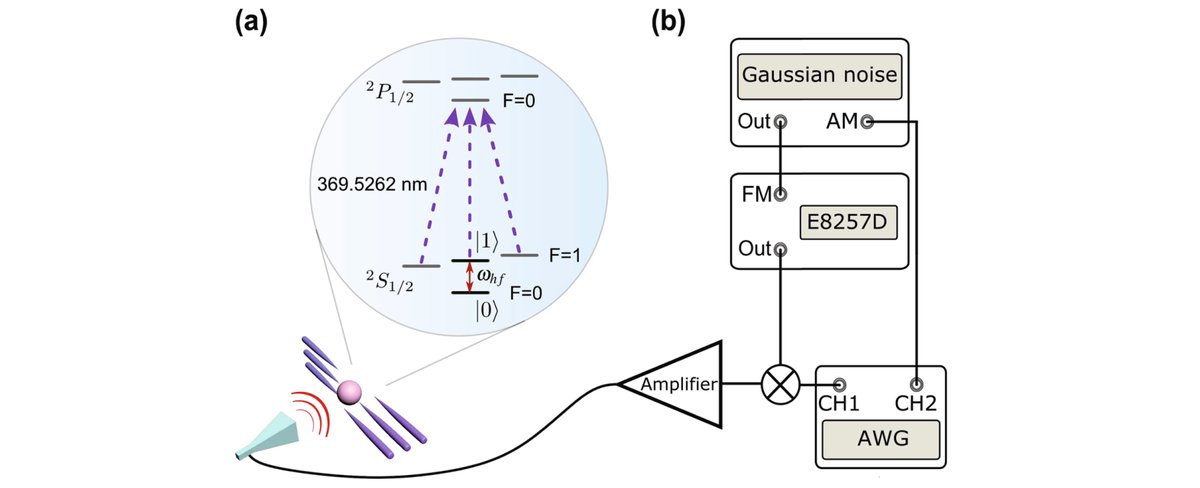
Fig. 1. Experimental scheme to investigate the thermodynamics of adiabaticity in open quantum systems. (a) Schematic of the six-needle Paul trap and relevant energy levels. (b) Experimental microwave instrument for generating the driving field and controlling the Gaussian noise as a dephasing channel.
Reviewers gave high praise: “The present work would be one of the very few, and probably the most convincing, theoretical and experimental discussion on the relation between thermodynamical adiabatic processes and quantum adiabatic processes in open quantum systems.”
The first author is Dr. Chang-Kang Hu, a former PhD student from our laboratory. This work was supported by MOST, NSFC, CAS, Anhui Province, and the Postdoctoral Science Fund.
Find the article here: https://doi.org/10.1038/s41534-020-00300-2