Our work “Experimentally testing quantum critical dynamics beyond the Kibble-Zurek mechanism” has been published in Communications Physics (Nature). Building on our earlier Kibble-Zurek experiment, we go beyond the standard KZM to probe the full probability distribution of topological defects formed during a quantum phase transition.
Beyond the Mean: Full Counting Statistics
The Kibble-Zurek mechanism (KZM) describes the universal dynamics across a phase transition, predicting that the average number of topological defects scales as a universal power law with the quench rate. However, the KZM focuses only on the mean number of defects. In this work, we aim to validate a much richer prediction: the measured distribution of kink pairs follows a Poisson binomial distribution, in which all low-order cumulants scale with universal power laws.
Quantum Simulation in Momentum Space
We experimentally probed the distribution of kink pairs in a one-dimensional quantum Ising chain driven across the paramagnet-ferromagnet quantum phase transition, using a single 171Yb+ trapped ion as a quantum simulator in momentum space. Each mode of the quantum Ising model is mapped to a Landau-Zener crossing, whose dynamics can be simulated with our ion-trap qubit. By measuring the excitation probability for each mode, we reconstruct the full counting statistics of topological defects.
Key Results
We experimentally verified the universal scaling of the first cumulants and reported deviations due to noise-induced dephasing of the trapped ion. Our results establish that the universal character of critical dynamics extends beyond KZM, from the mean kink number to the full probability distribution of topological defects — providing a much more stringent test of universality at quantum phase transitions.
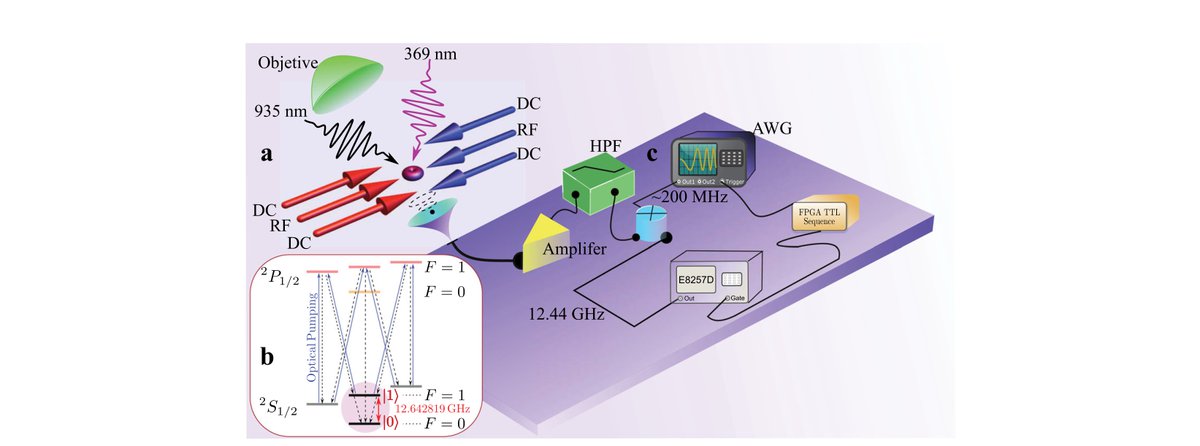
Fig. 1. Experimental setup. (a) A single 171Yb+ ion trapped in a needle trap. (b) The qubit energy levels. (c) The qubit is driven by a microwave field, with operations programmed via an arbitrary waveform generator (AWG).
This work was done in collaboration with Fernando Javier Gómez-Ruiz and Adolfo del Campo from the Donostia International Physics Center, Spain.
Find the article here: https://doi.org/10.1038/s42005-020-0306-6