Our work “Experimental demonstration of suppressing residual geometric dephasing” has been published in Science Bulletin. We experimentally demonstrate effective suppression of residual geometric dephasing — a key obstacle for high-fidelity geometric quantum gates — using modified dynamical decoupling schemes on a single trapped 171Yb+ ion.
The Problem: Residual Geometric Dephasing
The geometric phase (Berry phase) is a promising strategy for fault-tolerant quantum information processing because it depends only on the geometry of the path executed, not the dynamics. However, decoherence caused by environmental noise destroys the geometric phase. Traditional dynamical decoupling sequences such as Spin Echo (SE) and CPMG can eliminate dynamic dephasing but cannot reduce residual geometric dephasing, which remains a critical barrier for high-precision geometric quantum manipulation.
Our Solution
We designed modified dynamical decoupling schemes that carefully choose the angles of neighboring adiabatic paths on the Bloch sphere. By varying the tilt angles in the SE and CPMG sequences, we ensure that the accumulated geometric dephasing in successive segments cancels out. This is achieved through two schemes:
- Modified SE: Using different slant angles for neighboring evolution segments so that the geometric dephasing contributions cancel.
- Modified CPMG: Separating adiabatic paths into four parts with swapping π pulses, ensuring zero net geometric dephasing.
Results
Our experimental results demonstrate that the modified schemes can reduce the dephasing rate by more than one order of magnitude compared with traditional dynamical decoupling schemes in the regime where residual geometric dephasing dominates. We also investigated the impact of noise intensity and correlation time on the coherence of the quantum system, confirming that these methods are effective across a wide range of noise conditions.
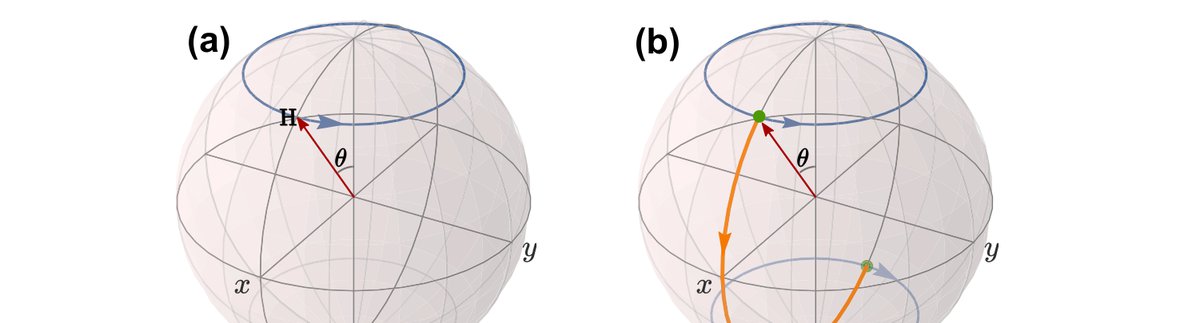
Fig. 1. Dynamics of Hamiltonian H in the Bloch sphere and corresponding geometric phase. (a) The Hamiltonian H tilted by angle θ evolves around the z axis, accumulating both dynamic and geometric phases. (b) The spin echo strategy, where the Hamiltonian rotates in opposite directions, eliminates dynamic phase and acquires pure geometric phase.
Find the article here: https://doi.org/10.1016/j.scib.2019.09.007