Our work “An Ultraviolet Fiber Fabry–Pérot Cavity for Florescence Collection of Trapped Ions” has been published in Chinese Physics Letters. We demonstrate a fiber Fabry–Pérot cavity (FFPC) operating in the ultraviolet range at 369 nm, specifically designed for enhancing fluorescence collection from trapped 171Yb+ ions — a key technology for building scalable quantum networks.
Why Fiber Cavities?
Trapped ions are an ideal platform for quantum information processing, but building a large-scale quantum computer and long-distance quantum communication requires the ability to remotely distribute entanglement between ions. The key ingredient is efficient photon collection. A fiber Fabry–Pérot cavity can provide a large Purcell factor to enhance the photon emission rate while maintaining high coupling efficiency between the single fiber mode and the cavity mode — solving the long-standing problem of low photon collection efficiency.
Technical Achievements
We designed the FFPC at the bad cavity limit for fluorescence enhancement at the 2P1/2 to 2S1/2 transition wavelength of Yb+. The concave mirror profiles on fiber-end faces were fabricated using CO2 laser machining with spatial filtering, achieving an averaged eccentricity of only 0.22 ± 0.04. The mirrors were coated for high reflection in the ultraviolet range by ion-beam sputtering, achieving a coating reflectivity of 99.76% and a finesse of 1300 ± 100.
Key Results
Based on measured experimental parameters and numerical simulation, we estimate:
- Purcell factor > 2.5
- Single-mode fiber collection efficiency > 10%
These results demonstrate the FFPC’s potential to entangle remote ions, which is the basis for constructing quantum networks and developing distributed quantum computation.
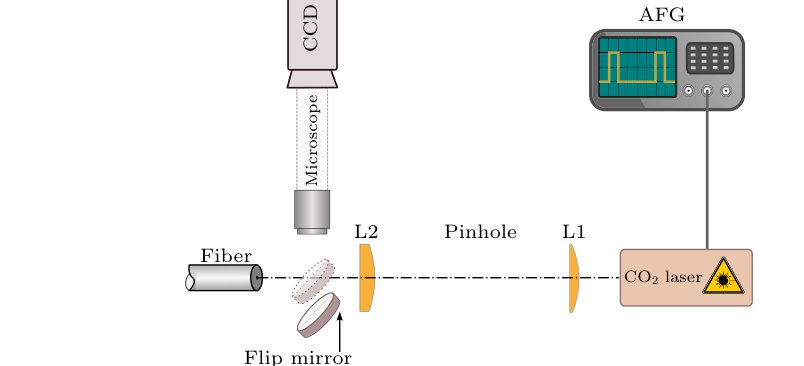
Fig. 1. Schematic diagram of the laser machining setup for fabricating FFPCs, and surface characterization of the machined fiber-end face using AFM. The setup uses a CO₂ laser with spatial filtering to produce concave mirror profiles with high circularity.
Find the article here: https://doi.org/10.1088/0256-307X/34/1/013701