Quantum control
Optical-tweezer ion gates
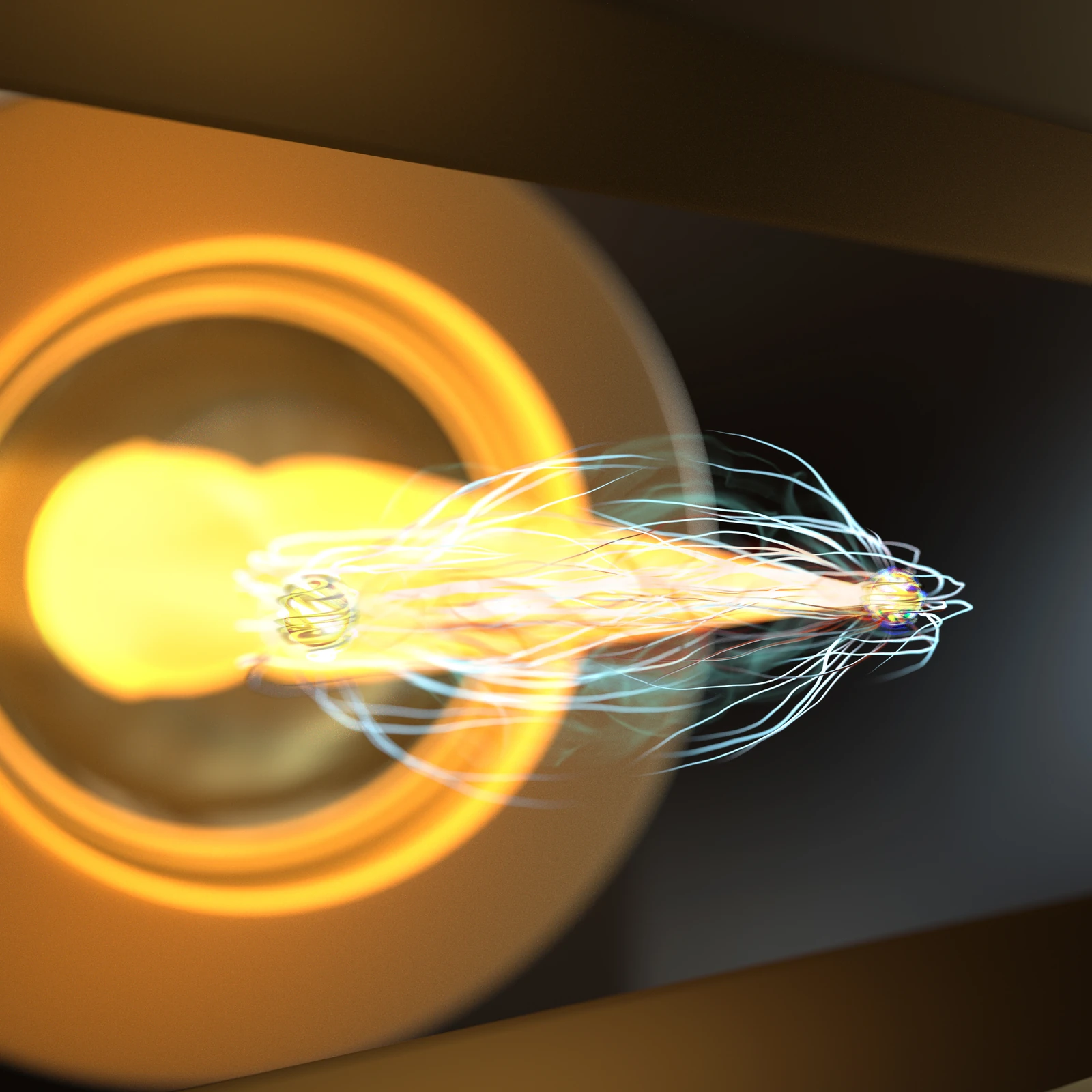
Addressed gates with the optical Magnus effect
Tightly focused light provides more than a small addressing spot: its spatially varying polarization offers a new way to couple an ion’s spin to its motion. Using the optical Magnus effect, we implemented addressed entangling gates driven by co-propagating Raman light through a single objective. This geometry simplifies the optical interface while retaining flexible selection of the ions involved in the gate.
The work was reported in Physical Review Letters 135, 260604 (2025). After correcting for state-preparation and measurement errors, the measured Bell-state fidelities were 98.7(1)% in a two-ion chain and 97.2(4)% in a four-ion chain.
From precise addressing to phonon control
We combine single-sided polarization-gradient control with in-situ aberration correction and coupling to axial motional modes. Optical tweezers also provide local potentials for tuning ion motion; building on demonstrated control of an ion’s vibrational frequency, we are developing ways to reshape phonon modes within ion crystals and reduce unwanted motional crosstalk.