Our work “Transverse Polarization Gradient Entangling Gates for Trapped-Ion Quantum Computation” has been published in Physical Review Letters as an Editors’ Suggestion on December 24, 2025.
We realized high-fidelity entangling gates for trapped ions based on the polarization gradient of tightly focused light. This scheme simplifies the current entangling gate configuration and is compatible with the optical tweezer architecture, holding great significance for large-scale trapped-ion quantum computation.
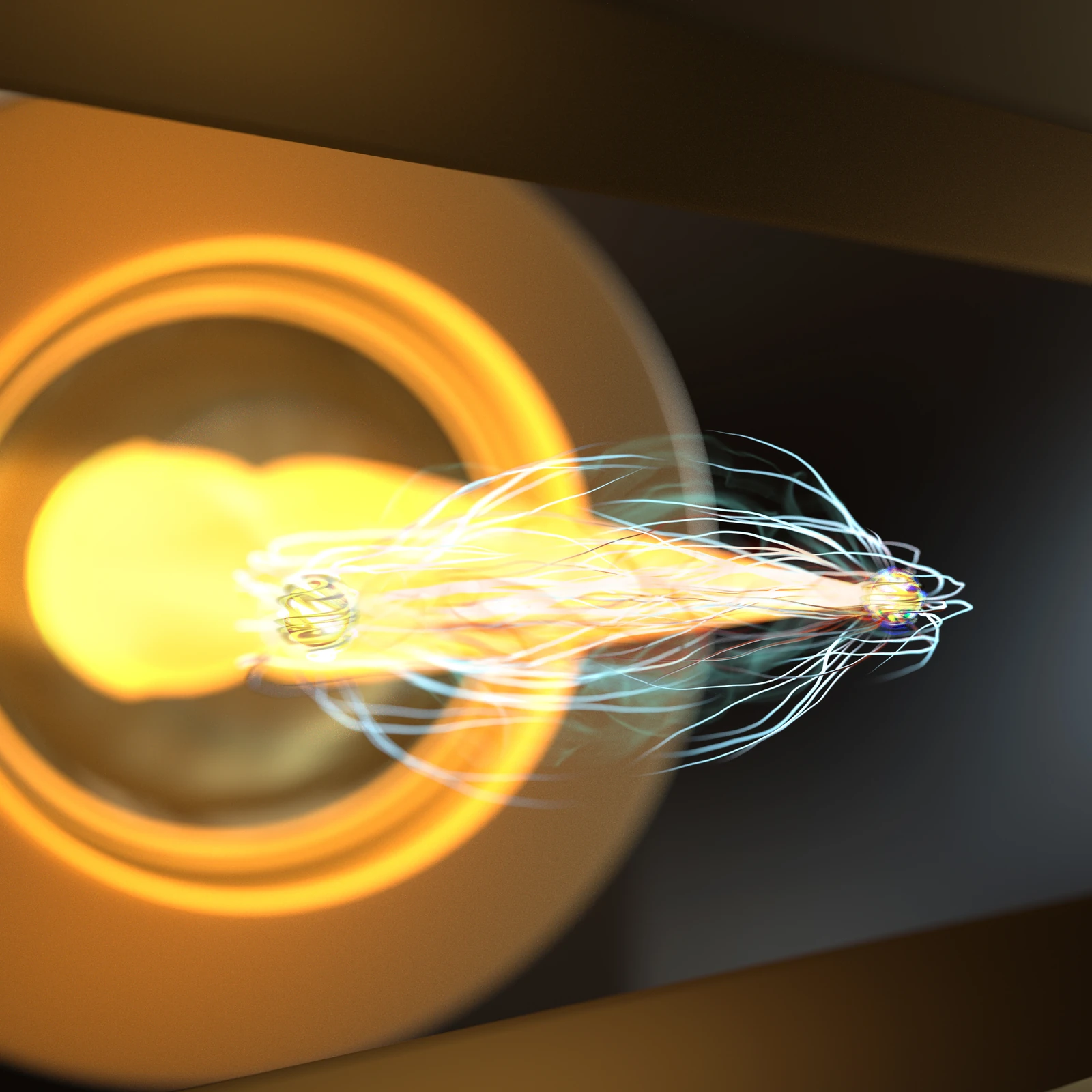
Background and Challenge
Trapped-ion quantum systems, with their ultra-high operation fidelity and coherence, are one of the leading physical platforms for building large-scale quantum computers. Ion-array-based quantum computing architectures, which construct quantum processors through optically addressing individual ion qubits in parallel, offer the advantages of high connectivity and parallel computational efficiency. However, scaling up this architecture faces a fundamental challenge: dense phonon modes in large ion arrays cause gate crosstalk, making it difficult to implement high-fidelity entangling gates directly. In recent years, the international community has proposed using tightly focused optical tweezer arrays to reshape the ion phonon spectrum and suppress crosstalk, but demonstrating optical tweezer gates in optically addressed ion-trap quantum computers has not yet achieved a breakthrough.
The Optical Magnus Effect Approach
Building on years of innovative research and independent development in trapped-ion quantum computation, our team has realized a novel entangling gate scheme based on the optical Magnus effect: analogous to the Magnus effect in fluid dynamics, a spinning ion in a focused light stream (optical tweezer) experiences a transverse force — perpendicular to the light propagation direction. This scheme exploits the transverse field gradient of a tightly focused laser to create a state-dependent push that establishes quantum entanglement between ions. This approach eliminates the traditional complex counter-propagating laser beam configuration, greatly simplifying the experimental setup and reducing operational complexity.
Key Results
After correcting for state-preparation and measurement errors, we measured Bell-state fidelities of 98.7(1)% in a two-ion chain and 97.2(4)% in a four-ion chain of 171Yb+ ions. This quantum gate is capable of achieving fidelities above 99.99% in theory. We analyzed and discussed the main sources of infidelity in the current experiment, and expect to reduce the gate error by more than an order of magnitude in future experiments.
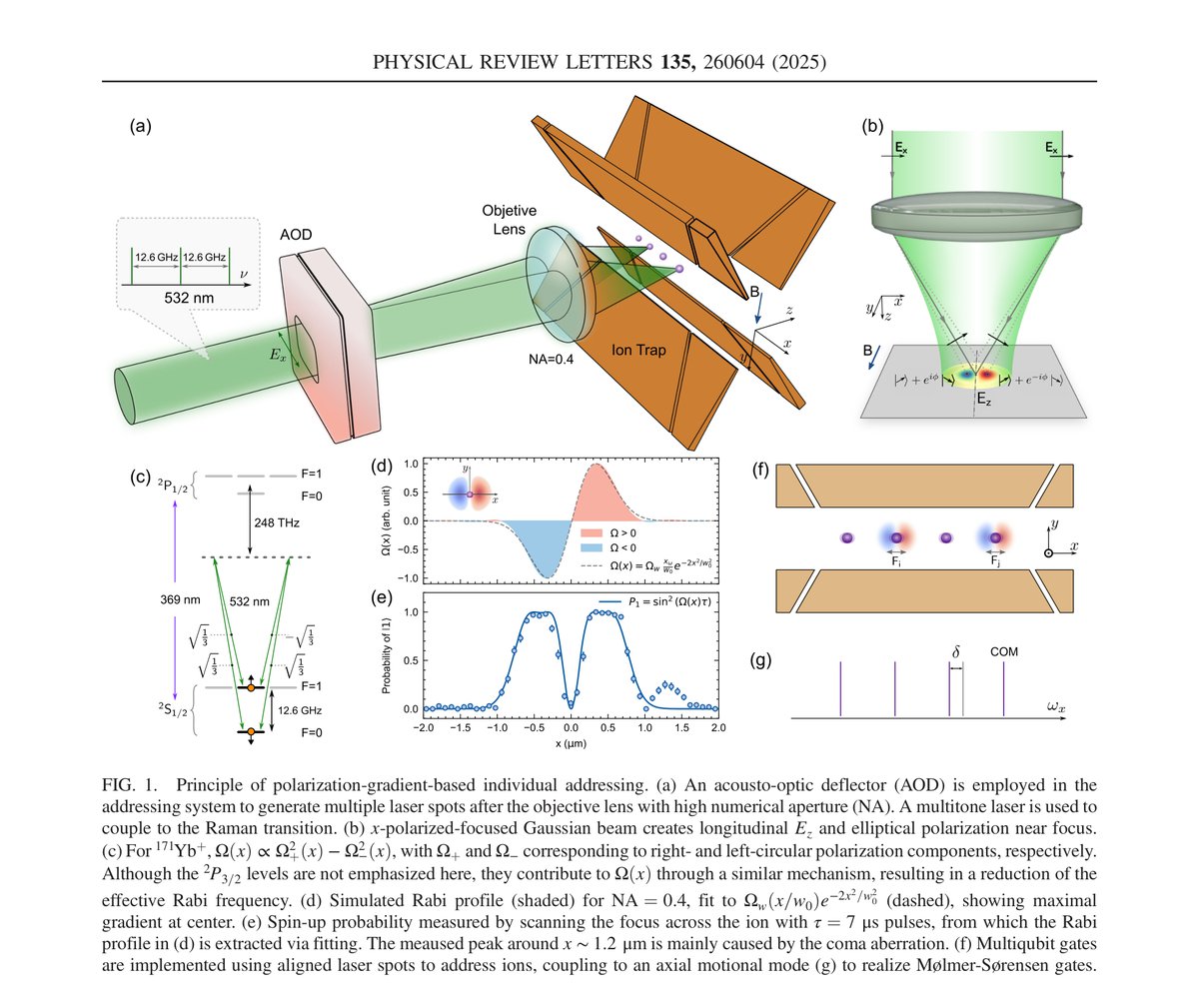
Fig. 1. Principle of polarization-gradient-based individual addressing. An acousto-optic deflector (AOD) generates multiple laser spots through a high-NA objective lens, producing polarization gradients that enable spin-dependent forces on individual ions.
Significance
The key innovation of this technique lies in its excellent compatibility with optical tweezer gates — since the tweezer operation itself involves transverse motion — and the significant simplification of optical configurations, making the optical tweezer gate scheme highly feasible in experiment. This provides a simpler and more flexible path toward large-scale, scalable trapped-ion quantum computation.
Reviewers gave high praise: “This paper demonstrates a successful combination of optical tweezers with linear ion chains, proposing an ingenious and powerful mechanism through which two-qubit gate operations can be realized between arbitrary ion pairs…” and “The results of realizing this type of quantum gate are encouraging, and this method addresses an important challenge in scaling up ion-trap quantum computation…”
Find the article here: https://doi.org/10.1103/w5l6-wmrl
See also the report by Photon Box (光子盒): https://news.qq.com/rain/a/20251225A06IAR00
(Source: China Science Daily, by Min Wang)