Hybrid quantum network
Hybrid Quantum Network
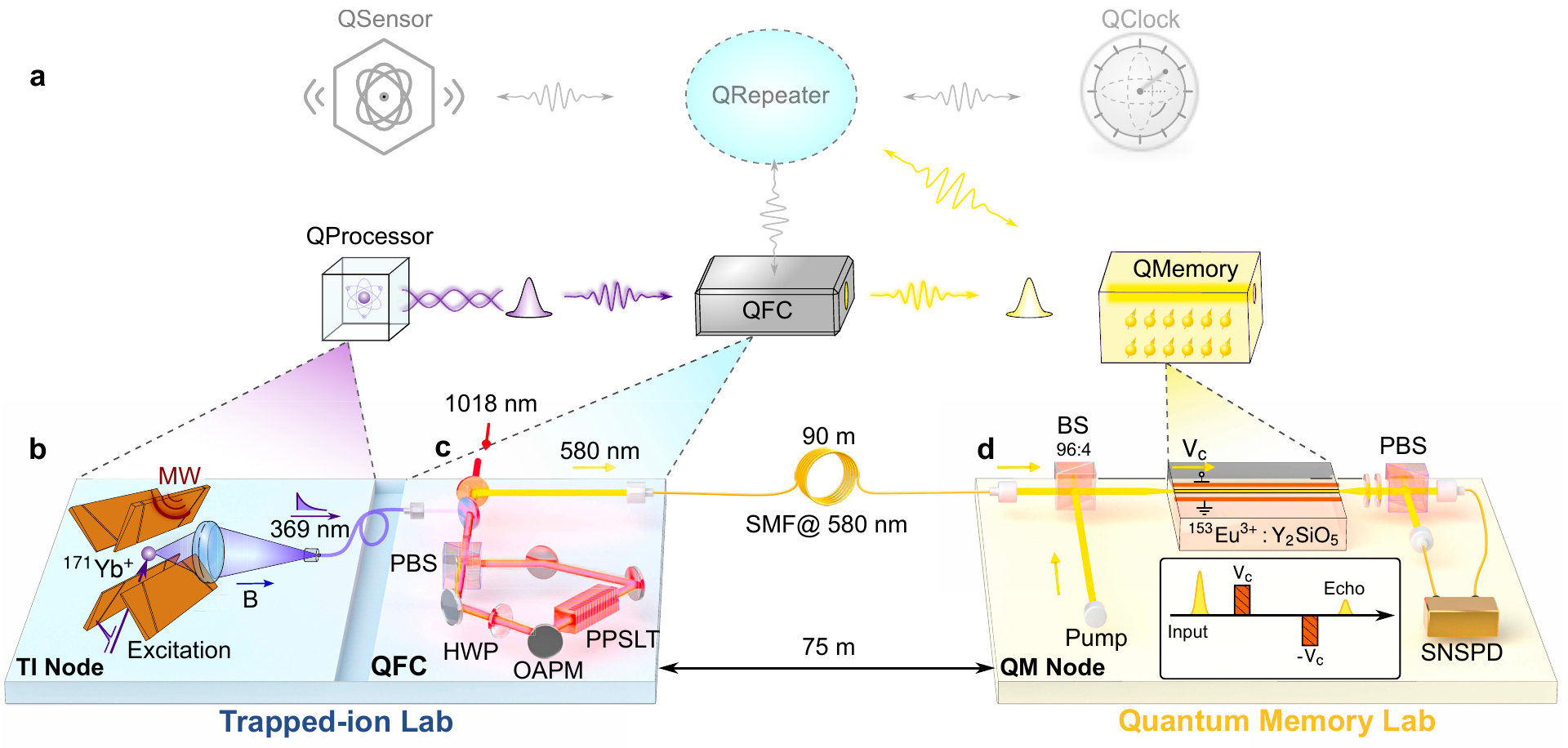
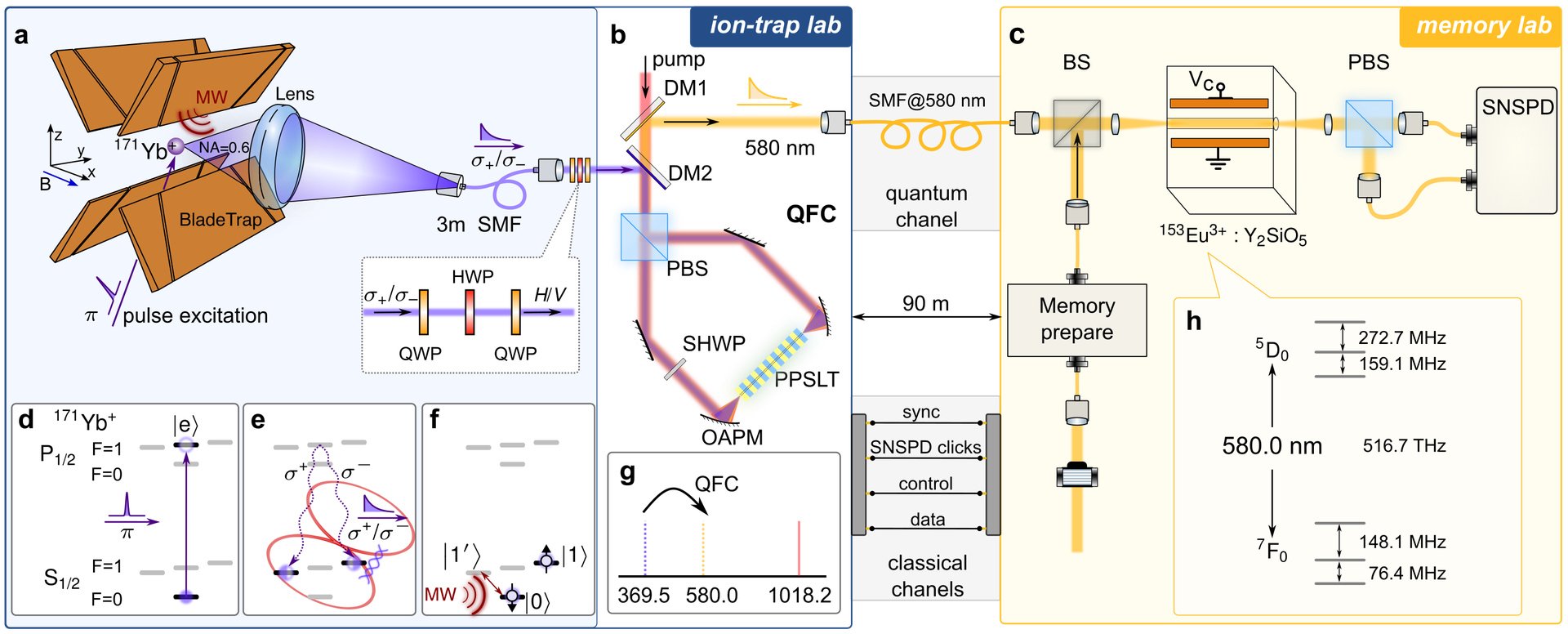
Trapped ions provide long-lived coherence and high-fidelity quantum operations, while solid-state memories store photonic quantum states. We develop interfaces that combine these capabilities in a hybrid network, connecting local ion control with remote optical storage.
Our polarization-preserving frequency converter bridges the 369.5 nm emission of a ytterbium ion and the 580 nm transition of a europium-doped crystal memory. A Sagnac loop stabilizes the polarization components, and off-axis parabolic mirrors provide achromatic coupling across the wavelength bands (Chinese Optics Letters, 2026). The two figures show the network architecture and the experimental system linking the ion node, frequency converter and memory.
Working with Professor Zong-Quan Zhou’s team, we established ion–memory entanglement between laboratories separated by 75 m and connected by 90 m of optical fiber. Joint measurements after storage and retrieval verify quantum correlations across this heterogeneous link. The experiment is reported in the preprint Heterogeneous entanglement between a trapped ion and a solid-state quantum memory (arXiv:2603.05836), with further details in Chen-Xu Wang’s doctoral thesis (2026). We plan to extend these interfaces to neutral-atom systems and explore distributed quantum computing across physical platforms.